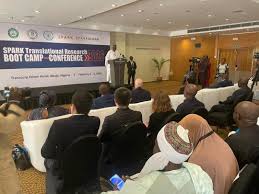
Nigeria is pushing for a shift from basic scientific discovery to real-world health solutions as it hosts the SPARK Translational Research Boot Camp and Conference 2026 in Abuja, bringing together senior officials, scientists, and global research leaders.
At the opening, Coordinating Minister of Health and Social Welfare, Muhammad Ali Pate, stressed that scientific inquiry remains the foundation of societal progress. He warned that global health gains are fragile amid overlapping crises, urging research that delivers tangible benefits.
“Science extends life expectancy, reduces mortality, and improves health, but its impact is fully realized only when discoveries reach the people who need them”, Pate said.
Reflecting on COVID-19, he noted its lasting effects on politics, economies, and healthcare systems, emphasizing the need for resilient research ecosystems.
Pate highlighted Africa’s dual challenge of rising non-communicable diseases alongside infectious diseases, alongside rapid technological changes in biology, computing, and AI. He cautioned that poor governance of technology could erode public trust, calling for stronger collaboration between scientists, communicators, and sociologists.
He also noted Africa’s paradox: home to 1.4 billion people, yet receiving a tiny fraction of global research funding. “Research must move from the bench to bedside”, he said, linking SPARK to Nigeria’s Health Sector Renewal Investment Initiative, which emphasizes governance, service delivery, and health security. Nigeria will also launch Africa’s first healthcare manufacturing academy later this week.
Co-Director of SPARK at Stanford University, Prof. Kevin Grimes, said the program addresses a gap in translating discoveries into practical solutions. SPARK pairs scientists with industry mentors to help move ideas from the lab to market, a model proven successful in Taiwan and now adapted for Africa.
Grimes emphasized that African scientists must lead Africa’s research agenda. “Healthcare products should be developed in Africa, for Africans’, he said, noting that genetic and pharmacological differences affect treatment efficacy.
Director-General of the National Institute for Pharmaceutical Research and Development, Obi Adigwe, said translational research strengthens science by delivering visible societal benefits. He praised Pate as a champion for research and stressed that Africa must invest locally rather than rely on external solutions.
About the Author