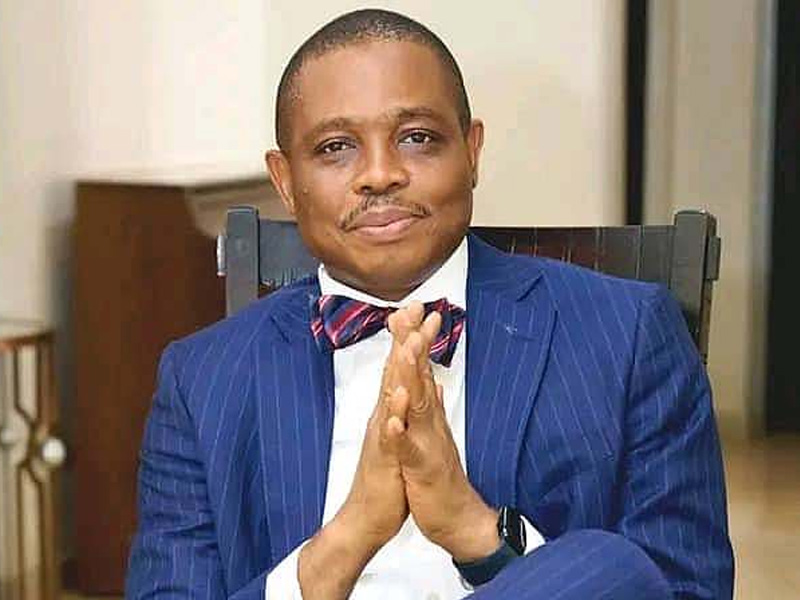
President of the Nigerian Bar Association (NBA), Afam Osigwe (SAN), on Wednesday insisted that serious allegations, including forgery and false asset declarations, must be thoroughly investigated and should not be allowed to end with the resignation or removal of a public officer.
Osigwe made the remarks in the wake of the resignation of NMDPRA CEO Farouk Ahmed, following corruption allegations levelled against him by the President of the Dangote Group, Alilo Dangote.
Spesking dudomg a TV intdrciew, the NBA president warned that allowing high-profile officials to quietly leave office without accountability weakens institutions and entrenches a culture of impunity. He stressed that resignation does not amount to exoneration and must not be treated as closure.
“Allegations of this nature are too weighty to be used merely as tools for political expediency or administrative convenience. Once such claims are made, there is a public duty to investigate them to their logical conclusion, either to clear the individual’s name or to establish guilt based on credible evidence,” Osigwe said.
He added: “We have said this before in similar cases. When weighty allegations such as forgery or false declarations are raised, there ought to be an investigation. People should present documents, and where others are complicit, they too should be held accountable.”
Osigwe cautioned against a pattern in which allegations surface, a resignation follows, and public interest fades without any transparent inquiry. Such an approach, he noted, creates the impression that allegations are weaponised simply to remove someone from office, after which no one genuinely seeks the truth.
He emphasised that accountability processes must be driven by a sincere desire to uphold the rule of law, not by political manoeuvring or attempts to give one party an advantage in regulatory or commercial disputes.
Politicising serious accusations, he warned, reduces them to power plays and undermines public confidence in governance and justice.
While declining to take sides in the specific controversy, Osigwe said perceptions of corruption can sometimes be as damaging as proven misconduct, making it all the more important for allegations to be properly examined.
Failure to investigate, he added, harms not only the individuals involved but also the credibility of public institutions. “Building strong institutions requires consistency, transparency, and follow-through in handling allegations against public officers. This is how institutions are built and how we prevent such issues from recurring,” he said.
Osigwe maintained that Nigeria’s anti-corruption efforts would remain superficial unless allegations are followed by credible investigations and, where necessary, prosecution. He stressed that accountability must go beyond symbolic gestures to demonstrable outcomes.
Dispute Threatens Nigeria’s Economic Sovereignty, Agbakoba Warns
Meanwhile, a former NBA President, Olisa Agbakoba (SAN), has warned that the ongoing dispute between Dangote Petroleum Refinery and the NMDPRA goes beyond a commercial or regulatory disagreement, raising fundamental questions about Nigeria’s economic sovereignty and constitutional management of its hydrocarbon resources.
In a press statement issued on Wednesday, titled: “The Dangote Refinery–NMDPRA Dispute: Beyond Commercial Disagreement to Questions of Economic Sovereignty”, Agbakoba said the impasse highlights deeper contradictions in Nigeria’s petroleum governance framework.
According to the statement, the controversy surrounding Africa’s largest refinery, built at an estimated cost of $20 billion—reveals a striking paradox: Nigeria now has world-class refining capacity yet remains heavily dependent on imported petroleum products.
He noted that a private investor has delivered infrastructure long absent in the country but now faces regulatory obstacles from an authority whose mandate includes promoting efficiency, investment, and growth in the downstream sector.
“The issue at stake transcends commercial disagreement,” the statement said, describing the situation as one that strikes “at the heart of a fundamental development question: the sovereignty of Nigeria’s governance process over its hydrocarbon resources.”
Agbakoba criticised policy inconsistencies, particularly the reported difficulty domestic refineries face in securing crude oil feedstock while licenses for imported refined products continue to be issued.
He argued that such outcomes undermine local value addition, sustain foreign exchange pressures, and entrench Nigeria’s long-standing dependence on fuel imports. He warned that the dispute reflects a broader structural problem in Nigeria’s oil sector, described as continued reliance on a “Contract Oil” model.
Under this system, crude oil is largely treated as an export commodity, while refining, job creation, and industrial development are outsourced to foreign economies. As a result, Nigeria exports raw crude only to import refined products at premium prices, perpetuating economic dependency and denying the country the full benefits of its natural resources.
This approach, the statement argued, has contributed to decades of underdevelopment and vulnerability to global energy market shocks. In contrast, Agbakoba highlighted Saudi Arabia’s petroleum governance model, described as “Development Oil.”
Saudi Arabia, he said, prioritises domestic refining, downstream integration, and control of the petroleum value chain, avoiding policies that undermine local capacity. By cFaroomparison, Nigeria, despite being Africa’s largest oil producer, lacks similar downstream control, including ownership of a national tanker fleet.
Agbakoba cited Section 44(3) of the 1999 Constitution, which vests ownership and control of oil and gas resources in the federal government to be managed for the welfare and security of Nigerian citizens.
He argued that regulatory actions that frustrate investments capable of creating jobs, reducing import dependence, and strengthening local capacity may amount to a breach of this constitutional obligation.
About the Author