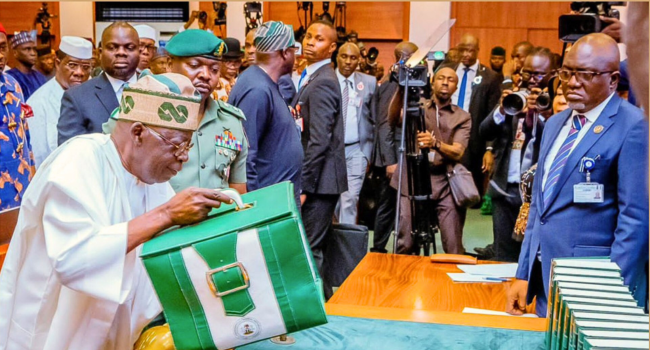
Lawmakers reset Nigeria’s fiscal calendar, extend 2025 budget to March 2026 amid revenue pressures and weak capital execution
Nigeria’s National Assembly has approved a revised ₦43.5 trillion 2024 Appropriation Act and a reworked ₦48.3 trillion framework for the 2025 fiscal year, marking a major fiscal reset aimed at tackling revenue shortfalls, debt pressures and persistent weaknesses in budget implementation.
The approvals followed marathon plenary sessions in both the Senate and the House of Representatives on Tuesday, culminating in the passage of the Appropriation Act (Repeal and Re-enactment) Bills for the 2024 and 2025 fiscal years. The bills were transmitted to the legislature last Friday by President Bola Ahmed Tinubu.
As part of the reset, lawmakers also approved the extension of the 2025 fiscal year to March 31, 2026, a move designed to address the long-standing problem of overlapping budget cycles.
Senate backs revised figures after committee review
At the Senate, the revised budgets were adopted following the presentation of a consolidated report by the Chairman of the Senate Committee on Appropriations, Senator Solomon Adeola (Ogun West).
Adeola explained that the legislation repealed earlier budget provisions and replaced them with figures that better reflect current fiscal realities, including constrained revenues, rising debt obligations and shifting national priorities.
According to the committee’s report, the original ₦35.005 trillion 2024 budget was repealed and re-enacted with a new aggregate expenditure of ₦43.561 trillion, covering statutory transfers, debt servicing, recurrent spending and capital expenditure.
For 2025, the previously approved ₦54.99 trillion budget was repealed and replaced with a revised total expenditure of ₦48.316 trillion, with part of the capital allocation deferred to 2026 due to funding and execution challenges.
Capital spending adjusted, emergency funding added
Adeola disclosed that an additional ₦8.5 trillion was injected into the capital component of the 2024 budget to fund special interventions addressing security, humanitarian and economic emergencies across the country.
He noted that the revised framework was carefully structured to balance urgent national needs with fiscal responsibility, ensuring that debt-related spending does not weaken oversight or undermine budget discipline.
For the 2025 budget, the committee removed ₦6.674 trillion from capital allocations and deferred it to the 2026 fiscal year, citing expectations of improved revenue performance and stronger implementation capacity.
The senator also warned against the continued practice of running multiple budget cycles simultaneously, describing it as harmful to transparency, accountability and effective fiscal planning.
Following debate, the Senate passed the bills after third reading.
House of Representatives concurs
The House of Representatives also approved the revised ₦43.56 trillion 2024 budget and ₦48.31 trillion 2025 budget after adopting the report of its Committee on Appropriations.
The passage followed clause-by-clause consideration of the estimates at the Committee of Supply and their subsequent approval at plenary, presided over by Speaker Rt. Hon. Tajudeen Abbas.
A breakdown of the revised 2024 budget shows:
- ₦1.74 trillion for statutory transfers
- ₦8.27 trillion for debt servicing
- ₦11.26 trillion for recurrent (non-debt) expenditure
- ₦22.27 trillion for capital expenditure and development fund contributions
For the revised 2025 budget, allocations include:
- ₦3.64 trillion for statutory transfers
- ₦14.31 trillion for debt servicing
- ₦13.58 trillion for recurrent (non-debt) expenditure
- ₦16.76 trillion for capital expenditure
Like the Senate version, the 2025 budget will run until March 31, 2026.
Tinubu explains rationale for budget overhaul
In his communication to the National Assembly, President Tinubu said the revisions were necessary to accommodate previously omitted budget items and to realign capital spending targets with Nigeria’s revenue realities and execution capacity.
The president acknowledged persistent weaknesses in the implementation of the capital component of the 2024 budget, noting that these challenges have slowed infrastructure delivery nationwide.
He explained that extending the lifespan of the 2025 budget would allow Ministries, Departments and Agencies (MDAs) sufficient time to access and utilise the targeted 30 per cent capital releases, which the government now considers a more realistic benchmark.
According to Tinubu, the revised framework forms part of a broader fiscal reform agenda aimed at ending overlapping budgets, improving planning, strengthening accountability and delivering better value for public spending.
About the Author