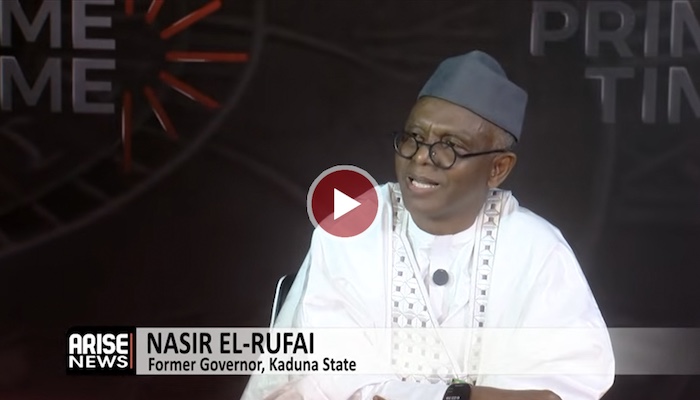

Former Kaduna State Governor, Nasir El-Rufai, has accused the Federal Government of orchestrating what he described as an attempted “abduction” at the Abuja International Airport, alleging that security agencies are being deployed for political ends against opposition figures.
Speaking in an interview on ARISE News on Friday, El-Rufai insisted that operatives of the Department of State Services (DSS) tried to detain him without a warrant upon his return from Cairo, despite prior communication with the Economic and Financial Crimes Commission (EFCC).
“It wasn’t the EFCC,” he said. “It was the DSS. But the DSS were procured to abduct me by the ICPC that has never communicated with me ever.”
Recounting the airport incident, the former governor said he was approached by a DSS operative shortly after disembarking.
“Well, I came out of the plane, and a young man that is well dressed with a nice suit came to me and said, ‘I am from the DSS, Department of State Services. I would like to meet with you in our office.’ I said, ‘That’s fine. Where is the letter of invitation?’ He said, ‘My bosses have it. I will escort you to them.’ I said, ‘I’m going through immigration. Just get me the letter.’”
El-Rufai claimed more operatives emerged as he proceeded towards immigration.
“Apparently, they had moved about 50 DSS operatives to the airport with the specific instructions that I should be detained, I should be abducted and detained,” he alleged.
According to him, he refused to accompany the officers without a formal letter.
“They said, ‘We are from the DSS, sir, we are going this way. We need to go to your office.’ I said, ‘I’m not going to your office. I’m not going anywhere until you show me a letter of invitation.’”
He added: “I said, ‘Even the president cannot tell me I have to do anything. It’s a free country, it’s a democratic country, and I don’t have to do anything that I do not wish to do. So you are just a middle-level or senior civil servant. The president cannot tell me what to do. Don’t say I have to. It’s inappropriate language.’”
El-Rufai said he proceeded through immigration, had his passport stamped and exited the airport, alleging that operatives later assaulted one of his aides and seized the passport.
“That’s the aide that got beaten up and they seized the passport from him. If I had the passport with me, I would not be talking this,” he said.
He added that he was “quite touched” by what he described as spontaneous resistance from other passengers.
“Once people begin to lose confidence in the neutrality of such institutions, we are on our way to anarchy,” he warned.
Clarifying earlier statements by his lawyers, El-Rufai said the EFCC had formally written to him while he was abroad and that he had responded through his lawyers.
“The EFCC had written to me while I was away and said, ‘We would like to have a chat with you over certain issues.’ And my lawyers replied that I’m not in the country, I’m on my annual vacation. Once I know the date of return, I will let you know. We have written to the EFCC to say I will come and see you at 10am on the 16th of February.”
He alleged that the Independent Corrupt Practices and Other Related Offences Commission (ICPC) was instead behind the airport episode.
“Subsequently, we found out that it was the ICPC that procured the DSS to abduct me and then hand over to them. And this is a modus operandi of the ICPC that increasingly has become a personal tool of Nuhu Ribadu. Nuhu made the call and made the order that I must be in custody yesterday.”
When challenged on how he knew this, he replied: “He made the call because we listened to their calls. The government thinks that they are the only ones that listen to calls. But we also have our ways.”
El-Rufai said the ICPC later delivered a letter inviting him for questioning.
“Yesterday around 5pm, the ICPC finally did the right thing by bringing a letter to my house to say we want to see you on Friday the 13th. My lawyer wrote back to say my client is not an idle person that has no programme. We’ve received your letter. We will honour the invitation. But on Monday we are going to the EFCC that has written before. After the EFCC, we will go to the ICPC.”
The former governor described the investigations as politically motivated.
“In civilised countries, you don’t start investigation by abducting a person or even arresting a person and keeping him while you’re investigating. It’s violation of human rights. You do your investigation.”
Pressed on whether political motives were at play, he responded: “Absolutely.”
“Some of the professionals in these institutions feel very bad that they are being compelled. When some of my people face them, they tell them, ‘Look, we’re sorry, but this is all political. Why don’t you guys go and settle with them?’ Settling with them means what? Submit to be a member of APC, agree that Tinubu will have a second term.”
El-Rufai defended his record in office, challenging anyone to produce evidence of wrongdoing.
“I have 16 years’ record of public service and I have challenged every Nigerian that has worked with me or knows me to come forward and expose me if I’ve ever taken a bribe or demanded a bribe or done anything unlawful in the course of my duties. I have said that on national television — there are 250 million Nigerians — to come forward and prove me wrong.”
He referenced previous investigations under former President Goodluck Jonathan, saying they yielded no convictions.
“They investigated me at length and found nothing. In the end, I was charged to court for one alleged offence — that in my tenure as Minister of the FCT, one of 27,000 plots was allocated to my wife. They lost. The judge warned the EFCC not to do things like that.”
On ongoing scrutiny of his tenure in Kaduna, he said: “They have investigated me since June 2023 in Kaduna and have come up with nothing. They have arrested my former chief of staff, my commissioner of finance, my commissioner of local government, virtually all our senior officials. Most of the charges are frivolous and I’m quite confident they will lose.”
He added: “I’m not afraid of scrutiny, but I am suspicious of malicious scrutiny.”
Responding to allegations that his administration paid armed groups, El-Rufai was categorical.
“I am probably one of the few governors that from day one took the position on the advice of my security council that we must never negotiate with cattle rustlers, with bandits. The position of the Kaduna State Government when I was governor is the only repentant bandit is a dead one. We never negotiated. We never paid any group for kidnapping anyone.”
He acknowledged that security funds were disbursed through established channels.
“The commissioner of internal security brings me proposals for security spending. There is a standing order every month. If there is any special emergency, he brings it and I approve. He decides what he does with it. If he chooses on his own to go and give money to armed groups, I don’t know about that. But to the best of my knowledge, the position of our government is that we don’t negotiate with bandits. We don’t pay them.”
On accusations that dissenting voices were harassed under his watch, he defended his record.
“Our security strategy in the state was two-pronged. We inherited communal violence and tribal intolerance. We developed a strategy of zero tolerance to any nonsense from any group that thinks it can advance its interest through violence. I was very hard on that.”
He said that when individuals published what his government considered inflammatory falsehoods, the Attorney General would petition the police.
“Anyone that does something that we think is likely to cause criminal violence, from previous history, the Attorney General writes to the police and says, ‘Look, this person has published A, B, C. We’ve asked him to retract. He has refused to retract. Please investigate him for injurious falsehood, incitement, under the Penal Code.’ That’s what happened.”
El-Rufai maintained that what occurred at the airport did not amount to a lawful arrest.
“Arrest has a legal meaning. Arrest means a lawful activity with a warrant. The police have, under the Police Act, the power to arrest without a warrant. But every other agency must go to a judge and show cause. So when you try to take a person without a valid order, it’s not an arrest, it’s an abduction.”
He concluded: “I will go to them. I have nothing to hide. But I will not submit to being abducted. There is a difference between lawful process and political intimidation.”
Boluwatife Enome
About the Author