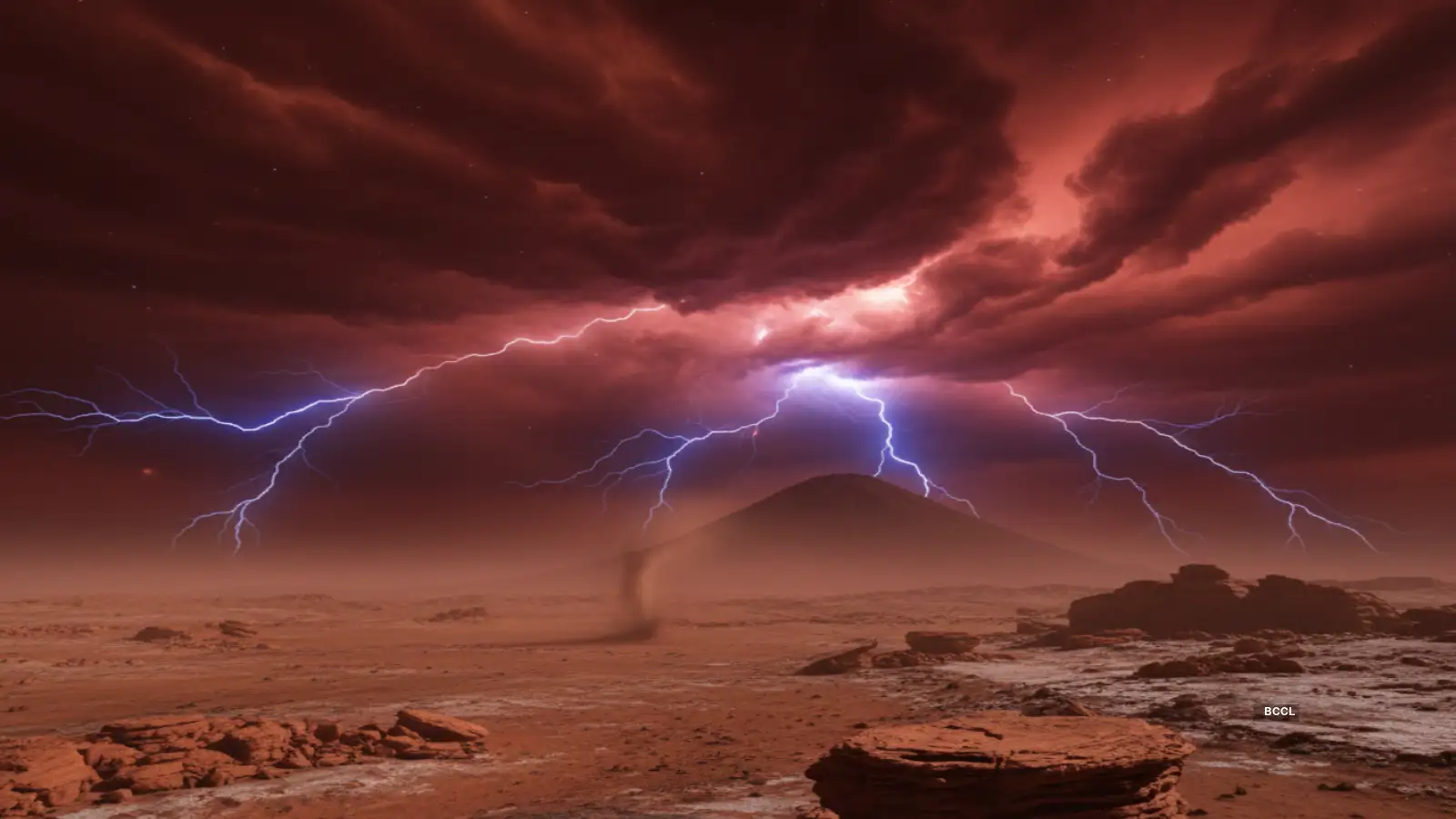
For the first time ever, a NASA rover has captured evidence of lightning on Mars — tiny electrical “zaps” crackling through the planet’s ceaseless dust storms.
The discovery, revealed in a new Nature study, settles a long-standing scientific debate over whether electrical discharges occur in the thin, dust-filled Martian atmosphere. Until now, researchers lacked hard proof.
It turns out that NASA’s Perseverance rover, exploring Mars since 2021, was unwittingly recording the sounds of these micro-lightning events with its onboard microphone.
These flashes are nothing like the powerful, kilometre-long bolts familiar on Earth. Instead, they are faint static sparks — akin to the tiny shock you might feel touching a car door on a dry day — said lead author Baptiste Chide of France’s CNRS research centre.
Though low in energy, these discharges are surprisingly frequent. “They are happening absolutely all the time — and everywhere on Mars,” Chide told AFP.
The sparks form when tiny dust grains collide, build up electric charge, and release it in miniature arcs only millimetres or centimetres long. Each arc generates an audible shock wave, which Perseverance’s SuperCam microphone picked up by chance.
Why It Happens on Mars — but Rarely on Earth
Dust storms and dust devils on Earth can also generate electric fields, but they rarely escalate into discharges. Mars, however, is different.
Because of its extremely low atmospheric pressure and unique atmospheric composition, it takes far less charge for lightning-like events to occur, Chide explained. Scientists have theorized this phenomenon for decades and even simulated it in laboratories.
A European mission — the ESA’s Schiaparelli lander — once carried an instrument specifically designed to detect such discharges, but the spacecraft crashed during its 2016 landing attempt, leaving the mystery unresolved.
That changed when Perseverance’s microphone inadvertently captured the sounds researchers had been seeking.
Daniel Mitchard, a lightning specialist at Cardiff University, wrote in Nature that the study offers “persuasive evidence of dust-induced discharges,” though he expects some scientific debate to continue because the phenomenon was heard but not visually observed.
Implications for Martian Climate — and Future Astronauts
The findings shed new light on the dusty Martian climate system. Dust, Chide noted, “drives the Martian climate” in much the same way water drives Earth’s weather. A major dust storm season is expected to begin later this year.
Electrical discharges may also play a role in breaking down organic molecules on the Martian surface — a crucial factor for the search for life — and could help explain the puzzlingly rapid disappearance of methane detected in Mars’s atmosphere.
The discovery carries practical consequences for future missions as well. Engineers can now design robotic instruments with improved protection against these tiny electrical shocks.
And for future human explorers, the question grows larger.
“In the long term, isn’t there a risk that the suits of astronauts who stay on the Martian surface for a long time will be damaged by these discharges?” Chide asked. “We will have to ask ourselves this question.”
About the Author