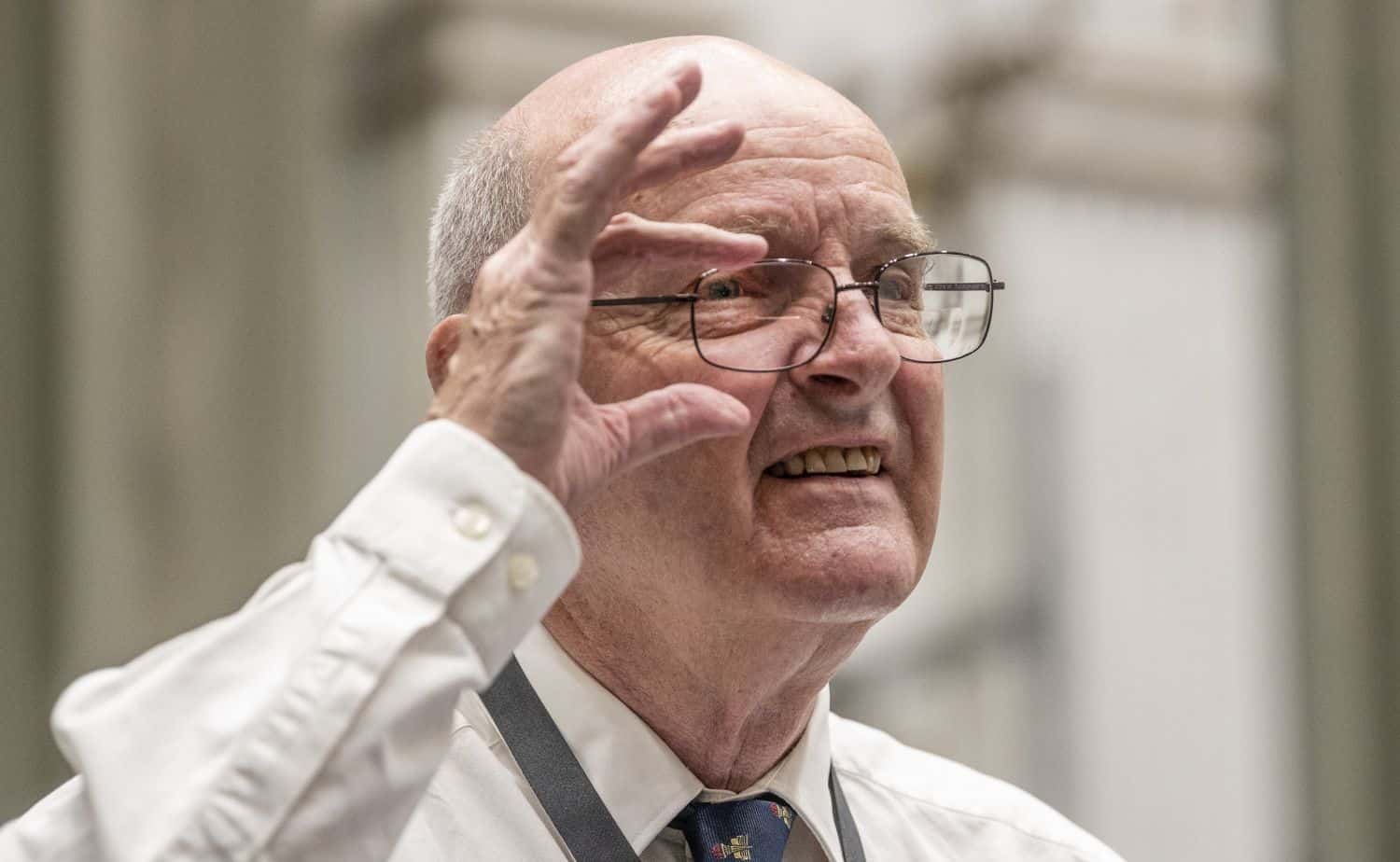
CAPE TOWN, SOUTH AFRICA – FEBRUARY 10: Paul O'Sullivan testifies at the Parliamentary Ad Hoc Committee inquiry into alleged corruption and political interference in the criminal justice system at Good Hope Chambers on February 10, 2026 in Cape Town, South Africa. The inquiry was set up to probe political interference, leadership failures, and internal dysfunction in the South African Police Service (SAPS) with a particular focus on allegations raised by Lt Gen Nhlanhla Mkhwanazi about interference within the police command on July 6th. (Photo by Gallo Images/Brenton Geach)
Fraud examiner Paul O’Sullivan finally appeared before Parliament’s ad hoc committee on Tuesday, where he denied claims that he is a foreign agent or former spy during a tense exchange over his background.
O’Sullivan was testifying before the committee investigating allegations of corruption, criminal infiltration and political interference within South Africa’s law enforcement structures.
His appearance followed testimony by several witnesses, including KwaZulu-Natal (KZN) police commissioner Nhlanhla Mkhwanazi, who implicated him.
After O’Sullivan asked to give evidence virtually — arguing that he faced security risks and was overseas— the committee appealed to National Assembly Speaker Thoko Didiza to force his in-person appearance at the Good Hope Chamber in Cape Town.
Didiza opted not to issue a subpoena.
However, once Parliament put security measures in place, O’Sullivan ultimately decided to appear before the committee in person.
Paul O’Sullivan testifies before ad hoc committee
During Tuesday’s proceedings, O’Sullivan outlined his professional background, stating that he established forensic investigative firm O’Sullivan Brosnan and Associates in 2012, focusing largely on fraud in the private sector.
He told the committee his non-profit organisation, Forensic for Justice, was launched in 2015 to investigate corruption in government institutions, particularly within the criminal justice system and state-owned entities such as Eskom.
O’Sullivan testified that he had initially avoided investigating the public sector as he had no interest.
READ MORE: ‘Fiction created by Phahlane’: McBride denies Paul O’Sullivan controlled Ipid
That position changed, he said, after criminals allegedly attempted to kill him in 2001 following his decision to cancel a R300 million security contract.
According to O’Sullivan, former police commissioner Jackie Selebi became involved in an effort to “neutralise” him.
“One thing led to another and after a few years, I realised [Selebi] was engaged in corruption so I decided it would be in the public interest to not have a chief of police commissioner that was corrupt,” he said.
Watch the ad hoc committee below:
O’Sullivan said his work ultimately contributed to Selebi’s conviction and imprisonment.
“I can say that I probably spent about seven years of my life to provide evidence to the Scorpions for that investigation.”
He further told the committee that none of his companies receive foreign funding.
Multiple citizenships
Addressing allegations raised by Mkhwanazi, O’Sullivan rejected claims that he was acting as a foreign agent because he holds multiple citizenships.
He revealed that he was born in England to Irish parents and grew up in Ireland, and currently holds Irish, British and South African citizenship.
“I have been in this country now for 40 years, and I can categorically state that I have not performed any agent activities,” O’Sullivan said.
“My loyalty is to South Africa.”
O’Sullivan said having more than one passport was largely practical, allowing him to travel more easily internationally.
“I am stating clearly under oath, I have never acted as a foreign agent in this country.”
Clash over affidavit
Tensions escalated when EFF leader Julius Malema challenged O’Sullivan over his affidavit, specifically paragraph three, which states that he would not discuss his family, background or business interests prior to 1990 due to security concerns.
O’Sullivan told MPs that his fears were rooted in repeated attempts on his life.
“Over the last 15 years, there has been 10 attempts on my life. In 1996, I was shot three times.”
Committee members, however, argued that his oath required him to answer questions fully.
READ MORE: ‘Summons is a last resort’: Didiza denies protecting Brown Mogotsi, Paul O’Sullivan
MK party MP David Skosana pointed out contradictions in the affidavit, noting that O’Sullivan referenced events before 1990, including a commendation from Scotland Yard in 1978.
Committee chairperson Soviet Lekganyane weighed in, saying it was within the committee’s mandate to probe any information it considered relevant.
O’Sullivan maintained that his oath did not require him to endanger his family.
“I am here to cooperate and I am definitely not agitated,” he said.
Oral evidence
Malema insisted that paragraph three be removed, warning that allowing witnesses to place limits on questioning would undermine the committee’s authority.
“This is just like a principal telling us that we cannot go past 1990 in this textbook. It can’t be correct. It smells like supremacy,” he said.
Evidence leader Norman Arendse told the committee that affidavits could not dictate the scope of questioning, noting that he had already asked O’Sullivan questions not covered in the statement.
“What is important is the oral evidence put before the committee,” Arendse said.
He added that it was entirely relevant for the public to understand what O’Sullivan did before coming to South Africa.
“No witness can tell this committee or evidence leaders that certain questions are off limits.”
O’Sullivan’s military background and intelligence work
Continuing with his testimony, O’Sullivan later told the committee that he served in the British army and military intelligence during the 1970s.
“I worked for the British government in counter-espionage and counter-terrorism activities,” he said.
When asked whether his work involved the ANC, which was designated a terrorist organisation during apartheid, O’Sullivan said his activities were focused on Europe, including the Irish Republican Army (IRA).
He indicated that he left the army to study electrical engineering and later worked in property development.
READ MORE: Paul O’Sullivan hits Mkhwanazi with defamation lawsuit
O’Sullivan revealed that he obtained permanent residency in South Africa in 1989 and subsequently moved to the country after investing in property.
He said he had visited South Africa several times before relocating because he liked the country, the weather and the people he met.
He denied having any connections to security forces after moving to South Africa during apartheid.
“I came here as a tourist, not a terrorist.”
‘I was never a spy’
O’Sullivan denied having any links to UK intelligence agencies MI5 or MI6.
“MI5 and MI6 are organisations which are separate entities from military intelligence.”
He also rejected claims that he had forensic investigative training before arriving in South Africa, although he acknowledged he had investigative experience.
“I got forensic training whilst I was living in South Africa.”
O’Sullivan explained that his role in the British army involved counter-intelligence work, which focused on identifying and uncovering spies rather than conducting espionage himself.
“No, I was never a spy.”
He further revealed that he became a police reservist in 1990 after settling in South Africa.
NOW READ: R5 million lawsuit: O’Sullivan’s comments on Mkhwanazi go to court
About the Author