By Ikechukwu Nnochiri
One of the 500 persons the Federal Government is prosecuting for alleged complicity in terrorism-related offences revealed on Thursday how his right leg was shattered after he attempted to expose members of the Boko Haram terrorist group.
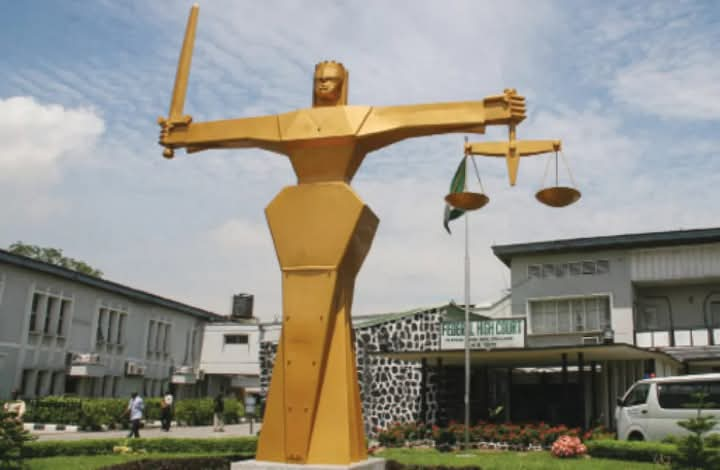
The 37-year-old man, Ali Kolo, who was eventually handed a nine-year jail term after he had already spent 10 years in detention, told the Federal High Court in Abuja that the insurgents shot him with an AK-47 rifle, a development that landed him in a hospital before he was arrested.
In response to the four-count charges the FG preferred against him, Kolo—who insisted he was a victim—said the incident occurred in Borno State.
Represented by his counsel, Mrs. A. O. Usman, the defendant stated that he was attacked by insurgents while on his way to report them to the military.
The defendant admitted that, owing to the attack, he was unable to report the insurgents to security agents.
He therefore pleaded guilty to only one of the four counts against him, which related to the concealment of information about the activities of the terrorist group in Borno State.
Government lawyer Mr. David Kaswe, who led the prosecution, told the court that Kolo had, in 2017, failed to convey information on the activities of the terrorists to the military or any other security agency, as required by the provisions of the Terrorism (Prevention and Prohibition) Act, 2013.
He tendered an extra-judicial statement in which the convict admitted failing to relay information on the terror group to the appropriate quarters, as well as an investigation report that indicted him for refusing to help the FG curb terrorists’ activities.
Following a no-objection stance by the defence lawyer, Trial Justice Peter Lifu admitted the two exhibits in evidence.
Thereafter, the prosecution urged the court to impose a 10-year jail term on the defendant, based on his guilty plea, his confession in his statement to the military, and the investigation report that indicted him.
On his part, the defendant pleaded with the court for leniency.
He insisted that he could not have reached the nearest military outpost to report the terrorists, given the condition of his leg from the gunshot wound.
Delivering judgment in the matter, Justice Lifu, who agreed that the defendant had failed to report the terror group’s activities to the appropriate authorities, nonetheless noted that the failure was due to circumstances beyond his control.
The court therefore convicted and sentenced him to nine years in prison.
It ordered the sentence to run from 2017, when the defendant was arrested and detained.
The trial judge held that, by prisons law, the convict had already served more than the sentence in pre-trial detention.
He directed the defendant’s immediate release from custody so he could attend to the gunshot wound on his leg.
Although the prosecution counsel expressed reservations about the verdict and made a spirited effort to persuade the court to impose a stiffer sentence, Justice Lifu drew his attention to the fact that nothing before the court established the defendant as either a Boko Haram member or someone trained in weapons handling.
The court stressed that he was guilty only of concealing information, adding that the convict had suffered enough and must be freed immediately upon the signing of the warrant for his release.
It was the position of the court that keeping him further in prison would amount to double jeopardy.
In another development, the court jailed a Borno state-based bricklayer, Ibrahim Buba, for 10 years also for failure to relay information on the activities of the Boko haram to the military.
Buba, also known as Baba Gana, had in his defence, claimed that he ran from Borno State to Mubi in Adamawa State, and later to Onitsha in Anambra State when terrorists were after his life for recognising some of them.
Pleading guilty to a two-count charge against him, the defendant admitted knowing two of the terrorists.
He equally confessed that he did not pass information to the military and instead ran to Onitsha where he was apprehended in 2023 while engaging in bricklaying job.
Buba’s plea for leniency led the court to impose a 10-year prison sentence on him instead of 20 years that was demanded by the prosecution.
Justice Lifu ordered that the jail term should start from March 24, 2023, when the convict was arrested and detained.