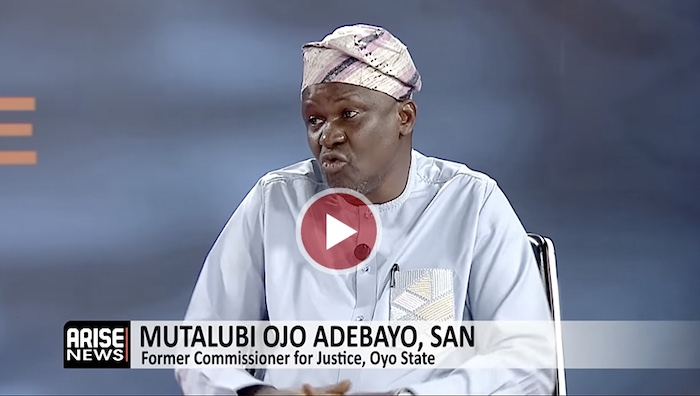

Former Oyo State Commissioner for Justice and Senior Advocate of Nigeria, Mutalubi Ojo Adebayo, SAN, has defended President Bola Tinubu’s directive withdrawing police escorts from so-called VIPs, insisting that only judges and a limited category of public officials genuinely require state-provided security.
Speaking in an interview with ARISE NEWS on Sunday, Adebayo said judges occupy a special constitutional position that makes police protection indispensable. “Judges are not VIP. They are even a special class of people. They are more than VIP. They need police escort as a matter of duty, as a matter of course,” he said, warning that exposing judges would endanger both them and society.
He dismissed complaints by some lawmakers over the withdrawal of escorts, describing such arguments as misplaced. “To me, Senator Abdul Ningi is taking the matter too far. I would say that he’s a clown, or maybe he’s joking,” Adebayo said. “What are they doing in the Senate that they need escorts for? They don’t need it, honestly.”
Adebayo argued that legislators and political office holders should not be compared with judges, stressing that excessive security convoys were unjustified. “They should not be going around with retinues of security details. They should be limited and restricted, not as if the president himself is going somewhere,” he said, adding that ministers may require security but not in excess.
He also rejected the idea that the president’s family members should enjoy police protection. “Let the children of the president apply for private guards, not policemen. They don’t need it,” he said, recalling his own time in office. “I served as Attorney-General of Oyo State for four years. I never had a police escort. I never applied for it.”
According to him, heavy police presence can even increase personal risk. “I consider it a great risk. When people see you with the police, they ask, ‘Who is that man?’ and you become exposed,” he said, adding pointedly, “The guilty are always afraid. Those who go around with them know why they are doing so.”
On Nigeria’s military deployment to the Republic of Benin following an attempted coup, Adebayo strongly backed the Tinubu administration, disagreeing with critics who argue Nigeria lacks the moral authority to intervene. “I disagree,” he said. “If you leave your neighbour to do whatever he likes, you will also suffer from whatever he’s doing that may be untoward.”
He maintained that Nigeria’s action was rooted in ECOWAS obligations, not moral posturing. “It’s not about moral rights. It’s about the treaty signed by ECOWAS countries,” he said, adding that members are bound by the agreement they ratified. “If anyone goes against democratic rule, it behoves all of them to restore sanity and order. That was exactly what President Bola Tinubu did, and we need more of that intervention.”
Addressing concerns about the shrinking opposition space and rising defections to the ruling party, Adebayo rejected claims of coercion. “I don’t agree that the opposition has been stifled in Nigeria. PDP’s misfortune is self-inflicted,” he said, tracing the party’s crisis to internal disputes predating the 2023 elections.
He argued that political defections are constitutionally protected. “Whatever is not prohibited by law cannot be illegal,” he said. “We have freedom of association and freedom of assembly. You should be able to join any political party of your choice.” Drawing comparisons, he added, “I’ve seen Muslims become Christians and Christians become Muslims. So what is strange about politics?”
Adebayo described Nigeria’s parties as largely non-ideological. “There is no political party in this country that is an ideological beast, including the APC,” he said. “No identity, no character. Just grab power.” Still, he insisted Nigeria is not a one-party state, pointing to the existence of multiple parties and opposition-controlled offices.
On the Supreme Court decision setting aside the presidential pardon granted to Miriam Sanda, Adebayo cautioned against conclusions drawn from social media summaries. “None of us have seen a copy of that judgment. People are speculating,” he said, noting that differing legal opinions were common in Nigeria.
However, he argued that the existence of a pending appeal does not automatically bar the grant of pardon. “Even the mere fact that an appeal is pending is not exclusive to a pardon being granted,” he said, explaining that a beneficiary may still pursue an appeal to clear their name. “A pardon wipes the slate clean, but the person may still want the court to pronounce on the merits.”
He added that Sanda’s appeal could have been withdrawn if she was satisfied with the commuted sentence. “It’s her case. She has the right to withdraw the appeal,” Adebayo said, concluding that presidential pardon powers and judicial processes can coexist within constitutional bounds.
Boluwatife Enome
About the Author