President Yoweri Museveni has once again pledged to crack down on corruption, warning that misuse of public resources undermines government programmes and economic transformation.
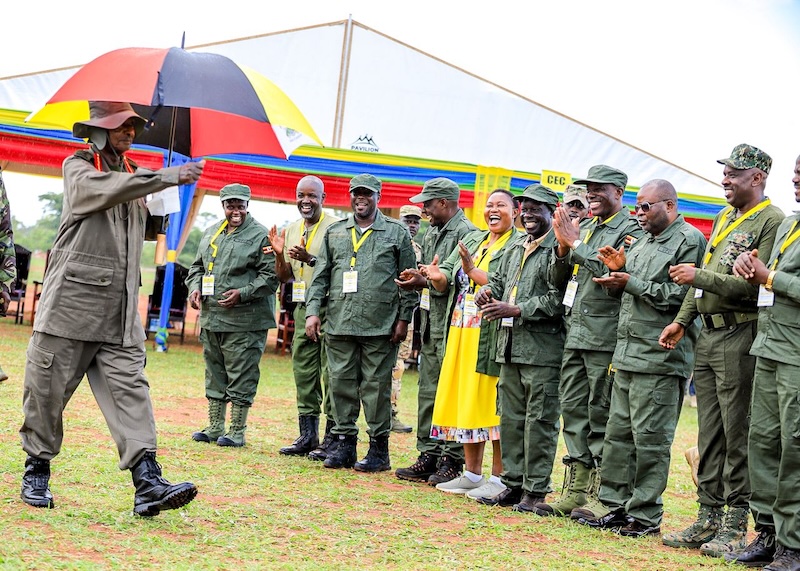
Museveni, who is set to be sworn in on May 12, 2026, after four decades in power, made the remarks while addressing newly elected National Resistance Movement (NRM) legislators at the party’s retreat at the National Leadership Institute (NALI) in Kyankwanzi.
He said wealth cannot be built through corruption or dependence, urging leaders to restore accountability as a cornerstone of leadership.
“If you are corrupt, you waste government resources and become a bad example. I will not tolerate corruption; it diverts us from our mission,” Museveni said.
His remarks come amid growing concern over the misuse of public funds. Police data in the 2025 annual crime report indicates at least 389 cases linked to Parish Development Model (PDM)-related corruption, highlighting persistent accountability gaps at the local level.
The retreat is being attended by more than 350 MPs-elect, including dozens of first-time legislators and NRM-leaning independents. It is intended to provide a platform for lawmakers to raise grassroots concerns.
Masaka City Woman MP Justine Nameere cited alleged theft of medicines in public health facilities.
“We don’t know where the medicines disappear to. Sometimes only basic painkillers are available,” she said.
Museveni responded with a renewed pledge to act, repeating his frequent commitments to tackle corruption, which has increasingly overshadowed his administration.
He recently remarked that the NRM system had been killed by corruption, citing allegations that some State House officials demand large sums of money to arrange meetings with him. Several of his cabinet ministers have also been implicated in various corruption scandals over the years, further fuelling concerns about accountability within government.
“Corruption, including the theft of drugs in government hospitals, shall be tackled very seriously in this new term,” he said.
The President also emphasised that political leadership requires ideological grounding, saying leaders must understand the movement’s philosophy and strategy.
“A follower may support some aspects of the movement without going deep into its beliefs, but a leader must understand ideology, philosophy and strategy,” he said. He described the Kyankwanzi retreat, an entrenched NRM tradition dating back to the bush-war era — as a training ground where leaders learn to “diagnose” societal problems and apply practical solutions.
Museveni urged leaders to promote wealth creation through productivity rather than dependence.
“Prosperity does not come from begging or corruption. Every adult must produce a good or a service and earn from it,” he said.
He identified commercial agriculture, manufacturing, services and ICT as key drivers of Uganda’s economic transformation, in line with government policy frameworks under Vision 2040 and the Third National Development Plan.

Recent economic indicators appear to support this trajectory. Uganda’s private sector activity expanded in March 2026, with the Purchasing Managers’ Index rising to 54.3, above the 50-point threshold that signals growth.
Museveni also warned against identity politics, arguing that sectarian divisions undermine markets and national cohesion.
“If we emphasise religion and tribes, some of your products will not be bought. That is why we said we should love Uganda first,” he said.
He reaffirmed the NRM’s four ideological pillars — patriotism, Pan-Africanism, socio-economic transformation and democracy, as the foundation for Uganda’s development strategy, linking them to regional and continental market integration through the East African Community and the African Continental Free Trade Area.
“Integration means strength. Fragmentation means weakness,” Museveni said.
Vice President Jessica Alupo, who chaired the session, described the retreat as a critical moment for MPs to receive direction from party leadership. NRM secretary general Richard Todwong said a detailed post-election performance report would be presented.
Museveni congratulated MPs on their electoral success but cautioned that the party’s performance exposed internal weaknesses.
“We could have done more if we got rid of some weaknesses,” he said. The Kyankwanzi retreat is intended to align lawmakers with the ruling party’s philosophy, governance approach and legislative priorities for the 12th parliament.