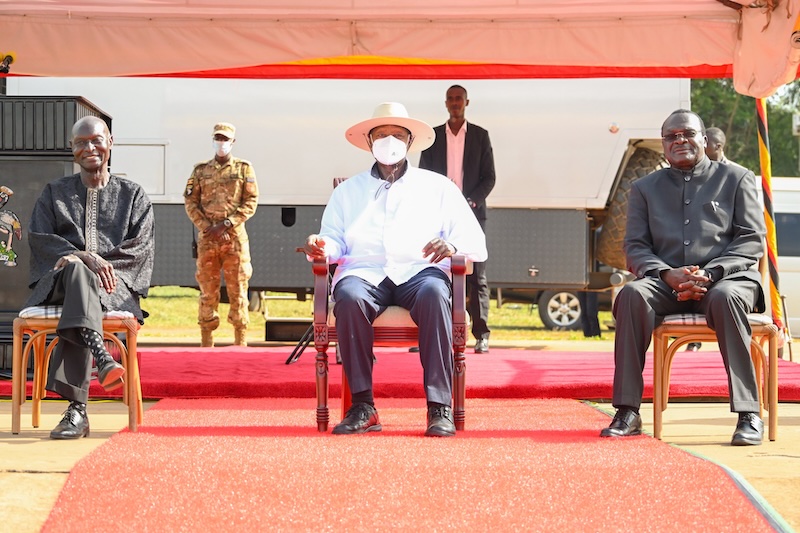
President Yoweri Kaguta Museveni has praised retired chief justice Alfonse Chigamoy Owiny-Dollo for what he described as corruption-free leadership that helped transform Uganda’s judiciary.
Speaking during Owiny-Dollo’s homecoming celebrations on Saturday at Kaunda Parade Ground, Museveni said that although he often receives reports of corruption within the judiciary, the former chief justice has never been linked to such allegations.
“During the time I have worked with him, I can testify to three qualities. The first one is that I have never heard any story of personal corruption involving him in the judiciary. I normally get stories that there is still corruption in the judiciary, but I have never heard his name associated with any of them,” Museveni said.
Museveni also credited Owiny-Dollo with helping to demobilise armed resistance by locals in the Acholi sub-region against the National Resistance Army (NRA) after it took power in 1986.
The President further said Owiny-Dollo transformed the justice system by championing Alternative Dispute Resolution (ADR), which allows communities to resolve disputes outside the formal court process.
“I was talking about it (Alternative Dispute Resolution) all the time, but no one in the judiciary was picking it up until his Lordship Owiny-Dollo came and embraced it,” Museveni said.
The homecoming celebration was organised under the Rocco Paco initiative, a programme aimed at reviving the social and economic fabric of the Acholi sub-region. The initiative, launched in 2024, is being championed by Owiny-Dollo and former presidential candidate Olara Otunnu.
Museveni welcomed the initiative and pledged government support, saying it aligns with the agenda of the ruling National Resistance Movement to promote household wealth creation.
“I thank the people of Acholi for giving us a brilliant young person who has made a great contribution. Rocco Paco is a very good idea; it is exactly what the NRM has been talking about for years, wealth creation for every household,” he said.
The President also urged leaders and residents in the Acholi sub-region to adopt high-value crops, arguing that crops such as cotton, sugarcane and tobacco require large pieces of land but often generate lower returns.

Earlier, in his keynote address, Owiny-Dollo called on the government to support the Rocco Paco initiative, saying collaboration between the state and community leaders would be key to transforming the region.
“We can do our part by sensitizing our people and offering leadership advice, but we can only do so much. If the government of Uganda joins hands with us, we will each play our role for the benefit of our people,” Owiny-Dollo said.
He expressed optimism that with full government support, the Acholi sub-region, currently ranked among the poorest in the country, could undergo significant transformation within five to ten years. Owiny-Dollo also called for government support for agricultural mechanisation through a household production model.
“We can mechanise this land about 28,000 Sq Km by targeting households and family land. When people invest in their own land, the income goes directly into their pockets. Some land can also be allocated to investors under agreed modalities,” he said.
He encouraged residents to transition to high-value crops such as coffee and cocoa, noting that the shift would require community sensitisation, farmer training and supportive bylaws from local governments.
“I call on the central government, the local government and district leadership both incumbent and incoming that if we want real transformation here, we must come up with by-laws compelling our people to grow meaningful crops,” Owiny-Dollo said.
Jane Frances Abodo said Owiny-Dollo’s career has been defined by courage, integrity and a deep commitment to public service. She credited his leadership with strengthening reconciliation and restorative justice approaches that have helped bridge the gap between the formal legal system and traditional conflict-resolution mechanisms.
“Under your leadership, the judiciary achieved a number of milestones, including bringing courts closer to the people and ensuring that justice became more accessible to communities that had long been underserved,” she said.
Meanwhile, Richard Todwong, secretary general of the National Resistance Movement, said Owiny-Dollo’s career offers an important lesson for leaders serving in government.
“For us who are still working in government, it is also a lesson that in whatever we do and in the positions we hold, we need to serve with dignity and respect, and be honest and obedient so that we do not embarrass government and we also do not embarrass our tribe,” Todwong said.
Justice Owiny-Dollo retired on January 18 after attaining the mandatory retirement age of 70 years. He served for five years as chief justice following his appointment in August 2020 by President Museveni.
About the Author