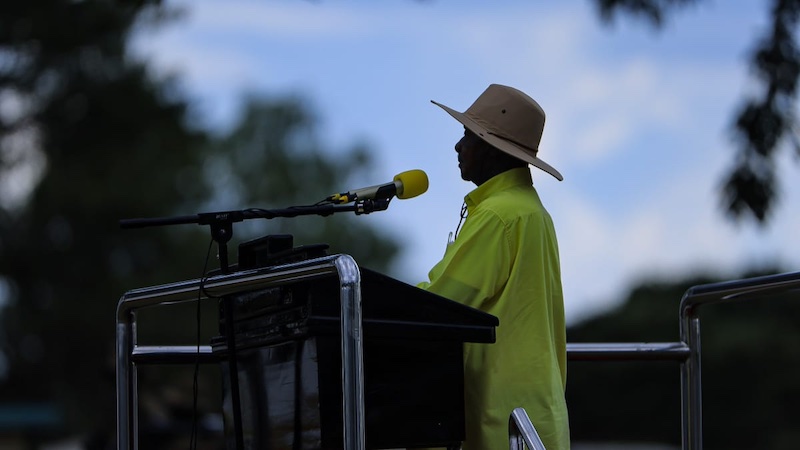
The Electoral Commission (EC) has officially declared Uganda’s incumbent President Yoweri Kaguta Museveni as the winner of the January 15 polls.
According to the Electoral Commission (EC) chairperson, Yoweri Museveni has secured a seventh presidential term, extending his four-decade rule by another five years after winning 7,946,772 votes, representing 71.65 per cent of the valid votes cast. The tally comfortably surpassed the constitutional requirement of 50 per cent plus one needed for an outright first-round victory.
Museveni’s closest challenger, Robert Kyagulanyi Ssentamu aka Bobi Wine of the National Unity Platform (NUP), came second with 2,741,238 votes (24.72 per cent).
The remaining candidates trailed far behind. Nathan Nandala Mafabi of the Forum for Democratic Change (FDC) garnered 209,039 votes (1.88 per cent), while Alliance for National Transformation (ANT) candidate Mugisha Muntu polled 59,276 votes (0.53 per cent). Common Man’s Party candidate Mubarak Munyagwa received 31,666 votes (0.30 per cent), National Peasants Party’s Robert Kasibante obtained 33,440 votes (0.30 per cent), and Conservative Party flag bearer Joseph Mabirizi secured 23,458 votes (0.21 per cent).
The results were declared after tallies from 49,512 of the 50,739 polling stations, approximately 98 per cent, had been received, leaving 1,227 stations pending.
Voter turnout stood at 11,366,201 out of 21,649,067 registered voters, translating into roughly 52.5 per cent participation. More than 10 million eligible voters did not cast their ballots.
Museveni swept most regions of the country but faced stiff competition in opposition strongholds, particularly Buganda and Kampala. In Buganda, Bobi Wine narrowly edged Museveni with 1,160,780 votes (49.37 per cent) against Museveni’s 1,157,832 votes (49.25 per cent).
The declaration sparked celebrations among National Resistance Movement (NRM) supporters at the national tally centre in Lubowa. Among the high-profile figures present were Vice President Jessica Alupo, Prime Minister Robinah Nabbanja, party vice presidents Hajj Moses Kigongo and Anita Among, who also serves as Speaker of Parliament—alongside other senior party officials.
In contrast, the NUP swiftly rejected the results. The party’s representative at the tally centre, Benjamin Katana, dismissed the outcome as fraudulent and inconsistent with what transpired at polling stations.
“The results declared by the EC are fraudulent and do not represent the transparency at the different polling stations across the country,” Katana said.
He cited alleged irregularities, including voter intimidation, arrests of party agents, ballot stuffing, and widespread voter suppression. When asked about the party’s next steps, Katana maintained that the mandate ultimately belongs to the people.
Pressed on the party’s next steps, Katana emphasised that the vote belongs to Ugandans, who are constitutionally empowered to pursue lawful action if dissatisfied with the outcome.
The election was conducted amid heightened controversy, including a nationwide internet shutdown imposed days before polling, delays attributed to technical glitches, heavy security deployment, allegations of fraud from both camps, and post-election unrest that reportedly claimed lives in some areas.
Moments before announcing the final results, EC chairperson Simon Byabakama appealed for calm, urging citizens to put national unity first and seek legal redress where necessary.
“I call upon voters, supporters and other actors to put Uganda first. Where anyone is not satisfied with the results, there are legal avenues they can pursue,” he said.
Compared to the 2021 election, where Museveni won with 58.38 per cent (6,042,898 votes) against Bobi Wine’s 35.08 per cent (3,631,437 votes), the 2026 contest saw the incumbent significantly widen his margin, despite a lower overall voter turnout.
About the Author