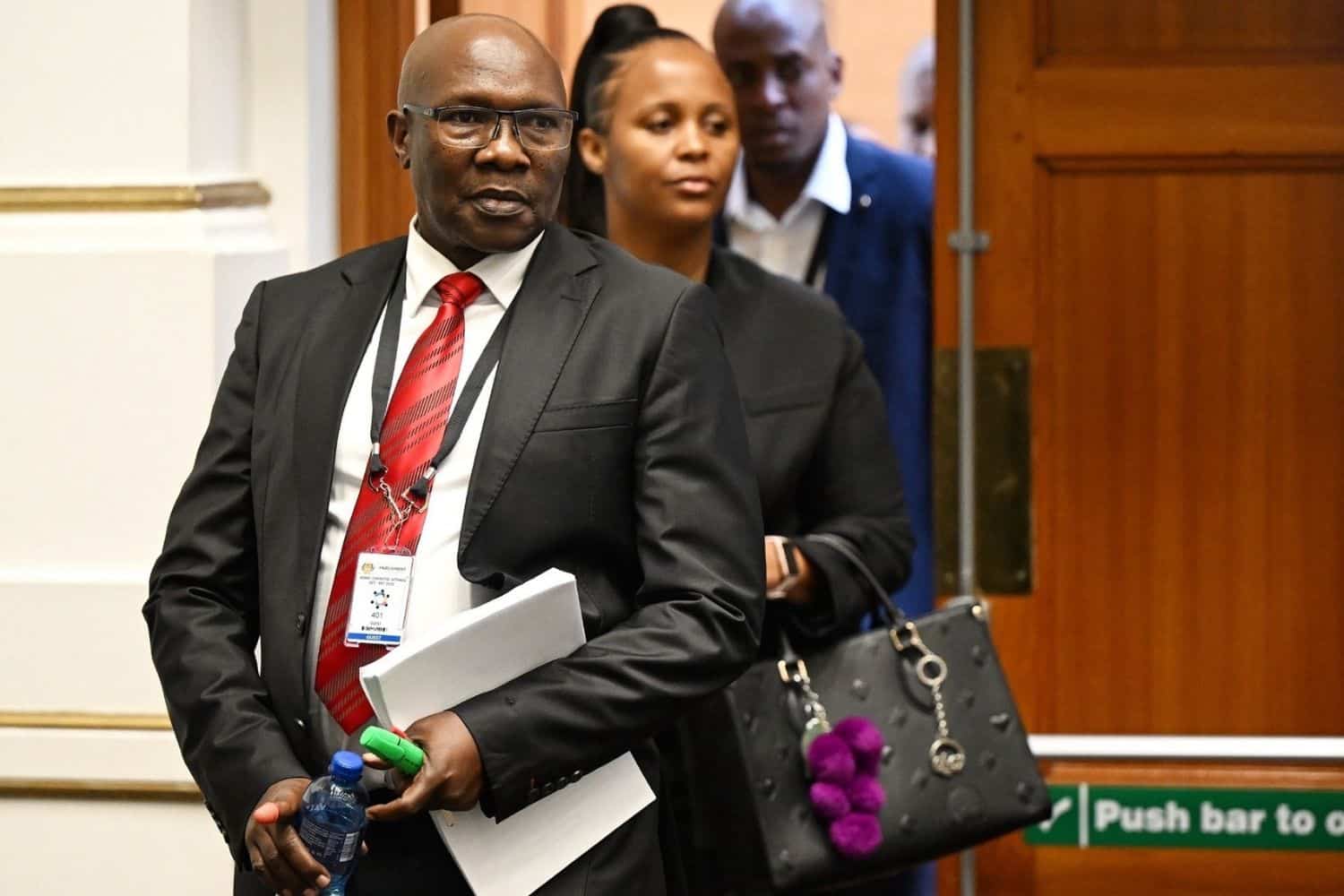
Crime Intelligence head Dumisani Khumalo says Police Minister Senzo Mchunu’s letter halting appointments has had a negative impact on his division, leaving critical positions vacant and affecting operations.
Khumalo took the witness stand at parliament’s ad hoc committee in Cape Town on Thursday.
He previously gave evidence about the disbandment of the political killings task team (PKTT) before the Madlanga Commission of Inquiry, which is investigating criminality, political interference, and corruption within the justice system.
Crime Intelligence head Dumisani Khumalo testifies
During proceedings, Khumalo, who is currently out on R10 000 bail, addressed criticism about his lack of detective experience.
Having joined the South African Police Service (Saps) in 1991, the Crime Intelligence divisional commissioner told the committee he chose to focus on operational coordination.
“When you are coordinating operations, you are like a choir conductor who must be able to sing and direct all parts of the choir.
“So, the theory I will get from each and every operational plan that I have to implement,” Khumalo said.
He highlighted that when he was appointed head of Crime Intelligence in late 2022, the division faced significant challenges.
“There were forever complaints, especially from the operational environments of Saps, which they are not getting the services that they expect from Crime Intelligence.”
Khumalo said the division was misaligned with Saps’ key performance indicators and burdened by outdated policies as well as legal frameworks.
“So the environment was just operating [in] a free mode. It was like operating like a Crime Intelligence that is serving [its] own purpose; that was the first issue that one had to rectify.”
Misuse of resources
Khumalo highlighted issues, including misuse of state vehicles and weak human and financial controls.
“Those vehicles were allocated to those seniors unlawfully, so because it amounted to fraud and corruption if you are benefitting twice,” he said.
He added that the lack of oversight had led to irregular appointments of family and friends within Crime Intelligence.
READ MORE: Crime Intelligence boss explains why investigations into organised crime need to be different
The division’s problems, he said, were also noted by the Zondo commission of inquiry.
He confirmed that efforts to address ghost workers in the division are ongoing.
“One had to hunt those people and dismiss them in terms of the [disciplinary] regulations of the Saps.”
Vacant positions hamper Crime Intelligence operations
Khumalo told the committee that Mchunu’s directives continue to impact Crime Intelligence’s performance.
Mchunu – currently on special leave – ordered the halt to filling vacant positions and the immediate disbanding of the PKTT in a letter dated 31 December 2024 to National Police Commissioner Fannie Masemola.
On Thursday, Khumalo remarked that the letter could have been addressed to him as well, given that it primarily affected his work.
“The letter came at a time when we had four vacant posts of provincial heads of Crime Intelligence and also a number of senior management posts that are still vacant at head office level.
“We had advertised two batches of senior management posts that were halted by the directive,” Khumalo said.
He detailed the staffing gaps, pointing out that four provinces currently have no provincial heads, and at the national level, two components remain without leadership.
Watch the ad hoc committee below:
Khumalo also highlighted critical shortages in the cyber section.
“It was one of the most important or critical posts that we wanted to fill since the beginning of 2024.”
He added that staff are overworked to compensate for these shortcomings.
“Most of us are working 24/7; 24 hours per day, because we must fill in the gaps that are there in senior management level.”
Khumalo added Masemola has assured him that the vacant posts will be re-advertised “soon”.
NOW READ: Former police minister Bheki Cele never gave directions to PKTT, says Khumalo
About the Author