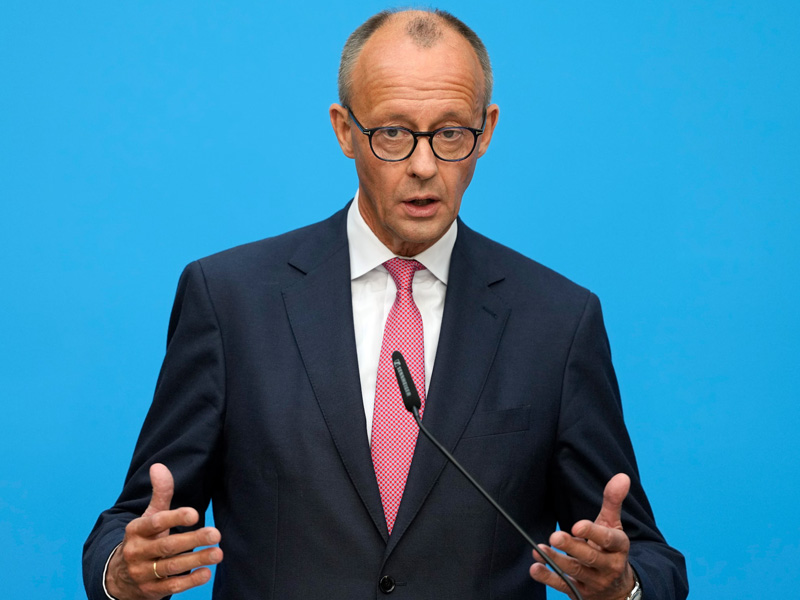
German Chancellor Friedrich Merz has called on Europe to more forcefully assert its interests in order to safeguard peace, security and prosperity in 2026, warning that the continent faces mounting threats from Russian aggression, global protectionism and shifting relations with the United States.
In his New Year address, Merz said the ongoing war in Ukraine poses a direct threat to Europe’s freedom and security, stressing that Russia’s actions go beyond Ukraine and are aimed at destabilising the entire continent.
“We are seeing more and more clearly that Russia’s aggression was and is part of a plan targeted against the whole of Europe,” Merz said, adding that Germany is confronted daily with sabotage, espionage and cyberattacks linked to Moscow.
Since assuming office in May, Merz has played a central role in strengthening European support for Ukraine and pushing for increased defence spending. Germany has significantly boosted military investment since 2023 as part of efforts to shoulder greater responsibility for European security.
The chancellor also warned of growing risks from global economic protectionism, noting that Europe’s reliance on imported raw materials is increasingly being exploited as a political tool. He said Germany, in particular, must adapt as it seeks to revive its export-driven economy while reducing dependence on China and navigating global trade tensions.
Europe’s largest economy has struggled in recent years due to weak domestic investment and structural reforms, and is expected to record only modest growth in 2026 following two consecutive years of contraction.
Merz further addressed Europe’s evolving relationship with the United States since President Donald Trump’s return to the White House in January 2025, acknowledging that the long-standing security partnership has become more complex.
“For us Europeans, this means that we must defend and assert our interests much more strongly by ourselves,” he said, while stressing that Europe must act with confidence rather than fear.
Merz described 2026 as a potentially decisive year for both Germany and Europe, urging the continent to take greater responsibility for its future and reconnect with the foundations of peace, freedom and prosperity built over decades.
Erizia Rubyjeana
About the Author