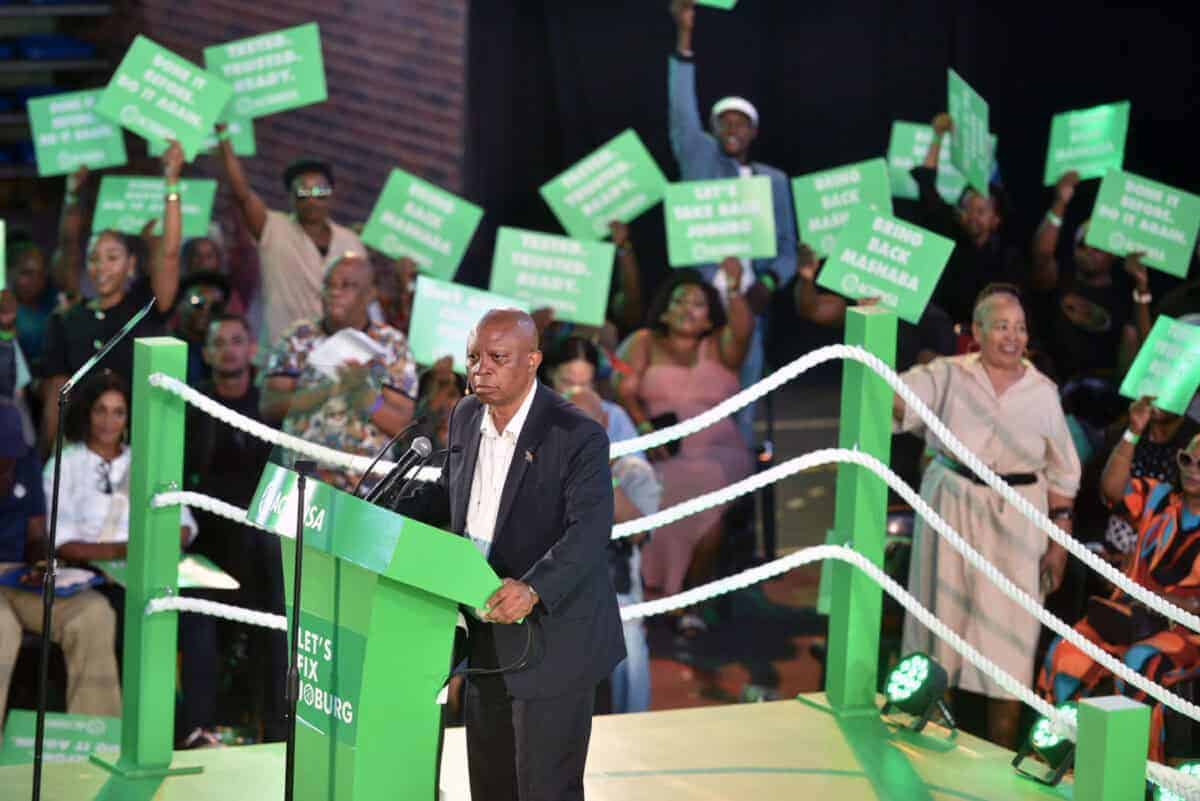
ActionSA leader Herman Mashaba speaks after his announcement of the party's mayoral candidate for Johannesburg in the upcoming Local Government Elections at Orlando Hall in Soweto, 21 February 2026. Picture: Nigel Sibanda/ The Citizen
It was not surprising when ActionSA unveiled Herman Mashaba as its Joburg mayoral candidate this past weekend.
In truth, the party is inseparable from its leader: members of the selection committee report to Mashaba directly or indirectly, his family bankrolls operations, and his influence runs so deep that many argue he effectively “owns” the party.
The real question, then, is not why he was chosen, but whether his return signals genuine rescue for Joburg, or if it’s simply a manoeuvre to block DA candidate Helen Zille? For weary residents, his comeback feels less like fresh hope and more like déjà vu.
When Mashaba first took office as Joburg mayor under the DA between 2016 and 2019, he arrived with bold promises: run the city like a business, fight corruption, restore basic services and inject efficiency into a bureaucracy he described as broken.
On paper, it sounded transformative. In practice, results were uneven. He did expose some corrupt contracts and launch high-profile enforcement drives, but his tenure was short-lived, crippled by fragile coalitions and political inexperience.
When he resigned in 2019, it was not because voters rejected him, but because alliances collapsed and political reality outstripped his ambitions.
ALSO READ: Mashaba pledges to revive SA’s arts: ‘We are making ourselves available to save you’
The cracks in his leadership were laid bare, proving Joburg’s systemic problems were too big for the Mashaba-approach to manage.
Now, Johannesburg faces an even deeper crisis. Water and electricity supply remain unreliable, roads are riddled with potholes, traffic lights barely function and crime is rampant.
The city’s finances are strained, and its administration plagued by instability.
If Mashaba returns, he inherits a city far more complex and broken than the one he left. And this time, the city requires more than the “businessman mayor” approach he tried before.
Even the possibility of a coalition with the DA seems implausible. Mashaba’s relationship with Zille has long been fraught with tension. “Zille thinks I’m a 66-year-old boy,” he said in a recent radio interview.
Their bitter fallout, which drove him out of the party, suggests cooperation would be rocky at best. Without stable alliances in council, any promises of reform risk being blocked by political infighting.
ALSO READ: The H-squared Helen and Herman show is on
History offers little reason for optimism. Mashaba’s strengths – decisiveness, charisma, business experience – cannot easily overcome Johannesburg’s entrenched administrative dysfunction or mend a fractured political landscape.
Without a workable coalition or the ability to navigate council politics, his return may be more symbolic than substantive.
If Mashaba wins, Johannesburg residents should temper expectations. Fixing infrastructure, restoring public services and improving safety will require more than showmanship or high-profile interventions.
It will require political acumen and durable alliances – areas where Mashaba has already faltered.
For many voters, the question isn’t just whether Mashaba can lead the city. It’s whether he will make a difference this time, or just replay the failures of his first term. Given the bitter history with the DA and the complexity of the challenges ahead, the odds are stacked against him.
Joburg’s problems will not be fixed by nostalgia, charisma or political showmanship. They require results, something Mashaba has yet to consistently deliver.
ALSO READ: Zille and Mashaba in the ring
The city is not simply in need of a new mayor, but of structural renewal. Years of instability have weakened municipal capacity, eroded accountability and entrenched dysfunction at every level of governance.
Any leader stepping into this environment will confront resistance, limited resources and a council chamber defined by fragile alliances.
For Mashaba, the margin for error is slim.
Reversing the decline will demand sustained cooperation, strategic compromise and administrative discipline over many years.
Whether Mashaba possesses not only the will, but also the political endurance to see that through, remains uncertain.
About the Author