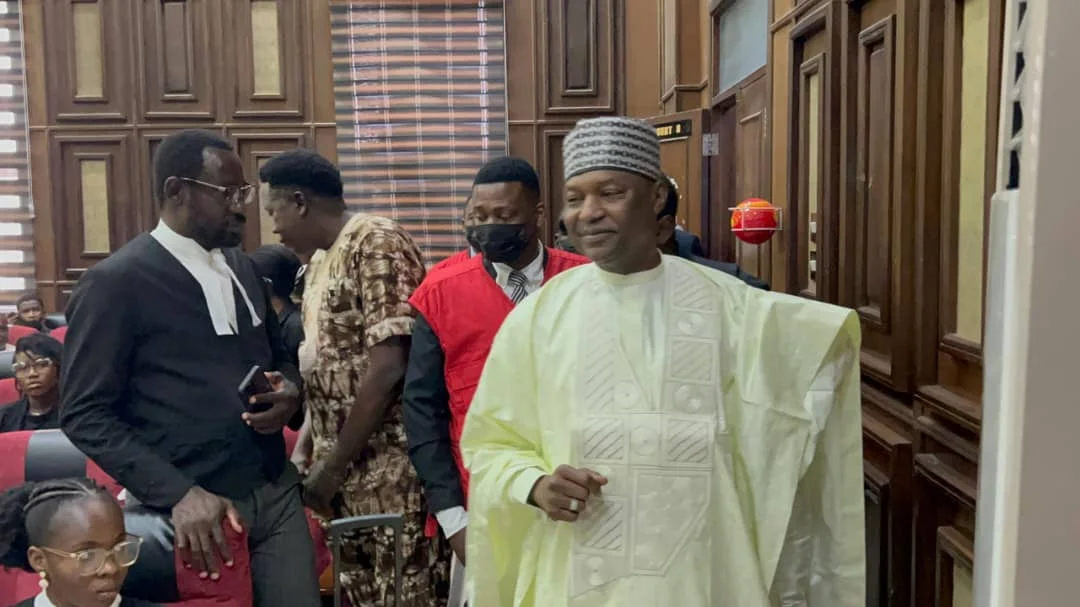
Former Attorney-General of the Federation (AGF) and Minister of Justice, Abubakar Malami has raised fresh concerns over what he describes as a renewed attempt by the Economic and Financial Crimes Commission (EFCC) to take possession of one of his properties in the Maitama district of Abuja.
According to Malami, operatives of the anti-graft agency arrived at his Maitama residence early Tuesday to enforce a court-ordered forfeiture and assume control of the property.
The latest development follows recent coordinated operations by security agencies targeting several assets linked to the former Attorney-General across the Federal Capital Territory, including private residences and office premises reportedly marked for seizure.
Eyewitness accounts and video footage from earlier enforcement operations captured tense exchanges between Malami and officials at one of the affected locations, with the former minister demanding to see court authorisation and questioning the legality of the exercise.
The EFCC, however, has maintained that the operation is lawful and backed by judicial authority.
Sources within the Commission said the enforcement action is being carried out in compliance with a valid forfeiture order issued by a competent court and in accordance with provisions of the EFCC Act empowering the agency to recover assets suspected to be proceeds of unlawful activity.
According to the Commission, the action is anchored on Section 5 of the EFCC Act, which authorises the agency to investigate economic and financial crimes and execute lawful asset recovery measures.
Malami Questions Timing, Alleges Political Undertone
Speaking after Monday’s earlier operation by EFCC officials, Malami acknowledged that an interim forfeiture order had been issued by the court on January 6, 2026, covering some of his properties, but insisted that he had already exercised his legal right to challenge the order.
He said the court had granted him 14 days to respond and that his legal team had since filed the necessary processes seeking to set aside the forfeiture.
According to him, the manner in which armed operatives arrived at multiple locations linked to him created unnecessary tension and caused distress to members of his family.
Malami said personnel deployed for the operation were heavily armed and fully equipped, describing their presence as intimidating.
He further argued that letters of invitation were eventually served not only at the residence where he was present but also at several other houses and business premises associated with him.
The former minister also alleged that the pattern and timing of the enforcement suggest political motivation.
He claimed that recent events, including his prolonged detention and the renewed pressure on his assets, point to what he described as political intimidation.
Malami noted that former Atiku Abubakar visited his residence on the same day before EFCC operatives arrived, suggesting that the sequence of events could invite political interpretation.
He also dismissed suggestions that the pressure could affect any future political ambition, insisting that his constitutional rights remain intact.
According to Malami, the right to seek elective office is guaranteed under the Constitution, and any possible governorship ambition remains a personal constitutional choice.
The unfolding dispute now places renewed attention on the legal battle over asset forfeiture, with both sides standing firmly on opposing interpretations of due process and enforcement authority.
About the Author