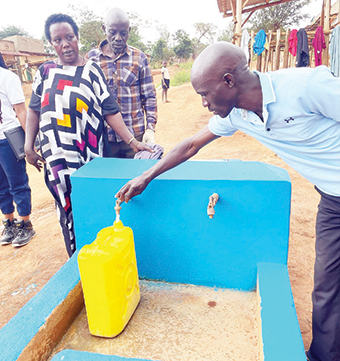

In Kasagama sub-county, Lyantonde district, a solar-powered water supply system is quietly redefining what reliable rural service delivery can look like, offering lessons for water governance, public safety, and community-led infrastructure management.
Installed under the government’s solar- powered water supply and irrigation initiative, the Kisaluwoko solar-powered water supply project has replaced open water dams that for decades served as the community’s primary source of water, despite their risks and unreliability.
Implemented by the ministry of Water and Environment (MWE) with financing of over 111 million euros from UK Export Finance, the nationwide initiative aims to address water scarcity and service gaps in hard-to-reach rural areas.
Nexus Green Ltd was contracted to construct 450 solar-powered water and irrigation systems across the country, with Kasagama selected following technical assessments that favored a centralized facility due to its terrain.
According to Monica Twikirize, the Nexus green project engineer, the Kasagama system operates using 18 solar panels producing 475 watts, pumping up to 20 cubic meters of water within seven hours daily, capacity considered adequate for the current population.
Unlike seasonal dams, the solar-powered system delivers predictable daily supply, a shift residents say has transformed household routines and planning. For village leaders, the impact goes beyond convenience.
Fred Ssekago, the Kisaluwoko Water Users Committee chairperson, says the community has moved from a reactive approach responding to accidents, illness, and water shortages, to structured water management.
“We now have rules, fees, security, and a maintenance plan,” Ssekago said, noting that residents contribute Shs 100 per jerrycan, funds used to pay a guard and support minor repairs.
Local authorities report that since the system became operational, incidents linked to open water sources, including drownings and waterborne diseases, have significantly declined. Denis Salongo Baguma, the Kasagama LC-I chairperson, described the project as a public safety intervention as much as a water supply solution.