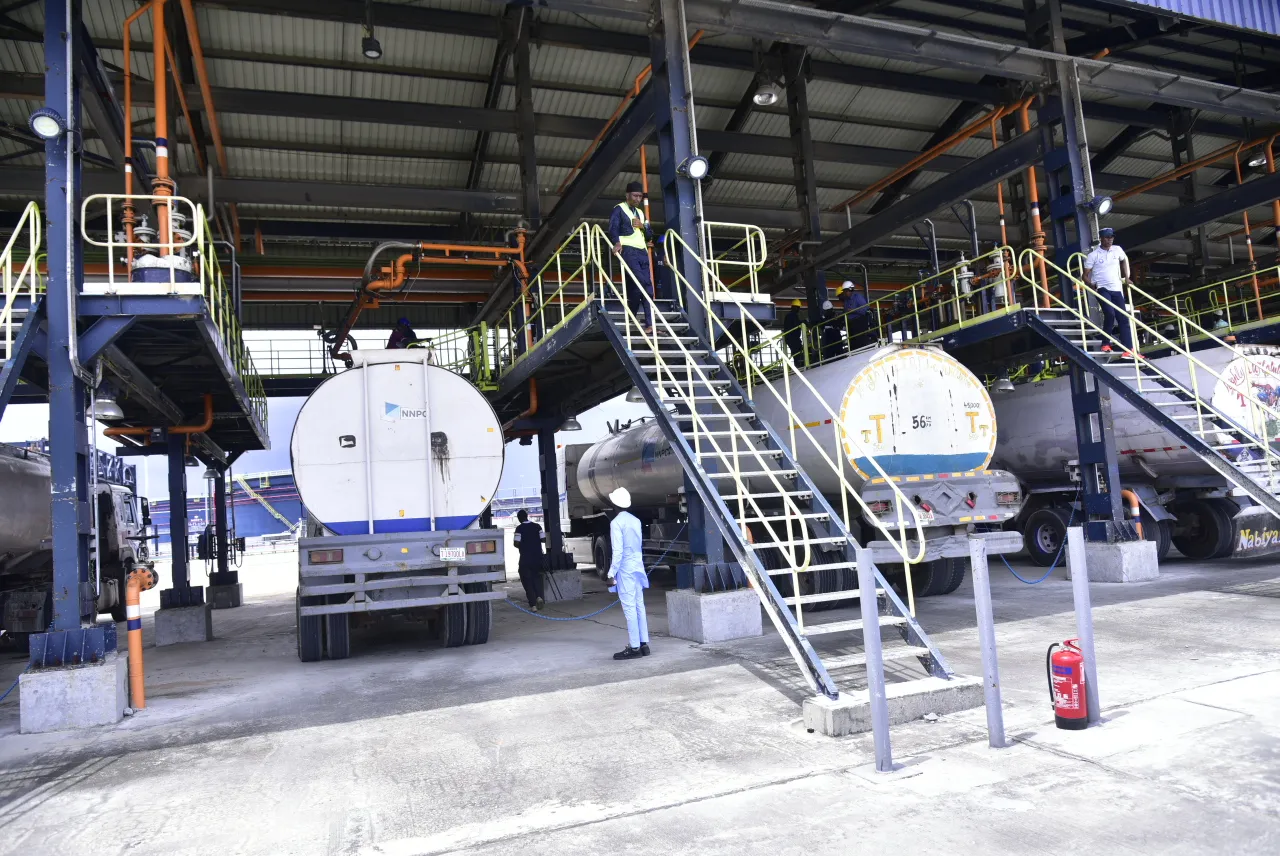
Local and international petroleum marketing analysts have attributed the drop in petrol imports into Nigeria to lower Ship-to-Ship (STS) prices offshore in Lomé and a stronger naira.
This is just as the Dangote Petroleum Refinery has successfully increased its daily domestic supply of petrol from a baseline of 32 million litres in December 2025 to a record 40.1 million litres in February 2026, the latest data from the Nigerian Midstream and Downstream Petroleum Regulatory Authority (NMDPRA) has shown.
In its latest assessment, Platts, a part of S&P Global Energy, said market prices for petrol traded in the Offshore Lome hub have weakened so far in 2026, while a strengthening naira improved incentives for buyers in Nigeria.
Its data, however, showed that a lack of Nigerian import permits has kept some volumes trapped offshore.
Platts assessed the daily STS Lome price at $669 per metric tonne (mt) as of February 12, 2026, adding that the average Platts STS Lome price from January 1 to February 12 was $647.75/mt.
This compares with $688.50/mt for the average of November to December 2025.
“Assuming a product density of 0.745 kg/l and using the Central Bank of Nigeria’s February 12 Naira/US dollar settlement, the market price in Lome on February 12 was Naira 675/litre.
“Factoring in costs from Lome into Lagos using costs for freight and discharge, the into-tank price in Lagos for gasoline (petrol) has averaged Naira 722.08/litre over the 30 days ending February 10, according to calculations by the Major Energy Marketers Association of Nigeria, using Platts Lome prices,” Platts explained.
Chief Executive Officer of Petroleumprice.ng, Jeremiah Olatide, who concurred with Platts’ assessment, said a stronger naira brought parity to Dangote Refinery and depot owners’ prices.
He explained that most private depots sourced their products from Lomé through the STS transaction model, which helped lower prices compared with direct imports from Europe and other international markets.
“So, when those vessels come to Lome, they go with their ships, and they do those transactions. And because of a stronger Naira lately, importers have been able to compete with Dangote Refinery.
“If you look at last week, before Dangote Refinery dropped its diesel price from N910 to N880, the private depot was selling at a much lower price than Dangote Refinery. They were selling the N900, but Dangote decided to lower the price to N880. So, they’ve been competing lately. One major factor is the strong Naira we’ve seen lately. And that is why they have been able to compete with Dangote,” Olatide said.
He also attributed the drop in imports to fewer licenses granted by the regulator, NMDPRA, noting that import licenses have been a recurring issue in the first quarter of this year.
He said the regulatory agency was trying to support local refineries, Dangote Refinery, and other modular refineries by limiting the number of import licenses.
He commended the regulator for taking that position, noting that as Dangote and others continued to produce and sell locally, it would help boost the economy.
NMDPRA disclosed that Dangote supplied about 40 million litres of petrol in January, higher than its December supply.
According to Olatide, production output has also helped stabilise the naira.
He said that with the delay of the import license for this year, importation will continue to drop for the benefit of the naira and the larger economy, adding that it will help Dangote Refinery to continue to stabilise.
Olatide noted that 60-70 per cent of the product used locally in December and January was sourced from Dangote.
He further said, “If you look at it, the naira has performed better in the last one or two months. And it means that importers are not chasing FX. So, it has helped the naira. It has contributed to the naira’s strength.
“So, what the regulator is looking at is how to keep encouraging Dangote Refinery to continue at that pace, at that 60-70 per cent local supply. If it continues at that level, the naira will continue to strengthen. But if they allow import permits, grant them as much as possible, and keep importing, there will be pressure on the naira because they want to source FX to get those products from Lomé.
Meanwhile, Dangote Petroleum Refinery has successfully increased its daily domestic supply of petrol from a baseline of 32 million litres in December 2025 to a record 40.1 million litres in February 2026.
This 25.3 per cent growth in production marked a critical milestone for the facility, as it scales up to meet the energy needs of over 200 million Nigerians and raises hopes for long-term price stability and national energy security.
The addition of an extra 8.1 million litres of petrol to the daily market in just one month came amid delays by the midstream and downstream regulator in the issuance of import permits for oil marketers.
An analysis of the NMDPRA report indicated that the Dangote Refinery has significantly narrowed the gap between what the country produces and what it consumes, with current data suggesting Nigeria’s average daily petrol consumption is approximately 60.2 million litres.
With the refinery now pumping out over 40.1 million litres every single day, the facility, the only functional petrol refinery in Nigeria, now supplies about two-thirds of the country’s fuel requirements locally.
According to the fact sheet, in January 2025, the Dangote Refinery supplied 19.1 million litres per day; 24.8 million litres per day in February; 22.9 million litres per day in March; 21.5 million litres per day in April; 18.5 million litres per day in May; and 18.1 million litres per day in June.
In addition, domestic supply from the refinery in July was 16.5 million litres; 19.8 million litres in August; 17.6 million litres in September; 17.1 million litres in October; 19.5 million litres in November, and 32 million litres per day in December.
During the period under consideration, the facility recorded a capacity utilisation rate of about 61.27 per cent, according to the NMDPRA. But during the week, the refinery maintained it could supply the full 75 million litres if given the go-ahead.
Also, petrol supply slumped from 74.2 million litres per day in December 2025 to 63 million litres in January 2026, ostensibly due to the ebbing pressure of the festive period, even as daily consumption reduced from 63.7 million litres daily in December to 60.2 million litres in January this year.
Emmanuel Addeh, Peter Uzoho
About the Author