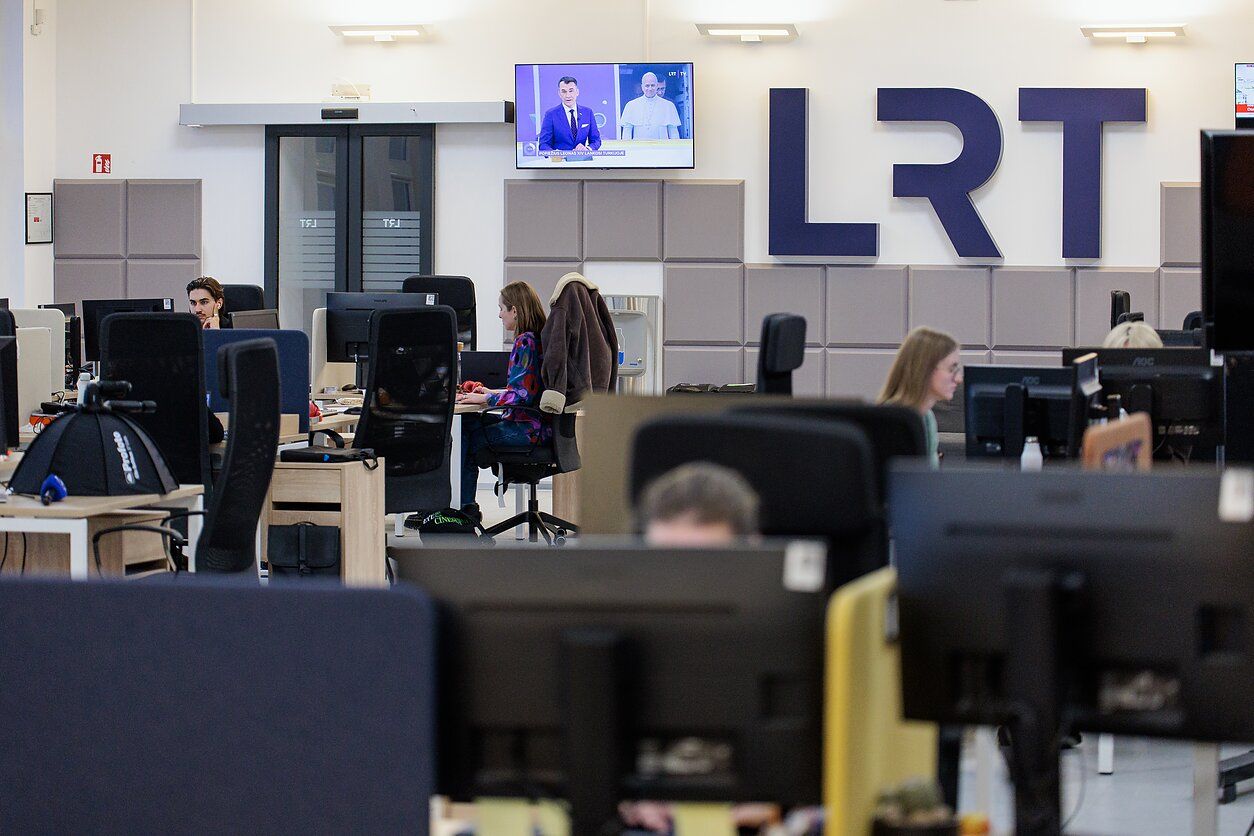
Journalists at Lithuania’s public broadcaster LRT have launched a week-long protest against recent parliamentary decisions that they say could undermine the organisation’s editorial independence and expose it to political pressure.
In a statement published on LRT’s website, staff announced that they would hold on-air moments of silence throughout the week.
“We will explain why free media is essential to a democratic society,” the statement said.
The protest follows the Lithuanian parliament’s approval of controversial amendments introduced by the populist Nemunas Dawn party.
The changes loosen restrictions on dismissing LRT’s leadership and impose a three-year budget freeze—steps critics argue could weaken the broadcaster’s autonomy.
Despite broad support from Lithuania’s governing coalition, press freedom advocates have sounded alarms. Under the new measures, LRT’s budget—normally indexed to 1% of income tax revenue and 1.3% of excise duties—will remain fixed at €79.6 million ($92 million) from 2026 to 2028, well below the €88.2 million projected for next year.
Lawmakers also approved an amendment allowing LRT’s council to dismiss its director with a simple majority, replacing the current two-thirds threshold. Journalists’ groups warn this could open the door to political interference.
The concerns have been echoed by the Council of Europe, the European Broadcasting Union, the International Press Institute, and multiple journalists’ unions, all of whom caution that the reforms risk politicising public media.
LRT employees argue that the amendments contradict the European Media Freedom Act and may violate Lithuania’s Constitutional Court doctrine. They also plan to highlight examples of “failed states where the media has been taken over”—including Hungary, Slovakia, Poland, and Georgia.
“We see this as an attempt at Orbanisation,” said Indrė Makaraitytė, head of LRT’s investigative unit, referencing Hungary’s Viktor Orbán and his widely criticised restrictions on media independence. She added that the reforms were being pushed through “without any discussion.”
Nearly 200 journalists are taking part in the protest, which will culminate in a public demonstration outside the Lithuanian parliament on December 9.
About the Author