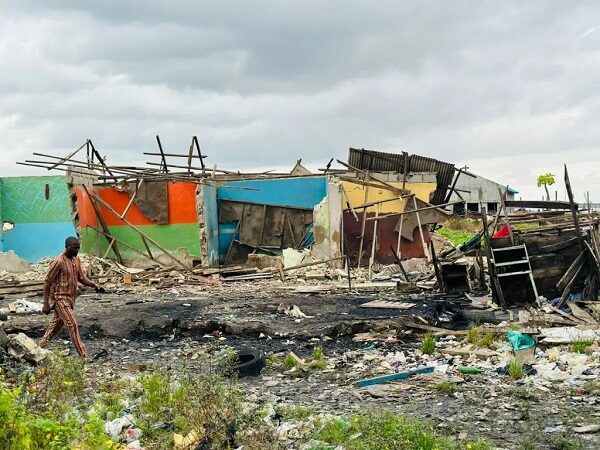
The Lagos State House of Assembly has thrown its weight behind the state government’s ongoing demolition of illegal structures and shanties built along shorelines and beneath high-tension power lines, dismissing calls by affected residents to halt the exercise.
The position of the Assembly was disclosed on Tuesday by the Chairman of the House Committee on Information, Security and Strategy, Mr Stephen Ogundipe, in a statement issued in Lagos.
The demolition exercise, being carried out by the Ministry of Physical Planning and Urban Development, has largely affected communities in Oworonsoki and Makoko, where hundreds of structures have been pulled down.
Last Thursday, residents of Makoko staged a protest at the Assembly complex, appealing to Governor Babajide Sanwo-Olu to intervene and stop further demolitions.
Responding to the protests, Ogundipe, who represents Oshodi-Isolo Constituency I, described the exercise as necessary and unavoidable, stressing that it was aimed at protecting lives and property across the state.
“It is quite worrisome that we continue to have ramshackle structures, sheds, and shanties, particularly along shorelines,” he said.
According to him, these areas have increasingly become hideouts for miscreants, street urchins, kidnappers, touts, traders, and hawkers, who frequently vandalise public utilities and pose security threats to innocent residents.
“While the demolition exercise may be painful for those directly affected, it is a necessary step to protect the larger society and uphold the rule of law,” Ogundipe stated.
He added that the government’s action demonstrated a commitment to preventing avoidable disasters and promoting sustainable urban development, describing the approach as responsible and forward-looking.
The lawmaker urged residents to remain calm and cooperate with government officials, assuring them that their concerns would be addressed and not ignored.
Ogundipe also advised citizens to comply with building regulations and planning approvals, stressing that adherence to development laws was a shared responsibility essential to preventing future tragedies.
Despite backing the enforcement drive, he assured that the Assembly remained committed to balancing the enforcement of laws with empathy, adding that measures would be taken to ensure that affected residents are not abandoned without support during the transition.
About the Author