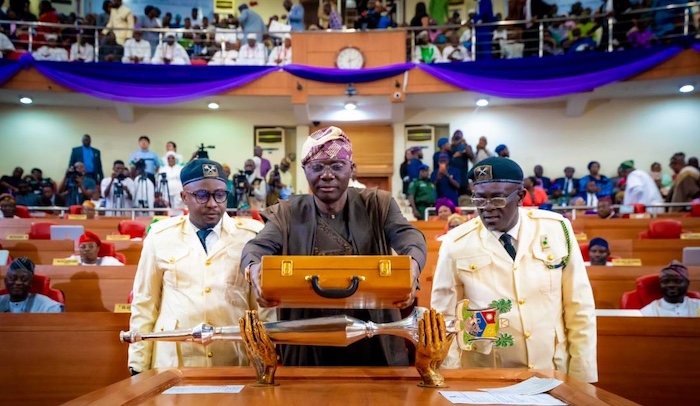
Lagos State’s N4.4 trillion 2026 “Budget of Shared Prosperity” has been passed by the state House of Assembly.
The budget, which was increased by N171 billion above what Governor Babajide Sanwo-Olu submitted, prioritised infrastructure, education, healthcare, economic growth, and social development, with over 52 per cent allocated to capital projects to drive inclusive growth across the state.
The 2026 fiscal year was approved by members following the adoption of the report of the House Committee on Economic Planning and Budget.
The committee chairman, Hon. Sa’ad Olumoh, presented the report during plenary on Thursday, detailing the assumptions, projections, and structure of the 2026 Appropriation Bill, tagged, “Budget of Shared Prosperity”.
According to the report, the 2026 budget represents the third budget cycle of the current administration and the final new-cycle budget of Governor Babajide Sanwo-Olu’s second term.
It was aligned with the administration’s development agenda, anchored on four strategic pillars: human-centric development, modern and adaptive infrastructure, a thriving 21st-century megacity economy, and effective governance that exceeds citizens’ expectations.
Olumoh stated that the budget framework was informed by macroeconomic indices, including an exchange rate benchmark of N1,512 to the dollar, an inflation rate of 14.7 per cent, oil production of 2.06 million barrels per day, and a benchmark oil price of $64 per barrel.
The committee also reviewed the 2025 budget performance, reporting a cumulative budget performance of 79 per cent as of November 2025. Capital expenditure performance stood at 75 per cent, recurrent expenditure at 87 per cent, while overall revenue performance was put at 79 per cent.
For the 2026 fiscal year, the approved budget size stands about N4.4 trillion, with proposed recurrent expenditure of N2.052 trillion and capital expenditure of N2.185 trillion.
The capital component represents a significant portion of the budget, underscoring the state government’s commitment to infrastructure development.
The budget included provisions for personnel costs, overheads, debt servicing, and debt repayment, with a projected deficit of about N243 billion to be financed through approved deficit financing options.
Sanwo-Olu had on Tuesday, November 25, 2025 presented a proposed N4.237 trillion budget for the 2026 fiscal year to the state House of Assembly.
Sanwo-Olu tagged the budge, “Budget of Shared Prosperity.”
During the address before the 40-member Assembly, the governor emphasised that the 2026 budget proposal was designed to promote shared prosperity and build a Lagos that benefits all residents.
“Our mission remains clear, to eradicate poverty and build a Lagos that works for all,” the governor said.
He stated that the budget was anchored on four strategic pillars: a human-centred approach, modern infrastructure, a thriving economy, and good governance.
During deliberations on the budget, lawmakers commended the budget, describing it as realistic and growth-oriented.
Hon. Aro Moshood disclosed that an additional N171 billion was added to the budget during the review process.
Hon. Femi Saheed said the size and structure of the budget showed that Lagos State remained on a strong economic footing, provided all stakeholders played their roles.
Hon. Gbolahan Yishawu, representing Eti-Osa Constituency II, highlighted the importance of revenue reforms and prudent loan repayment structures, stating that effective implementation would strengthen the state’s fiscal position.
The Assembly also received assurances from relevant officials that revenue-generating agencies would collaborate to ensure that projected revenues were met and possibly exceeded.
Segun James
About the Author