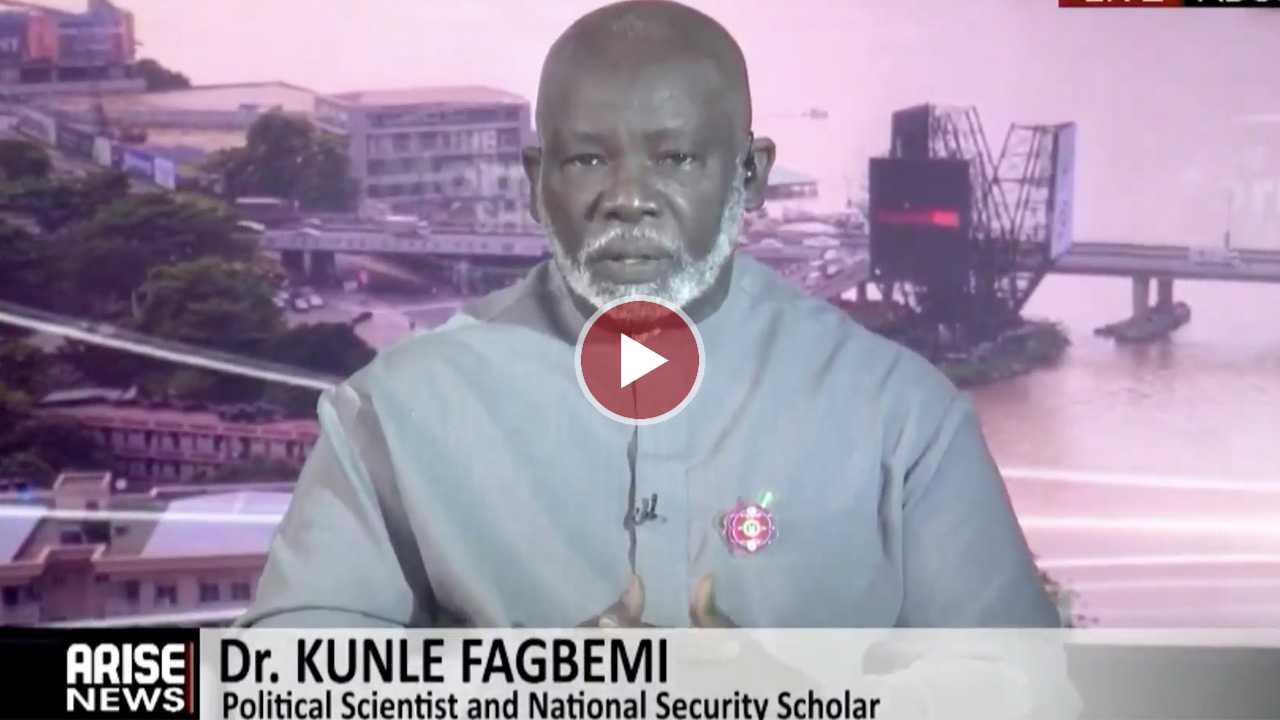
Political scientist and national security scholar Kunle Fagbemi has cautioned that it is too early to draw conclusions on the impact and success of the recent US intervention against terrorists in Nigeria.
Speaking during an interview with ARISE NEWS on Monday, Fagbemi emphasised that questions around the effectiveness of the airstrikes can only be addressed once a formal assessment has been completed.
He said, “It is not yet time to disclose. If and when you have the assessment done, is when we can begin to answer these questions in terms of the impact and success story.”
Fagbemi also highlighted the complexity of measuring success in precision airstrikes. He explained that multiple technical layers, from targeting coordinates to managing debris from munitions, must be considered. Misunderstandings often arise because information is shared selectively under defence protocols that balance the public’s right to know with operational security.
He noted, “Number one, you want to make sure that the projectiles, munitions that you are using will attack the correct coordinates that has been determined, and two, that if the projectile has to be powered by some materials, and those ones will fall down at some locations as they are going, because they expend some of those fuel materials along the line, they will have to calculate that those ones that are going to drop as debris will not cause harm, and that is part of why they are saying precision.”
Fagbemi also urged public officeholders and media actors to carefully manage and contextualise information on security interventions to avoid confusion and misinterpretation.
He said, “This intervention is not something coming from the blues. And we must be mindful that over the years, we’ve had a situation where the Nigerian state is a state party to the African Center for Strategic Studies. We are a state party to the African Crisis Initiative, that is now ACOTA, that is the Africa Contingency Operations Training Assistance. And then, the African Partnership Station, 2007. The African Crisis Initiative, that is ACOTA, is 2004. And Nigeria is a member of the Global Coalition to Defeat ISIS, which is the D-ISIS. And then we are a party to Trans-Sahara Counterterrorism Partnerships since 2005, which actually started in 2002 as Pan Sahel Initiative. Meaning, therefore, that there are a number of issues and instruments that have been ongoing, that have culminated into a strategic partnership that will lead to an intervention under the Responsibility to Protect, and under the purview of a number of these instruments.
“This is why we are always pleading with the occupants of public offices to always understand that they need to define and explain their roles correctly to Nigerians.”
Melissa Enoch
About the Author