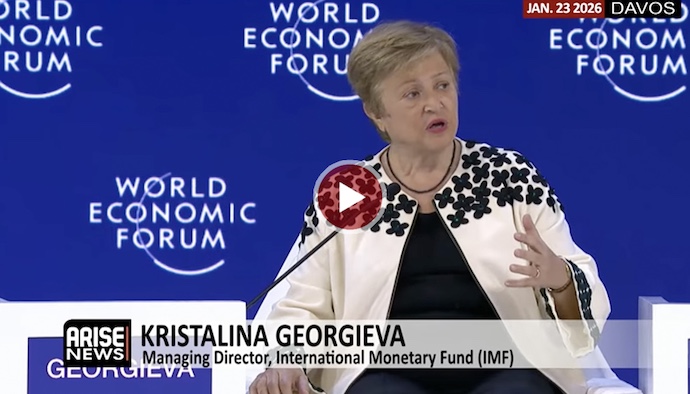
At the World Economic Forum in Davos on Friday, the Managing Director of the International Monetary Fund (IMF), Kristalina Georgieva, issued a stark warning about the rapid transformation AI is bringing to the global workforce.
Speaking to attendees, Georgieva likened the impact of artificial intelligence on jobs to a “tsunami” sweeping through labour markets.
She said, “We are researching what is actually happening in labor markets, and there are three important observations.
“Number one, massive transformation of demand for skills. We expect over the next years, in advanced economies, 60% of jobs to be affected by AI, either enhanced or eliminated or transformed, 40% globally. This is like a tsunami hitting the labor market.
“Number two, we look at the micro-level, what is happening with jobs, and we see that in advanced economies, one in 10 jobs is already enhanced, and the people in these jobs are paid better. When they’re paid better, they spend more money in the local economy, they spend more money in restaurants here and there. Demand for low-skilled jobs goes up, and actually, total employment seems to slightly increase because of it. But there are two very serious problems. The first one is that tasks that are eliminated are usually what entry-level jobs present, so young people searching for jobs find it harder to get to a good placement. And two, who is getting squeezed? The jobs that are not touched, they are kind of the same. They are now paying less. So, the middle class inevitably is going to be affected. And the third observation I would make that is my biggest worry, and actually, we heard people talking about it. Where are the guardrails?”
Georgieva stressed that the pace of AI adoption is outstripping society’s ability to manage it safely and inclusively. “This is moving so fast, and yet, we don’t know how to make it safe, we don’t know how to make it inclusive.
“So, my appeal is, wake up. AI is for real, and it is transforming our world faster than we are getting a hang of.”
Her warning comes as global debt reaches record levels, compounding economic vulnerabilities in the face of technological disruption. Georgieva urged policymakers, businesses, and workers to act quickly to prepare for the sweeping changes AI will bring.
Melissa Enoch
About the Author