Traditional activists have warned that the land question cannot be solved through legal means but requires deeper societal introspection.
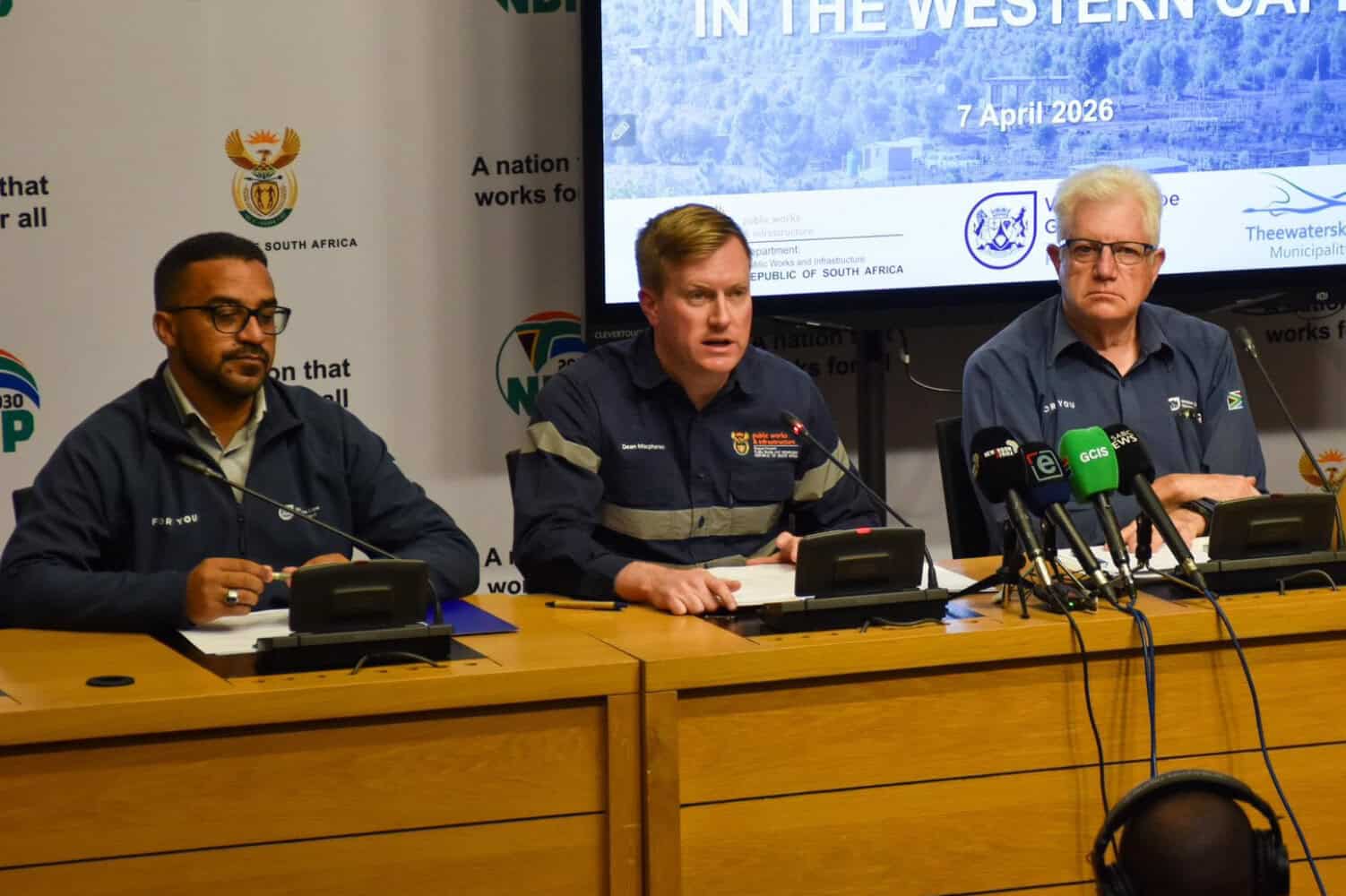
Department of Public Works and Infrastructure (DPWI) Minister Dean Macpherson on Tuesday revealed a plan to deal with a large section of hijacked state land in the Western Cape.
The occupants are self-described members of the Khoisan community who occupied the land used by the Department of Forestry, Fisheries and Environment (DFFE) in mid-2020.
The forestry department’s portfolio committee in November 2022 resolved that the then 4 000 occupants should be allowed to stay on condition that the community did not expand.
Macpherson stressed his interventions were about the rule of law, while the activists argue that “South Africa cannot resolve a land crisis with administrative language, while ignoring historical truth”.
R11 million in free services
Knoflokskraal is located in the Elgin Valley between Grabouw and Botsrivier along the N2, roughly 80km from Cape Town.
Owned by DPWI and the DFFE, it covers roughly 1 800 hectares and is meant for government forestry purposes
Queen Fazlin van der Schyf, who represented the community until her death in 2024, made the case before the portfolio community in 2022 that the community had an ancestral right to the land.
“There will not be any attempt to forcefully remove the current residents. The police must build and foster good relations with the community, and a way forward must be agreed upon in consultation with the Knoflokskraal residents,” the committee decided in 2022.
Macpherson stated the community now receives free basic services and electricity worth roughly R11 million per year.
He noted a December 2025 “social compact agreement” with the community had not been honoured and estimated the population to have grown to between 15 000 and 20 000.
He explained the situation was a planning issue for local government, an operational issue for national government and an economic concern for neighbouring private farms
“It should never have been allowed to get to this point, but it did because of politics and an unwillingness to do the right thing,” stated Macpherson.
Allegedly rife with crime
The minister is personally leading the retaking of Knoflokskraal under a “Ministerial Priority Project” and will drive targeted interventions.
Macpherson presented a slideshow documenting the sale of state land within the community, the use of excavation equipment for construction and seemingly thriving illegal enterprises.
He alleged the community was rife with crime and drug abuse and that Knoflokskraal was used for the storage and distribution of drugs and guns.
The minister listed police cases opened against members of the community, which include housebreaking, theft, fraud and shooting incidents.
“It is the creation of a parallel, unlawful system that benefits those who control it, not those who are drawn into it. This is the very definition of a criminal syndicate,” said Macpherson.
He added that criminal cases opened in relation to activities within the community go unsolved and has since asked the Minister of Police for a “comprehensive update” on criminal matters at Knoflokskraal.
“There are also allegations that municipal staff and police may have been bribed or compromised.
“If those allegations are proven, they would represent a profound betrayal of public trust and must be met with the full consequences of the law,” Macpherson said.
‘Not simply about title deeds’
Traditional and cultural activists, Soil of Africa, opposed Macpherson’s stance as it did not address the “lived reality of dispossession” experienced by indigenous peoples.
“What is unfolding at Knoflokskraal is not just a legal matter; it is a direct reflection of a state that has delayed confronting the root of land injustice,” Soil of Africa President King Bongani Ramontja told The Citizen.
He added that failing to properly address the Knoflokskraal community’s claims earlier had exacerbated the situation, but said Macpherson’s intervention “risks deepening” the crisis.
“Government cannot afford to be silent when land is occupied, only to re-emerge later with authority and force,” said Ramontja.
However, he explained that any historical claim to land in the country must be thoroughly tested and not based on “assumptions or political convenience”, and that this requires a detailed account of ownership and dispossession.
“Land in South Africa is not simply about title deeds, it is about identity, dignity, and historical restoration.
“Any process that does not begin with a full and transparent account of original land ownership is fundamentally flawed,” Ramontja said.
‘We will act lawfully’
DPWI’s plan to regain control of Knoflokskraal would feature three aspects: “containment, social facilitation and direct community engagement”.
Macpherson explained that the government would map the area and implement a containment strategy to monitor the community’s movements.
Once contained, the department will begin “the development of a community profile”, which will identify Knoflokskraal’s leadership structures and then assess their historical claims.
“We must remain faithful to the constitution. We will act lawfully. We will act carefully.
“We will act on the basis of evidence. We will act in a way that is fair, transparent and defensible. But we will act,” Macpherson concluded.
Ramontja dismissed the plan, believing the solution could only be achieved through a “functional partnership” with traditional leadership.
“We reject a narrow law and order approach to a deeply historical issue. You cannot police away a land question.
“You resolve it through courage, truth, structured engagement, and constitutional alignment,” he concluded.
NOW READ: Land expropriation: Almost 90% of claimants choose money instead of property