A young Khoisan man’s battle to have his identity recognised has finally come to an end after more than 18 years of struggle.
For many years, IT limitations prevented !Khūboab Oedasoua Lawrence and his family from obtaining official documents that accurately reflected his name.
First-of-its-kind Smart ID
The system was unable to print his first name, ‘!Khūboab’, due to special characters (non-alphanumeric symbols and punctuation marks).
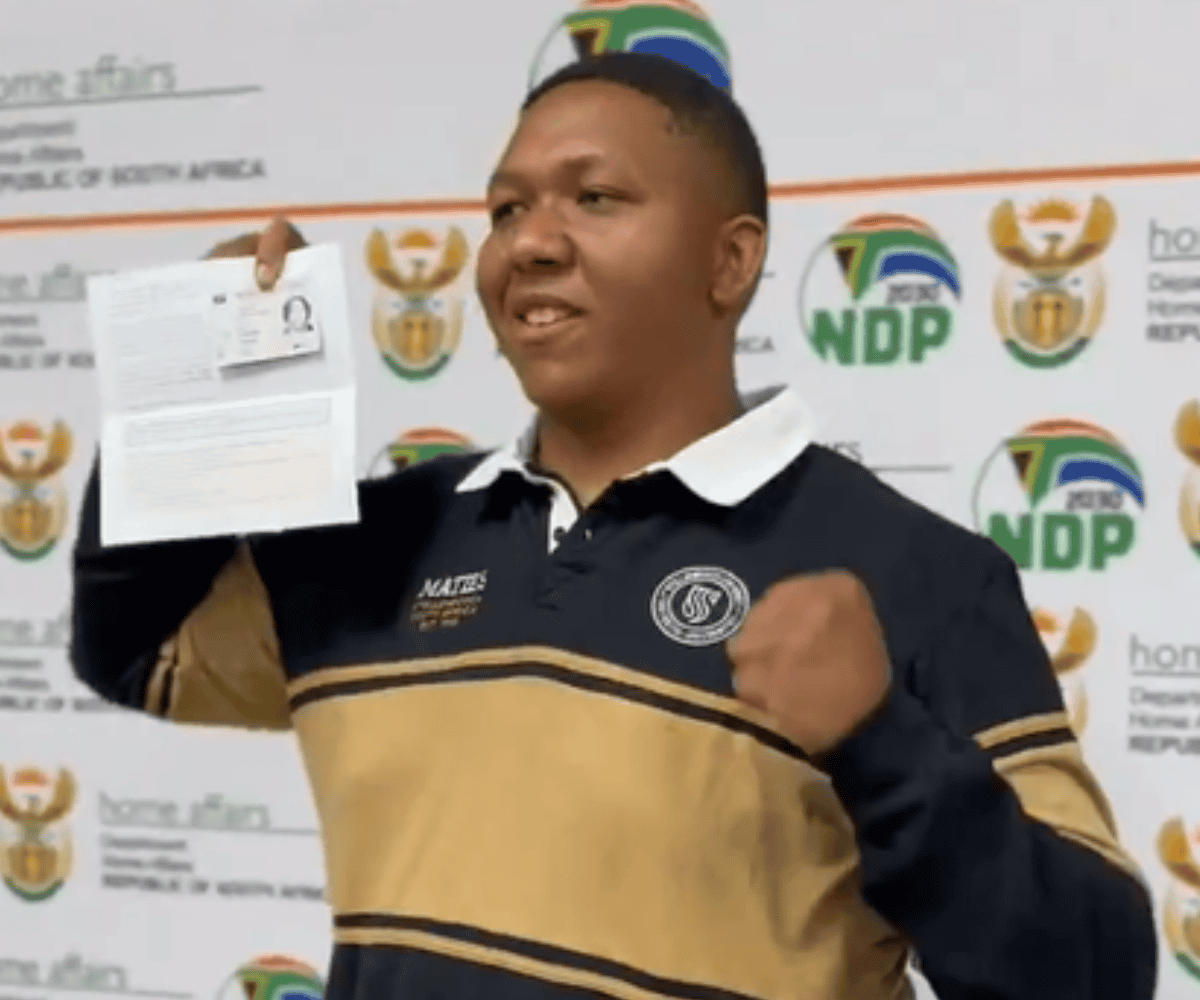
Now, the student based in Stellenbosch, Western Cape, has become the first recipient of an enabling document recognising a Khoisan traditional name.
Home Affairs Minister Leon Schreiber presented Lawrence with the first Smart ID card featuring special characters on 26 February, a milestone in the Khoisan community’s fight for rights and recognition.
Schreiber’s spokesperson Carli van Wyk said the minister was informed about Lawrence being unable to obtain a Smart ID reflecting his Khoisan first name a month ago.
“According to reports, his family had the same problem over 18 years ago when they were similarly unable to obtain a birth certificate that accurately reflects the spelling of his first name,” Van Wyk said on Thursday
“Following intervention from the minister, the department prioritised the matter and managed to identify the root of the problem as a technical IT limitation related to the use of so-called ‘special characters’.”
ALSO READ: Home Affairs rolled out over four million Smart ID cards in 2025
Traditional Khoisan names now recognised after upgrades
In less than four weeks, the department implemented the necessary upgrades and resolved the limitation, Van Wyk said.
As a result, birth certificates, Smart IDs and passports are now able to recognise and record Khoisan traditional names for the first time in South African history.
Home Affairs director-general Livhuwani Tommy Makhode will be issuing a circular to all offices informing them of the upgrades.
The department’s technical team is also on standby to effect further upgrades should there be a need to adjust additional special characters.
Watch: Home Affairs Minister Leon Schreiber hands over Smart ID to !Khūboab Oedasoua Lawrence
‘Diverse people unite’
Schreiber said the upgrades were a historic step forward to enhance the inclusion and dignity of Khoi-San communities in the country.
“As minister, I recognise that a name is more than a practicality – it is central to every person’s identity. I am therefore very proud that we were able to correct this long-standing problem within record time after becoming aware of it,” Schreiber said.
“South Africa’s national motto uses these same characters when it implores: !ke e: /xarra //ke, literally meaning ‘diverse people unite’. For the first time, this motto has now found expression at Home Affairs for the Khoi-San community,” he added.
The reform, the minister said, offers the latest powerful demonstration of how “our reform drive towards digital transformation is delivering dignity for all”.
Khoisans’ fight for recognition
The Khoi and San people in South Africa have been fighting for recognition for many years.
For nearly six years, a group of people from the Khoisan community camped on the grounds of the Union Buildings in Pretoria.
They did so in protest, fighting to be recognised as the country’s first indigenous people, for the Khoisan language to be made part of the official languages, and for the coloured identity to be scrapped.
They were evicted in February 2025.
NOW READ: ‘I want to fight back, but I’m tired’: Khoisan member reacts after Union Buildings eviction