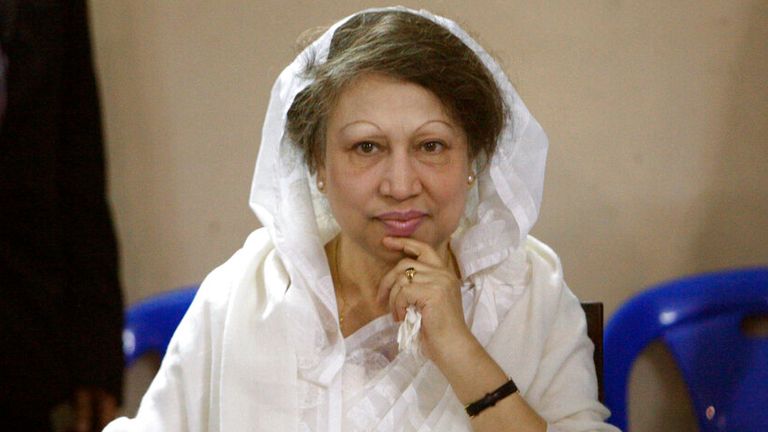
Bangladesh’s first female prime minister, Khaleda Zia, has died at the age of 80 after a prolonged illness, her party confirmed Tuesday. Her passing marks the end of one of the most influential and polarising chapters in the country’s modern political history.
Zia had been on life support at Evercare Hospital in Dhaka, with doctors describing her condition as “extremely critical.” The Bangladesh Nationalist Party (BNP) announced her death at 6 a.m., prompting crowds to gather outside the hospital in mourning.
Thrust into politics following the assassination of her husband, President Ziaur Rahman, in 1981, Khaleda Zia rose from relative obscurity to lead the BNP and become prime minister in 1991, breaking barriers in a male-dominated political landscape.
Zia is widely praised for her uncompromising stance against military rule in the 1980s, helping restore parliamentary democracy, and for advancing women’s education during her first term. Later administrations, however, drew criticism over disputed elections and corruption allegations, which she consistently denied.
For the past 16 years, Zia remained the symbol of opposition to Sheikh Hasina’s Awami League government, enduring imprisonment, house arrest, and political exile. She was released in January 2025 following mass protests that toppled the ruling party, reaffirming her role as a central figure in Bangladesh’s political landscape.
Despite her declining health, Zia remained influential ahead of upcoming elections, with the BNP signaling a return to power and positioning her son, Tarique Rahman, as a future party leader.
Tributes poured in from across Bangladesh and beyond. Interim leader Muhammad Yunus described her as a “symbol of the democratic movement,” while India’s Prime Minister Narendra Modi praised her role in strengthening regional ties.
Khaleda Zia passed away surrounded by family, leaving behind a legacy defined by resilience, fierce political rivalry, and a lasting imprint on Bangladesh’s democratic journey.
About the Author