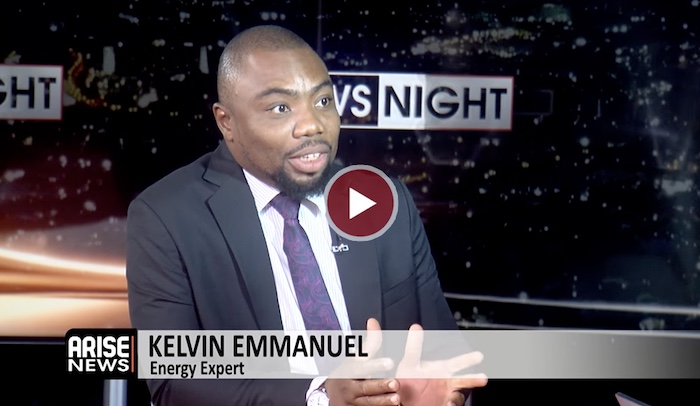

Energy expert Kelvin Emmanuel has warned that the Nigerian National Petroleum Company Limited (NNPCL) lacks the capacity to sustain its recent petrol price reductions, insisting the state oil firm cannot compete with Dangote Refinery due to structural inefficiencies and lack of economies of scale.
Speaking in an interview with ARISE News on Saturday, Emmanuel said, “NNPC cannot compete with Dangote. Dangote is an active, functional refinery with economies of scale, while NNPC is sourcing products from imports.”
His comments followed data from the National Bureau of Statistics showing that petrol prices fell by 12.6 per cent in November 2025, amid aggressive price cuts by Dangote Refinery and a corresponding response from NNPCL.
Emmanuel said price reductions across the country remain uneven, largely due to distribution challenges and the absence of a private-sector petroleum equalisation mechanism.
“There is a variance of prices in different parts of Nigeria because there is a need for a private sector–based petroleum equalisation fund to finance transportation of products,” he said.
He recalled that more than 15 years ago, the Bureau of Public Enterprises designed 22 retail storage distribution centres to act as buffers and strategic petroleum reserves, enabling product movement through pipelines.
“That was why you had facilities like the Atlas Group depot in Mosimi, which was vandalised in 2019 and has still not been restored,”Emmanuel noted.
He criticised NNPC’s pipeline system, describing it as exclusionary.
“The pipeline model that NNPC runs is a closed-loop system, not an open-access model. It doesn’t bring communities in to benefit or provide security,” he said.
According to Emmanuel, Dangote Refinery has had to independently solve logistics challenges.
“Dangote bought 4,000 CNG trucks and is providing a private-sector bridging allowance to distribute products nationwide,” he said, adding that this does not violate the Petroleum Industry Act.
“He is not operating petrol stations; he is in distribution and logistics. He has not violated the PIA in any way.”
Emmanuel said Nigeria’s heavy dependence on fuel imports before the refinery came on stream severely strained foreign exchange reserves.
“Up until 2024, Nigeria was spending about $28 billion annually importing petrol, diesel, Jet A1, petrochemical feedstocks, base oils, and residual fuels,”he said.
He argued that domestic refining offers economies of scale and foreign exchange stability.
“The benefit of having a refinery is economies of scale. In 2025 alone, Dangote spent $6.5 billion importing 100 million barrels of crude. Imagine the FX impact if that crude were sourced locally,”Emmanuel said.
However, he raised concerns about crude supply to the refinery.
“Only about 45 per cent of the crude feedstock is sourced locally,”he noted, questioning regulatory support for domestic refining.
He also criticised continued fuel imports, revealing that between November and December alone, Nigeria imported 1.8 billion litres of PMS worth $1.6 billion.
“We continue to ask why we are still importing,”he said.
Emmanuel further faulted regulators for weak quality control.
“The regulator still does not have fast labs at ports to test product integrity. Meanwhile, Dangote has one of the best labs globally, fully compliant with the PIA,”he said.
He warned that allowing unverified imports to compete with compliant local refining undermines fair competition.
“Competition should not come from marketers importing products whose quality the regulator cannot verify,”he said.
Emmanuel stressed that accurate fuel consumption data is critical for planning.
“Daily consumption data determines whether Nigeria needs more refineries, FX inflows and outflows, and balance of trade. If there’s no integrity in that data, government planning is stifled,”* he said.
On NNPCL’s pricing strategy, Emmanuel said the company lacks scale and is already operating at a disadvantage.
“NNPC was supposed to acquire 20 per cent equity in Dangote Refinery but ended up with 7.2 per cent. That was a terrible decision,” he said.
He added, “The so-called government-owned refineries are not operating. $3 billion was spent in six years and nothing came out of it.”
Emmanuel said NNPCL cannot sustain price cuts without incurring losses.
“If NNPC keeps reducing prices to compete with Dangote, they will operate at a loss just to keep up appearances,”he warned.
On the future of Nigeria’s moribund refineries, Emmanuel was unequivocal.
“Those refineries are dead. They are not coming back to life,” he said.
He questioned the logic of further state investment.
“The $3 billion spent on turnaround maintenance is equivalent to about ₦4.5 trillion, nearly Nigeria’s entire defence budget,”he said.
Emmanuel blamed political interference for NNPC’s struggles.
“There is too much interference from the State House. NNPC should be allowed to run as a proper company and face the market,”he said.
He concluded that investors would naturally prefer new, efficient assets.
“Which sensible company would invest in old NNPC refineries when there is a brand-new refinery in Lagos?”he asked.
Boluwatife Enome
About the Author