Screenshot
Despite increasingly erratic rainfall patterns and prolonged dry spells that disrupt traditional planting cycles, coupled with continuous soil erosion that washes away staple crops such as beans and maize in the volcanic hills of Rubirizi district, a group of resilient farmers continues to depend on agriculture as their primary source of household income.
Excessive rainfall in the area often triggers landslides along steep hillsides, destroying farmlands and crops. Poor agricultural practices on slopes have left many hills rocky as fertile topsoil is washed away, forcing farmers to cultivate even steeper and more fragile land.
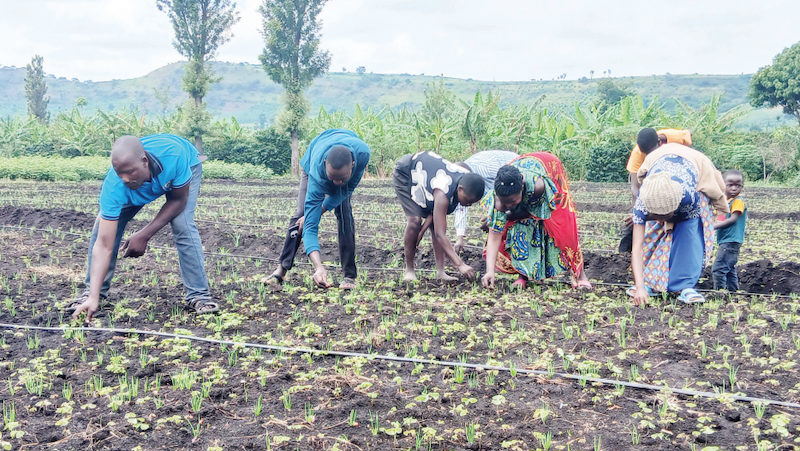
However, hope has been restored following the establishment of the Kafuro irrigation scheme in Kafuro village, Kirugu sub-county. The scheme has benefited farmers who previously relied solely on rain-fed agriculture, including Kihungye Church of Uganda.
Farmers under the scheme grow bananas, coffee, cotton, millet, and other crops, rekindling hopes of transforming livelihoods and uplifting the community. Osbadest Kanyesigye, a priest at Kihungye, said life in the area has been difficult due to water scarcity, noting that the nearest water source is too deep for children and the elderly to access safely.
“There are crocodiles in Lake Kyamwiga, so one has to be very careful when drawing water. I could not send my children to fetch water for fear of their lives,” he said.
The priest is among the beneficiaries of the irrigation scheme, part of which runs through church land. Driven by the long-held ambition to establish a Church of Uganda primary school in the area, the church—together with its congregation—has started growing watermelons, tomatoes, and coffee.
“The church aims to raise Shs 20 million from agricultural produce within the next two years to start a school. We also plan to renovate the lay leaders’ house, buy chairs and improve the church structure,” he said.
The church is currently preparing a four-acre piece of land to establish a banana plantation aimed at increasing its income. With weekly earnings of less than Shs 300,000, church leaders say agriculture has become a viable way to supplement income and meet development goals.
David Kisembo, a coffee farmer and owner of a coffee wet mill, said water shortages had previously affected both his plantation and processing operations.
“I used about 5,000 litres of water daily at the wet mill and on the coffee farm, which cost me Shs 30,000. With the irrigation scheme in place, I no longer incur this cost and instead save money to pay my children’s school fees,” he said.
Given the benefits, Kisembo believes the irrigation scheme is transforming farmers’ lives by providing reliable access to water and enabling them to pursue long-term ambitions.
“With this project, I aim to raise Shs 60 million to establish coffee solar dryers and storage facilities within the next two coffee seasons,” he said.
Adrine Kyotungire, another beneficiary, said the scheme has enabled her to plant crops throughout the year.
“I can now grow onions at any time of the season. My long-term goal is to raise Shs 1.5 million to start a poultry farm,” she said, adding that she has already purchased a plot of land worth Shs 3 million at the trading centre.
Previously, Kyotungire relied on water from Lake Kyamwiga, a process she described as costly and exhausting.
“Fetching water during the dry season cost me about Shs 600,000 per season to irrigate a small vegetable plot. Now I save that money for other needs,” she said.
However, she cited poor road networks—especially during the rainy season—and limited markets for agricultural produce as major challenges, calling on government to expedite trade agreements that would open up markets for farmers.
Benon Twinamasiko, another farmer, said he previously spent up to Shs 700,000 per season fetching water to irrigate his crops.
“Thanks to the free government irrigation scheme, I now save that money and spend it on other necessities,” he said.
geofreyserugo1992@gmail.com
About the Author