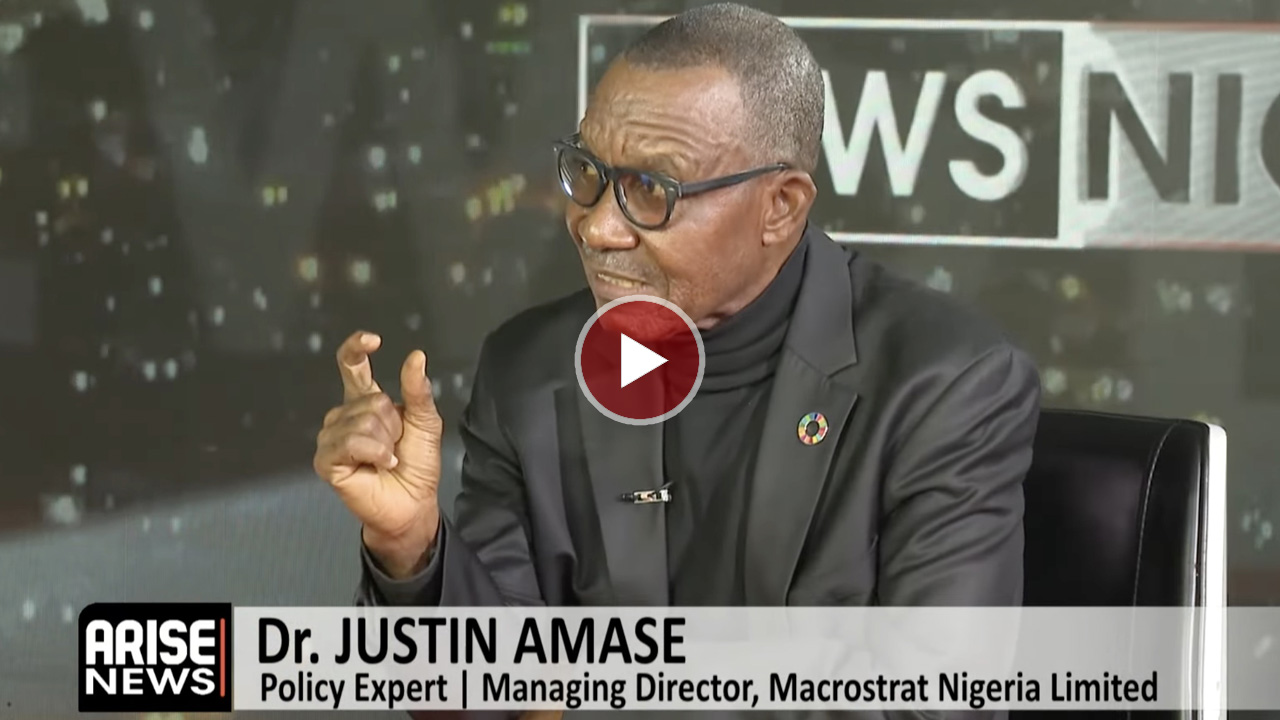

Policy expert and Managing Director of Macrostrat Nigeria Limited, Dr. Justin Amase, has cautioned that Nigeria’s reported decline in headline inflation does not yet reflect real improvements in living standards, describing the latest figures as largely driven by statistical adjustments rather than tangible price reductions.
Speaking in an interview with Arise News on Friday, Amase explained that the drop in headline inflation to 15.15 per cent in December 2025 from 17.33 per cent previously was primarily the outcome of changes in calculation methodology by the National Bureau of Statistics (NBS), rather than a sudden easing of economic pressures on households.
“The impact is really not felt yet on the common man,” Amase said. “What the numbers are showing is that, yes, there is disinflation — in other words, inflation is moderating — largely as a result of stability in some of the core drivers, especially the exchange rate.”
He traced the development to the rebasing exercise carried out earlier in 2025, noting that it initially produced a sharp statistical decline in inflation.
“You remember that in January 2025, that was the major inflation rebasing exercise in Nigeria. The exercise resulted in a sudden 10 per cent drop in headline inflation, and that trend continued because that drop was essentially a product of the new statistical methodology for calculating inflation,” he said.
According to Amase, the rebasing altered the consumer basket, expanded its components and adjusted item weights, but also introduced distortions.
“It changed the basket, increased the basket, and changed the weight for each of the items in the basket. All of that brought about a sudden drop,” he explained.
He said inflation figures reported between January and November were heavily influenced by a base-year effect that failed to reflect actual market conditions.
“Those figures were disconnected from the reality of prices in the marketplace. The methodology used a monthly base for year-on-year calculation rather than a 12-month base,” Amase said.
He disclosed that if the same method had been sustained in December, inflation would have spiked sharply.
“If they sustained that method of calculation, inflation in December would have been about 32 per cent, which would have been totally disconnected from the flow,” he said.
To correct this, Amase said the NBS carried out another adjustment in December to align inflation calculations with international best practice.
“They realigned the base year to 2024, adopted a 12-month inflation calculation period and allocated 100 as the base index. That changed the inflation numbers right from January to November,” he explained.
He noted that the January 2025 inflation figure was revised upward after the adjustment.
“As of January 2025, the headline inflation was 24.48 per cent, but after this new adjustment in December, it changed to 27.33 per cent,” he said.
Amase said the purpose of rebasing was not political optics but to better capture changes in consumption patterns.
“Globally, after some years, inflation is rebased for each country. The purpose is to capture economic activities that were not captured in the existing calculation,” he said.
“In Nigeria, consumption patterns have changed significantly from 2009 to today. People now spend more on data, fintech services and ICT. These were not reflected in the original methodology, so policy could not be effective,” he added.
However, he criticised the initial rebasing approach adopted earlier in the year.
“The methodology adopted in January did not reflect international best practice, especially in the choice of the base year for year-on-year inflation. That made it necessary to adjust again,” Amase said.
He said the revised method now presents a more realistic picture of inflation trends.
“This new methodology shows that inflation has been declining gradually, unlike what the old methodology suggested,” he said.
Despite the apparent moderation, Amase stressed that Nigerians were yet to feel relief because prices had stabilised at much higher levels.
“After the reforms, stability was achieved, but at higher price levels,” he said. “The exchange rate stabilised, but instead of ₦451 to the dollar as of May 2023, it is now hovering around ₦1,400 to ₦1,500.”
On Nigeria’s removal from a high-risk financial monitoring list, Amase said the country was previously flagged due to illicit financial flows and terrorism financing concerns.
“There were issues of illicit financial flows, and the issue of people funding Boko Haram and other outfits that drive insecurity,” he said.
According to him, recent government actions have helped address those concerns.
“The present government has addressed quite a number of them. The war on those funding Boko Haram has been stepped up, and the fight against illicit financial flows has also been intensified,” Amase said.
He concluded that while inflation data may now be statistically cleaner, meaningful relief for Nigerians would depend on sustained price reductions, income growth and deeper structural reforms.
Boluwatife Enome
About the Author