Justice Egwuatu Recuses Himself from Malami Forfeiture, Money Laundering Cases
Proceedings in the high-profile cases involving former Attorney-General of the Federation, Abubakar Malami, were stalled on Thursday after the presiding judge stepped down. Justice Obiora Egwuatu of the Federal High Court, Abuja, announced his withdrawal from the two matters filed by the Economic and Financial Crimes Commission (EFCC), citing personal reasons and the interest of …
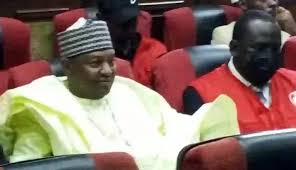
Proceedings in the high-profile cases involving former Attorney-General of the Federation, Abubakar Malami, were stalled on Thursday after the presiding judge stepped down.
Justice Obiora Egwuatu of the Federal High Court, Abuja, announced his withdrawal from the two matters filed by the Economic and Financial Crimes Commission (EFCC), citing personal reasons and the interest of justice.
The cases, recently reassigned to him by Chief Judge John Tsoho, concern the interim forfeiture of 57 landed properties valued at N212.8 billion allegedly connected to Malami, as well as an N8.7 billion money laundering charge filed against the former minister, his wife Asabe Bashir, and their son Abdulaziz Malami.
When the matter came up on Thursday, EFCC counsel, Ekele Iheanacho, informed the court that the defence had written to request an adjournment. According to him, Malami’s lawyer, Joseph Daudu (SAN), sought to move the hearing to 16 February to enable him attend proceedings at the Court of Appeal in a separate case.
Following the announcement, Justice Egwuatu declared that he would no longer handle the matters.
“For personal reasons and in the interest of justice, I recuse myself from this case and the related matter”, the judge stated, directing that the case files be returned to the Chief Judge for reassignment.
The proceedings were originally before Justice Emeka Nwite, who served as vacation judge over the Christmas and New Year period. On 6 January, Justice Nwite granted an interim forfeiture order transferring the 57 properties to the Federal Government after the EFCC argued that they were suspected proceeds of unlawful activities.
The order was made pending any challenge by individuals who may claim lawful ownership, after which the court would decide whether to make the forfeiture permanent.
Malami has since opposed the EFCC’s application for final forfeiture. In a motion dated 27 January and filed by his legal team led by Mr Daudu, he contended that the anti-graft agency obtained the interim order by withholding material facts and making misrepresentations to the court.
He also warned against what he described as the risk of “duplicative litigation” and “conflicting decisions”, maintaining that the action violates his constitutional rights, including his right to property, presumption of innocence, and protection of family life.
With Justice Egwuatu’s withdrawal, the cases will now be reassigned for further proceedings.
About the Author