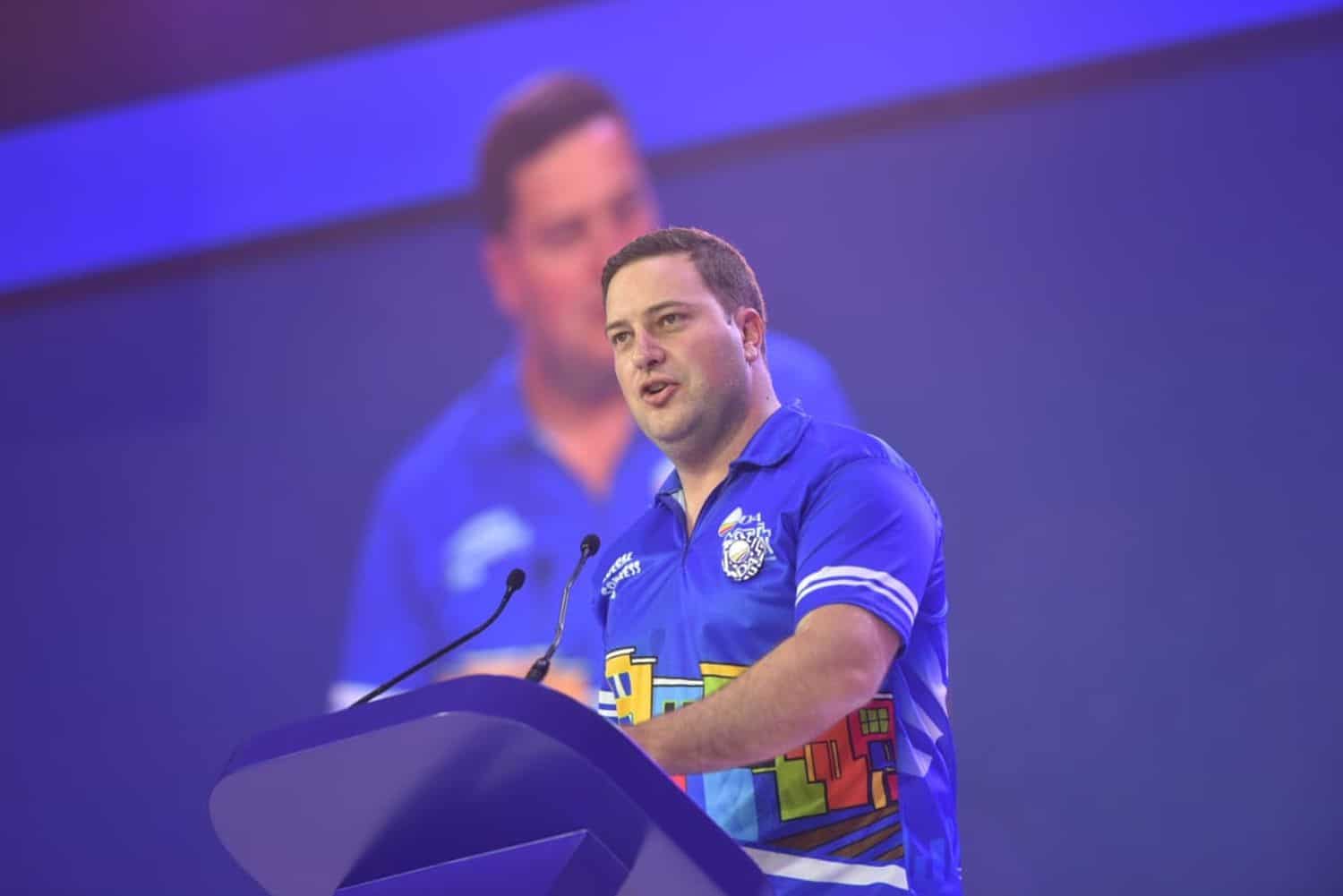
Geordin Hill-Lewis has been elected as the DA federal leader at the party’s federal congress in Johannesburg.
The announcement was made at the DA’s federal congress currently underway at Gallagher Estate in Midrand, north of Johannesburg, on Sunday, 12 April 2026.
The election of the federal leader was declared free and fair by the DA.
Hill-Lewis is the current mayor of Cape Town and succeeds former party leader John Steenhuisen, who has been credited with growing the party’s popularity and ushering it into power through the government of national unity (GNU).
Growing the DA
On Saturday, Steenhuisen told delegates at the congress that he plans to grow the party, further reaching out to communities that still do not trust it but are drawn to it.
“Our mission is to build the DA into the biggest party in South Africa, that is the prize before us, not victory for its own sake, and not power as an end in itself. But growth with a purpose and strength in the service of our beautiful country.
“A party strong enough to shape the future of South Africa in line with our values, but friends, if we are to be that party, then the DA must offer South Africa more than competence alone.
“Of course, competence matters a great deal, and it is our greatest strength but on its own it cannot be enough. South Africa is, of course, hungry for a party that can govern and fix our towns and cities, but it is also hungry for a party that understands what life is like for ordinary people struggling to get by.
“A party that listens, shows up and takes people seriously so the DA must combine competence with humility, principle with humanity and discipline with warmth. That is the kind of politics I believe in and the kind of politics I believe South Africa is looking for,” he said.
New DA leader
The Citizen recently spoke to Theo Neethling, a research fellow in political studies and governance at the University of Free State (UFS), about the challenges Hill-Lewis will face as he takes over his new role.
“First, he will have to address racial and voter perceptions, as the DA struggles to expand its support base beyond minority groups. In addition, the growing reality of coalition politics requires pragmatism, strategic thinking, and strong negotiation skills.
“A further challenge will be to find a balance between liberal principles and more popular policy approaches to garner broader support.
“He will also have to strengthen internal party unity after previous divisions while at the same time promoting the party’s geographical expansion beyond the Western Cape, particularly in provinces such as Gauteng and KwaZulu-Natal,” he said.
Taking the DA forward
Neethling said he believes Hill-Lewis is able to strengthen internal unity and grow the party.
“Especially if he can combine service delivery, coalition skills, and an inclusive political style,” he said.
Hill-Lewis’s predecessor, John Steenhuisen, told delegates at the congress on Saturday that when he took over the DA in 2019, an impression had been created that the DA was dying.
“The party I inherited in 2019 was on its knees, polling at 16 per cent, divided, and riven by a crisis of confidence.
“The media confidently proclaimed the death of the DA. But, together, the people in this room refused to accept decline as our destiny,” he said.
Steenhuisen future
Steenhuisen said he leaves the DA in a better position than he found it. He said he will now focus on his ministry in government while supporting the party’s new leaders.
“Not only are we now routinely polling close to 30 per cent. But, for the first time in the history of our party, the DA now co-governs the Republic of South Africa.”
“That is what we pledged to the people of South Africa at our last Congress, and That is exactly what we delivered,” he said.
NOW READ:Hill-Lewis’ rise through the DA ranks | The Citizen