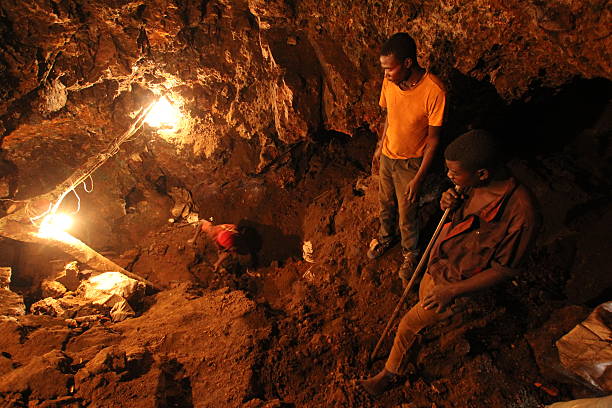
"Mwinilunga, Zambia - December 6th, 2012: Three young African miners work in an underground mine and dig for reseources."
Members of Parliament (MPs) have criticised the National Joint Operational and Intelligence Structure (Natjoints) for weak attempts to combat illegal mining in South Africa.
Natjoints is made up of the South African Police Services (Saps), the South African National Defence Force (SANDF) and the State Security Agency (SSA).
Tuesday’s meeting, led by chairperson Mikateko Mahlaule, heard a presentation by the police’s Major General Nonhlanhla Zulu on the state of illegal mining.
Despite continuous efforts made towards eliminating zama zamas in certain areas, MP James Lorimer said that the structure’s latest report was “disappointing”.
He said that he brought the topic of illegal mining to the committee 12 years ago “and in that time, I cannot say the situation has improved. It seems to have got worse.”
READ MORE: Sona: South Africa needs results, not promises
State of illegal mining in South Africa
The ever-present issue flared up again recently when residents in Payneville, Springs, went on a gold rush at a cattle kraal.
These activities were condemned by the Department of Mineral and Petroleum Resources (DMPR), which emphasised that mining activity should not be conducted without the required permits or mining rights.
It said unregulated digging causes ground instability, which poses a risk to residents nearby and children who play in the area.
Ekapa Mine being drained
The minister of Mineral and Petroleum Resources, Gwede Mantashe, also provided an update on the state of the Ekapa mine in Kimberley, following a mudslide that occurred while illegal miners were digging underground.
Mantashe said that a sudden flow of mud, moving at neck-breaking speed, had buried more than five people.
“Up to yesterday [Monday], a lot of water has been drained from Ekapa. Up to now, about 1 000 cubic meters of water have been drained.
“Today, the mud is being dug out to retrieve the corpses from underground,” he said
Mantashe said that the incident that occurred at the Ekapa mine is different from the Lily mine tragedy, and explained the process of the bodies’ removal from the location.
At the Lily mine in Barberton, the remains of bodies (Pretty Nkambule, Yvonne Mnisi, and Solomon Nyirenda) are trapped underground in a shipping container, almost 10 years after the mine’s collapse.
Mantashe plans to visit the Ekapa site again on Friday and has assumed the presumption of death, “because there’s no likelihood that after all these days, there would still be life after a mud rush.”
‘We want the big guns to be drawn in now’
MP Elsabe Ntlangwini highlighted the issue of kingpins and cartels that fund illegal mining operations.
“We got this presentation last year, and it seems, yet again, within this presentation, not much is being done to move into the kingpins who are selling these diamonds, golds and minerals.”
“We want the big guns to be drawn in now.”
She stressed that, “somewhere, somehow these minerals are making their way into the markets and there are not enough activities to curb that. Because, to just say you’re gonna go and arrest some illegal miner there, that is just a small scale.”
“It’s been years that people have been illegally mining our minerals, and nothing is being done. We get away with just arresting five small people, and then we make a whole TV movie out of it. [Meanwhile], the big guns get away.”
“We have yet to see police arresting big, illegal mining cartels that are doing these activities…that are fully funded. We ought to move in on the arrest.” Ntlangwini says.
Traditional Leaders
James also stressed the arrest of traditional leaders and pointed out that they are giving unlawful diggers permission to mine in communities without permits. This is another contributing factor to illegal mining in South Africa.
James mentioned that “it strikes him as unfair” that traditional leaders in communities just get “a lecture,” versus an ordinary man from Barberton who decides to dig with a pick and a wheelbarrow, would immediately be arrested for illegal mining.
“For how many years have we been lecturing traditional leaders, and can you tell me whether any of them has been arrested and prosecuted for giving permission for illegal mining?”
Suggesting that the system is flawed, “it seems ignorance of the law is no excuse unless you are a traditional leader. This looks like a two-tier system of justice, and I don’t find it acceptable.”
“Why did project Vala Umgodi end?”
“Why did project Vala Umgodi end?” Lorimer asked.
Operation Vala Umgodi was a prevention program conducted by NATJOINTS in December 2023 and was “demobilised” around October 2025 due to a lack of resources to sustain it.
James noted that the operation ended during a spike in illegal mining, which sounded like “a ridiculous decision,” and said that “there seems to be a great deal of foot-dragging on this.”
This was after a gunfight took place in Riverlea related to zama zama syndicates in the area. He emphasised that the main problem is that “there are no metrics or indication of any kind of success that has been achieved against illegal mining.”
“I think this denotes a lack of seriousness on the part of the police, and the department and a deal on the part of the committee.”
Major General Zulu had clarified that, despite this, Vala Umgodi was successful at destabilising illegal mining, which was the goal, though not long-term.
‘Just doing things without much success’
He says a lot of the report is just about “just doing things without much success.”
Lorimer referred to the Back to Basics Programme, which is a national strategy that was launched in 2014, aimed at prioritising five core pillars of focus to ensure basic services are delivered.
“With respect, basics are not what we need to cover. We need specialist skills.”
Lorimer recommended that a detailed report with the number of arrests, prosecutions and convictions should be released so that one can keep track of the actual progress being made in these operations.
Those categories covered, along with the five identified levels of illegal miners, starting with “the foot soldiers at the face, and ending with international traders.”
“I think we need that information. Because only by looking at things like that, will we be able to work out whether or not we are winning this battle.”
“We also need some indication of the materials recovered, and the value and number of machines ceased.”
He says we can only see how much has actually been done once the numbers of arrests have been released to determine the success of efforts to combat illegal mining. The results will determine the plan of action forward.
“I know steps have been taken notably during Vala Umgodi, but even that was not sufficient.”
Lack of equipment and resources
Ntlangwini had brought up another issue around how ineffective the police were after clearing illegal miners from the area.
The machinery would remain on site, and the next day, when authorities are no longer present, the unlawful miners would return and continue the job.
She mentioned that reports revealed that the government does not have the proper equipment to remove big machines to storage facilities to prevent them from returning.
“How will the government improve that?”
“Closing mines are simply not enough because the mine continues to operate once inspectors leave,” she says.
Major General Nonhlanhla Zulu responded to Ntlangwini by reassuring her that there are places to store the equipment and that additional machinery assistance is resourced from bigger operational mines nearby.
“The only problem that we are experiencing is the removal of heavy machinery.”
Specialised Police Training
James questioned the expertise of police officers in situations where specialised mining knowledge is required, “Consider that you are a police officer and you stop a truck next to the road loaded with mining material. How do you know what that is unless you have specialist skills?”
He asked why there has been no consideration for a permanent specialist police unit that would have the “knowledge” and “the firepower” to deal with illegal mining. Emphasising that it is key to be able to do something about the issue of illegal mining. He said that the tracking technological tool that they plan to use is “still in development,” over two years later.
He asked, “How long would it take to develop, and when will it be used?”
To which, Zulu said once the tracking tool has been developed, it will be shared with the relevant government departments, including Saps,” for better coordination”.
Workshops
In response to police specialisation, Zulu says, “We’ll be conducting workshops on illegal mining. I understand the fact that the police must be trained.”
Zulu also said that, so far, the provinces of Limpopo, the Northern Cape, North West, KwaZulu-Natal, the Free State, and Mpumalanga have already received training.
More workshops have been planned for 2026 to 2027 to train traditional leaders on land ownership and mining rights.
ALSO READ: From feared apartheid force to crime-fighter: Ramaphosa sends SANDF to tackle gangs, illegal mining
About the Author