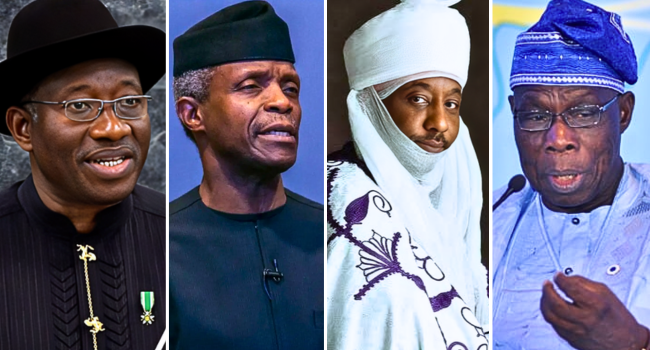
Former leaders and prominent figures, including ex-President Goodluck Jonathan, former President Olusegun Obasanjo, the Emir of Kano, Sanusi Lamido, and other advocates for youth leadership, have called on African nations to prioritize young people for top governance roles.
They emphasized that the energy, mental agility, and resilience of youth make them particularly suited to navigate the challenges of leadership.
The call was made on Thursday during a memorial lecture and leadership conference organized by the Murtala Muhammed Foundation, commemorating the 50th anniversary of the assassination of the late Head of State, General Murtala Muhammed.
Leading the discourse, Jonathan urged African nations to consider individuals aged 25 to 50 for senior political positions, citing their superior physical strength, sharpness of mind, and ability to withstand the rigors of leadership. He highlighted Nigeria’s “Not Too Young to Run” reforms and called for further reductions in age barriers for political office.
“The leader we are celebrating today became head of state at just 38. Obasanjo was also around 38 when he assumed office. And looking at the youth corps—a legacy of General Yakubu Gowon—it was created at age 32. So why should we believe that one must be in their 100s to lead a country?” Jonathan remarked.
Reflecting on leadership succession in Africa, Obasanjo praised General Murtala Muhammed for creating a capable successor, while acknowledging a persistent challenge: the inability of subsequent leaders, including himself, to cultivate enduring successors.
Ex-Vice President Yemi Osinbajo addressed the event on leadership values and Africa’s rising influence globally. He stated that true maturity is not measured by perfection or the absence of challenges, but by self-awareness, confidence of purpose, and the capacity to shape one’s destiny.
“If coming of age means self-awareness and the ability to chart your course, then Africa is no longer an emerging continent; it is in its moment,” Osinbajo said.
The Emir of Kano, Sanusi Lamido, stressed the urgency of restoring Africa’s dignity and pride:
“We need to ask ourselves: where have we lost our dignity, and how do we reclaim it? The day Africans can hold their heads high, as we did in 1975 and 1976, as equal human beings among nations, that day we will have truly come of age.”
Secretary to the Federation, George Akume, echoed the sentiment, emphasizing that leadership is determined not by age but by the quality of ideas, acknowledging the critical role of young people.
Other speakers underscored the importance of regional cooperation and strengthening democratic institutions to ensure sustainable and effective leadership across Africa.
About the Author