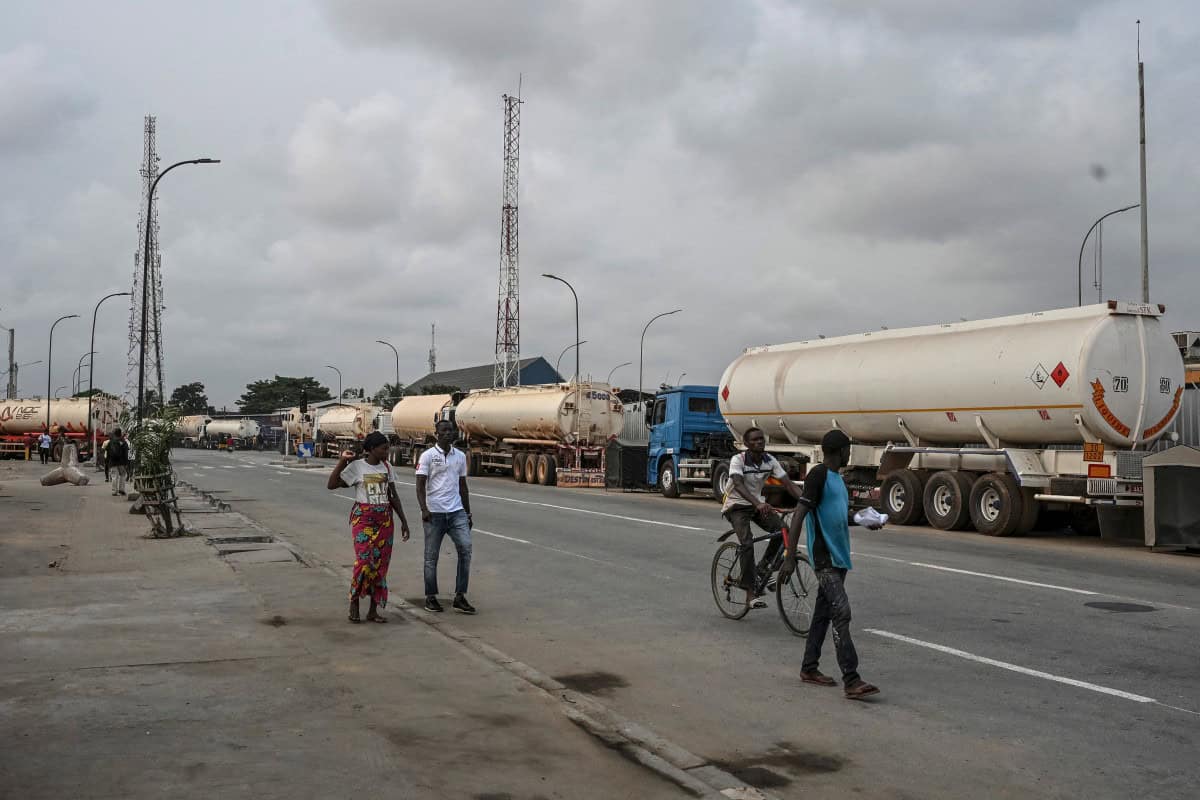
Malian tanker trucks wait to load fuel in the front of the Ivorian Refining Company (SIR) in Abidjan on January 15, 2026. (Photo by Issouf SANOGO / AFP)
Jihadists killed at least 15 drivers in an attack on a fuel tanker convoy last week in Mali, local sources told AFP Monday, amid a months-long fuel blockade that had recently died down.
The attack took place Thursday on a road leading from the Senegalese border to the major city of Kayes in western Mali, with local officials reporting dozens of tankers destroyed.
According to a local radio host in the town of Diboli, “15 drivers’ bodies” were counted on the ground next to the burned trucks, while a security official told AFP that “according to our information, there are 18 victims in total”.
The bodies were “abandoned on the ground next to burned out tanks”, the radio host said, adding that “the smell of the bodies’ putrefaction brought the villagers out to go and see. They were interred on the spot”.
Jihadists from the Al-Qaeda-affiliated Group for the Support of Islam and Muslims (JNIM) said in a statement that they had ambushed the Malian army Thursday between Diboli and Kayes, without mentioning the attack on the fuel tankers.
According to the security source, “JNIM fighters stopped (the drivers) before executing them blindfolded”, chastising them for bringing fuel to the capital Bamako despite the blockade.
ALSO READ: Experts say Mali jihadist attack highlights risk of expansion
The source added that the jihadists “formally banned touching the corpses, abandoning them on the roadside”.
During a meeting over the weekend with authorities, drivers demanded that the army recover the bodies.
The road from Senegal is not widely used for fuel transport, and military escorts for tankers on it had been suspended, with resources redirected to protect supplies mainly coming from Ivory Coast.
A member of the Malian Council of Shippers, CMC, said however that “we already had a significant stock of fuel at the port of Dakar which started to create a crisis between Mali and Senegal”.
“The warehouses in Senegal pressured us to move our products,” the member added.
Since September, JNIM has carried out a series of attacks on tankers as it waged a fuel blockade meant to cause shortages and strangle the landlocked country’s economy.
ALSO READ: Mali army says situation ‘under control’ after ‘terrorist attack’
However, the attacks have decreased in intensity in recent weeks and the latest assault marks the first of its size since early December.
By additionally imposing a total blockade on several Malian cities, JNIM was able to cripple Mali’s economy, including in Bamako.
Fuel supplies have improved significantly in the capital since last month, helping the economy to recover.
Impoverished Mali has been gripped by a security crisis since 2012, fuelled notably by violence from groups affiliated with Al-Qaeda and the Islamic State group, as well as criminal gangs.
The junta, which seized power in back-to-back coups in 2020 and 2021, had promised to stem the jihadist insurgency but has achieved little success.
About the Author