As soon as one reaches Yumbe district in West Nile, sounds of construction fill the air, a chorus of hope and determination.
Heavy machinery rumbles, and workers are seen in hard hats, diligently laying the groundwork for a project that promises to weave a stronger fabric of community and opportunity in a region that has been profoundly impacted by displacement.
The Project for the Improvement of National Road in Refugee-Hosting Areas of West Nile, funded by the support of the Government of Japan via the Japan International Cooperation Agency (JICA) Uganda, is not just about upgrading a road.
It is about transforming lives and promoting co-existence among refugees and the host community. The project kicked off in February 2021, with plans to upgrade an 11.54 km stretch of the Class B National Road from Yumbe Junction to Ure Bridge, construct the new Koro Bridge, and enhance a 2 km section of the Yumbe-Barakala-Bidibidi road using Labor-Based Technology (LBT).
For a region teeming with both refugees and host communities, this project promises to make transportation easier and open doors to economic prosperity. As of December 2025, the construction has reached about 21.03% completion.
Watching the progress unfold brings smiles to faces that have weathered storms of uncertainty. With the contractor already casting the foundation for the Koro Bridge and embarking on road construction, there is a palpable sense of anticipation in the air. The project will be completed on 30 December 2027 and handed over to the community.
“The beauty of Yumbe after two years will be different from the rest of the parts of West Nile. We are grateful to JICA, government of Japan and the Works and Transport ministry for this road and we shall be glad if the government of Uganda makes some extension,” Gule Ismael, a resident shared with the minister for Works and Transport, Hon. Gen. Katumba Wamala, who responded positively, leaving the crowd hopeful.
EMPLOYMENT AND EMPOWERMENT
What makes this project particularly special is its commitment to local employment. At the heart of its construction is the use of Labor-Based Technology, which prioritizes the skills and labor of the local population instead of heavy machinery.
This means jobs, dignity, and hope for many. Over 100 labourers, consisting of 74 men and 29 women, have been recruited.
“This means that women will have some money in their pockets to sustain their families,” explained Eng. Ssesanga Paul, Principal Executive Engineer, Roads, and Bridges in MoWT.
He added that the project will let this group make a 2km feeder road using local equipment and the road will have a single layer. This will not only let them experience first hand how roads are made but also equip them with skills that will benefit them in many ways.
The project aligns with Uganda’s refugee policy framework, which strives for self-reliance rather than reliance on humanitarian aid. Here, refugees are not just passive recipients of assistance; they are active participants in the community’s resurgence.
By equipping individuals with practical skills that extend beyond the project’s lifecycle, the LBT component nurtures empowerment. A unique aspect of this project is the committee formed to oversee its implementation.
Comprising representatives from MoWT, the Office of the Prime Minister (OPM), the United Nations High Commissioner for Refugees (UNHCR), and local leaders from Yumbe District, Ssesanga shared that this group ensures that the voices of the community are heard in decision-making.
Their role region is crucial in matters such as selecting LBT workers and determining fair wages. The project is more than just a series of construction projects. It has collaboration at the centre.
The Ambassador of Japan to Uganda, Sasayama Takuya mentioned that the Government of Japan is not merely investing in roads in the country but is supporting sustainability and growth.
Imagine a bustling marketplace where goods flow freely, where the sounds of laughter and commerce echo as farmers deliver their produce and traders transport their goods. This is the future that is slowly taking shape in the West Nile region.
THE JOINT INSPECTION OF THE PROJECT
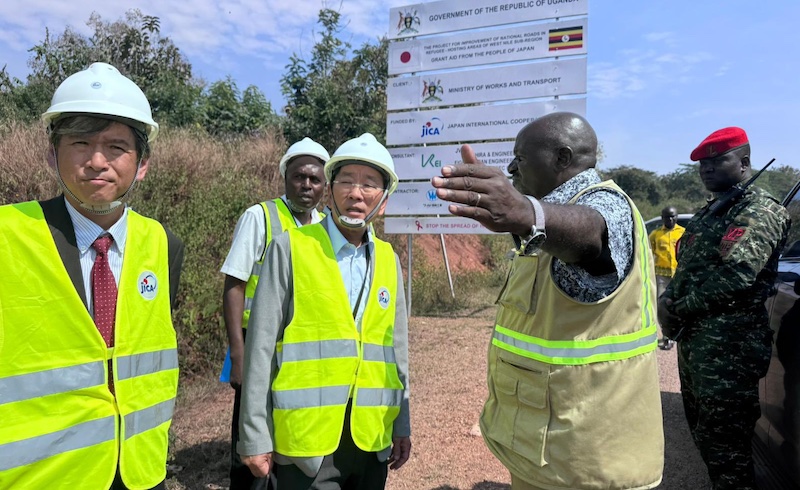
On December 16, 2025, a joint inspection occurred at the project site. A team from the ministry of Works and Transport led by the minister Gen Katumba Wamala as well as that from JICA in the company of the Ambassador of Japan to Uganda, the JICA Chief Representative Inoue Yoichi and Yumbe district leadership reflected on the project, and appreciated the strides made thus far.
Community members, alongside stakeholders gathered to witness progress and renew their commitment to the journey ahead. Inoue emphasized that this project is not just building infrastructure but bringing about understanding and unity between refugees and host communities.
As the road stretches ahead, lives will be transformed through employment, skill acquisition, and community solidarity.
“Projects like this remind us that even amid challenges, there are opportunities to foster growth, connect people, and ultimately pave the way for a brighter future, for refugees and all Ugandans,” a local intimated, adding that absence of a bridge has made visiting relatives in neighbouring villages and transporting produce difficult. He believes that the new Koro bridge under construction will reunite families.
About the Author