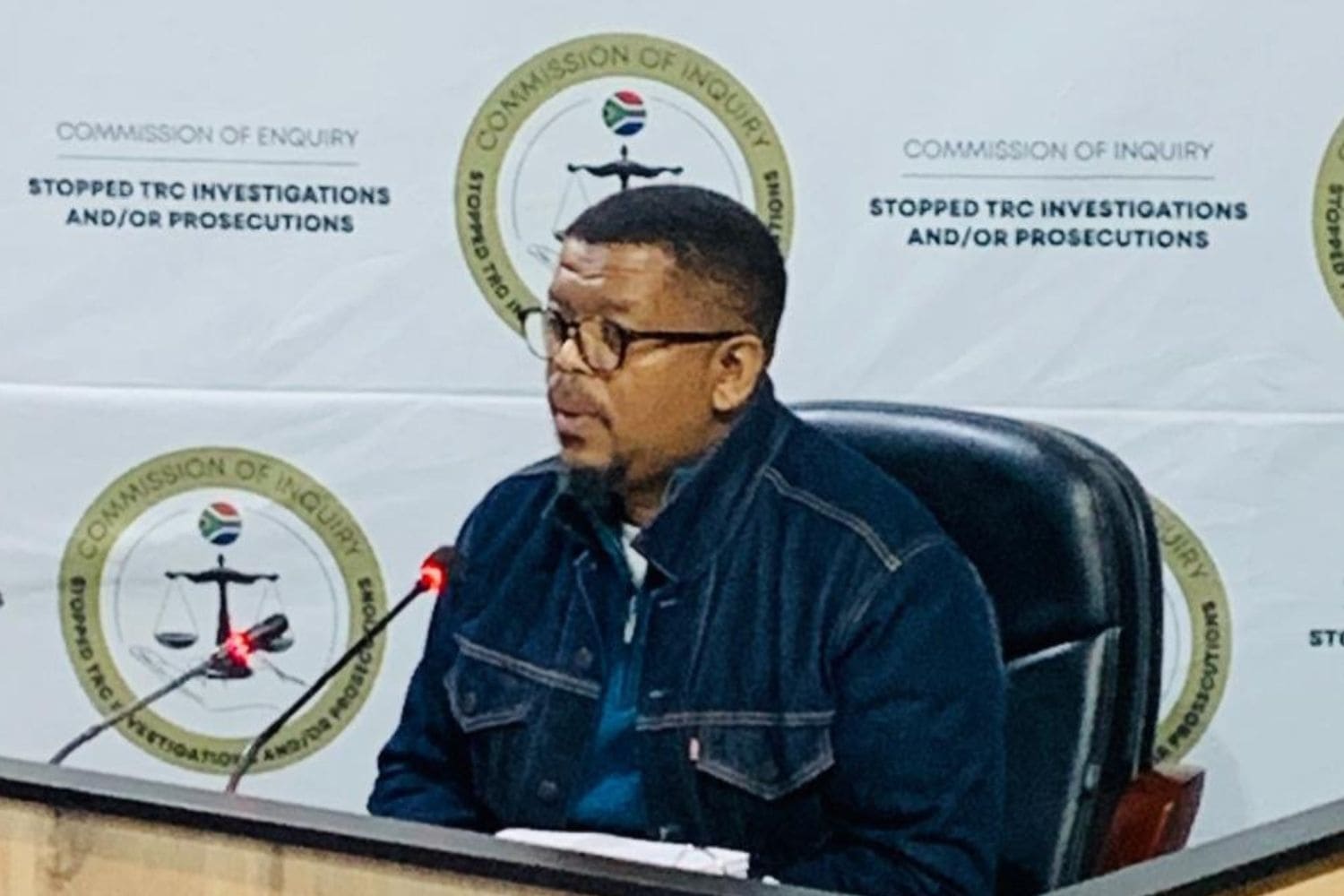
The son of Fort Calata, one of the Cradock 4 anti-apartheid activists killed by the security police in June 1985, says it was expected that President Cyril Ramaphosa and his ministers would seek to prevent evidence being provided to the Judicial Commission of Inquiry into alleged political interference in Truth and Reconciliation Commission (TRC) cases.
On Monday, Fort Calata’s son, Lukhanya Calata, continued his testimony at the inquiry to determine whether attempts were made to prevent the investigation and prosecution of apartheid-era crimes.
The inquiry is being chaired by retired Constitutional Court Judge Sisi Khampepe.
TRC inquiry evidence
Lukhanya denied that no actual evidence was presented to the inquiry into alleged political interference in TRC cases.
“We expected them, because it’s not as if they would openly admit that this is, in fact, what they have done.
“It’s sad that they are still not listening to us. They’re still not taking us seriously. They still choose to disrespect this commission. This is decades of work that we have put in trying to have [this case] heard,” Calata said.
ALSO READ: TRC inquiry set to begin after Zuma and Mbeki fail to recuse Khampepe
Justice for Fort Calata
Lukhanya said he is still seeking justice for his father after 41 years.
Fort Calata was killed by the security police in June 1985.
“The fact that, as I’m sitting here in front of you, commissioners, there’s still no justice for my father or for any of them. How do we explain that my rights to dignity, my rights to justice, are being violated as I sit here with you right now? How do we explain that? And then the only thing the politician says is, ‘well, you don’t have evidence’.
“We have this commission of inquiry that only came about because we had to take the very difficult decision to sue our government because our government was not listening to us. We had written letters to President Ramaphosa, begging him for meetings to try to have a civilised conversation,” Lukhanya said.
‘Active citizenry’
He said the ANC at one time used to talk about “active citizenry”.
“How more active citizens could we become by writing letters, petitioning our leaders, asking for meetings, begging for their time to be heard, begging our government to do the right thing? What is it that they want from us?”
Lukhanya said he is still struggling to come to terms with his father’s death.
“I’ve got a hole in my soul, the hole can only exist because my father was ripped away from me. He was taken from me when I was a little boy, and I don’t have peace. I do not have closure,” said Lukhanya.
“I’ve mentioned to this commission, to you commissioners, some of the issues that I deal with on a personal basis because of my lack of having a father of my father being in my life. This isn’t child’s play for me.
“It’s not something that I can forget, because every time somebody says Mr Calata, that reminds me of my father. Every time somebody calls me by my name, it reminds me of my father. Every day we live with this thing, every day.
ALSO READ: ‘We await legal advice’ – Zuma considers appeal over Khampepe ruling in TRC inquiry
Court
Lukhanya accused Ramaphosa of setting up the TRC inquiry to prevent his political fallout.
“The president didn’t want to hear us. So then we had to take the very difficult decision to go to court, and only once we went to court [did he set up the inquiry], and I suppose he was trying to minimise the fallout politically, where he is seen to be fighting or against the interests of families such as ours.
“He finally agrees to do so only when we go to court, I suppose to spare himself the embarrassment of having to be ordered by a court to set up a commission that would investigate why several administrations of the African National Congress had failed to do right by the families of people who died, advancing the interests not just of the of the African National Congress itself, but of the interest of this country of ours,” he said.
Lukhanya concluded his testimony.
On Tuesday, Yasmin Sooka, the former commissioner of the Truth and Reconciliation Commission, will be testifying.
Khampepe Inquiry
Ramaphosa appointed Justice Khampepe last year to chair a judicial commission of inquiry to determine whether attempts were made to prevent the investigation and prosecution of apartheid-era crimes.
This, after the 23 families sued him for R167 million in damages over extensive delays in prosecuting apartheid-era crimes recommended by the TRC.
Calata added that this is the only country the families of struggle stalwarts have.
“I don’t qualify for an American passport, a British passport, an EU passport, or any other. I only have this country. So if I don’t work every day in the best interests of building this country in the society for which my father sacrificed his life, then why don’t we do it?”
Apology for statements about Mbeki and Zuma
Earlier, Calata apologised and retracted statements he made about politicians during his testimony at the TRC cases inquiry.
Calata slammed former presidents Thabo Mbeki and Jacob Zuma.
This despite the pair mounting a legal challenge seeking the recusal of commission chairperson, retired Justice Sisi Khampepe.
“The TRC handed over its reports. It handed those reports over to former president Thabo Mbeki, not to anyone else. It handed it over to him, as the president of this republic. What did he do about it? What did his organisation do about it? What did his government do about it?
“I despise politicians. I really do. I think they’re the scum of the earth… I’ve got no issues with political activists, because my father was a political activist.”
Recusal bid
Zuma and Mbeki failed in their attempt to recuse Khampepe from chairing the commission last month.
The two presidents have since launched another legal challenge to force the retired judge to recuse herself from chairing the commission.
READ NEXT: Inquest into 1985 disappearance and deaths of Pebco Three to begin
About the Author