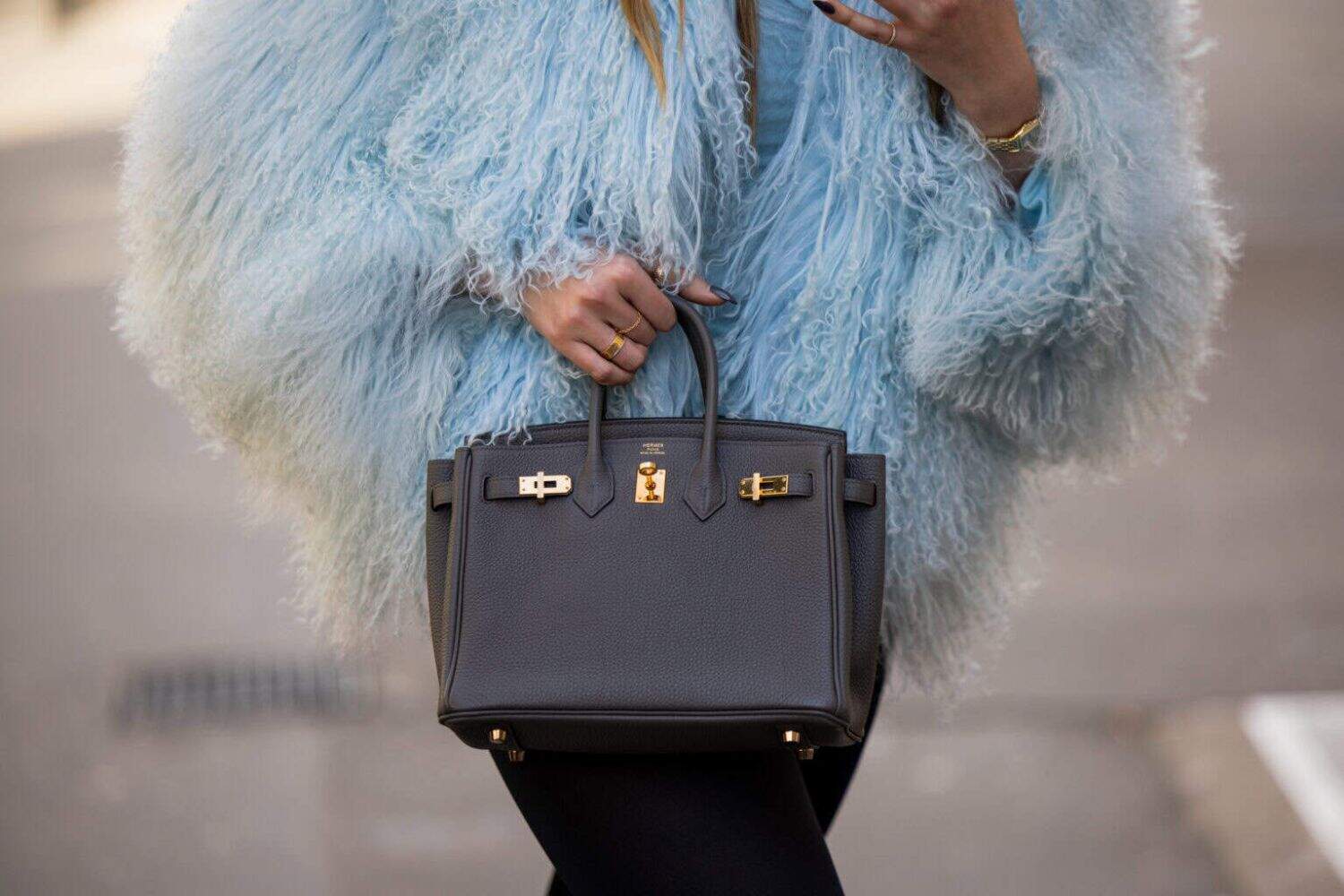
PARIS, FRANCE - MARCH 04: A guest wears grey Hermes bag outside Sacai during the Womenswear Fall/Winter 2024/2025 as part of Paris Fashion Week on March 04, 2024 in Paris, France. (Photo by Christian Vierig/Getty Images)
Forget the market, the glitter of gold bars, and the chaos of crypto; the most powerful investment of the modern days may be swinging from the arm of someone stepping out in Sandton traffic.
Some people do not see the value in buying expensive clothes because they believe it is not an investment, but that is not the case with the over R200 000 Hermès Birkin handbag.
However, not any regular person can buy the bag. Only customers with a sizeable purchase history at Hermès are offered the opportunity to buy a “quota bag,” such as a Birkin or a Kelly.
The ultra-rare Hermès Birkin, inspired by the 1960s-era French movie star Jane Birkin, could fetch twice its sticker price on the secondary market within five years, according to experts.
ALSO READ: From yachts to hearses: South Africa’s rich people are pawning luxury items
A better investment?
While markets dip and digital coins crash, the Birkin keeps climbing, driven by rarity, craftsmanship, and a global obsession that only intensifies each year.
These handbags are so rare that for an individual to get a brand-new one, they need to wait for at least two years. However, those in a hurry can buy them at pre-owned stores, making money for the previous owner.
James Firestein, founder of luxury resale and authentication platform OpenLuxury, told Fortune that the resale value of particularly the Birkin and Kelly bags over the past 10 years has outpaced gold.
“I know several instances where people have doubled their money based on buying it 10 years ago, and reselling it today in pristine condition,” he said.
The Hermès Game becomes an investment
But even Hermès’ most loyal shoppers don’t get to choose the exact Birkin model they want. The brand allows boutiques to purchase a select number of Birkins per season, and the style of the bags is rarely known ahead of time.
Firestein estimated that 75% of the people who own the bag actually use them, while the remaining 25% keep them in storage as investments.
“It’s similar to buying a Piccaso and holding it in your home, because you can look at it, you can enjoy it,” Firestein said. “But then you ship it off in a couple of years and trade it for something else.”
The value of a Hermès bag can increase dramatically over time, Firestein said, depending on its colour, material, and condition. Secondhand demand is so high partly because the resale market offers shoppers more options than the Hermès store, where customers are allowed one quota bag per year, and rarely get to choose the exact model they want.
Not just any Hermès bag
However, not just any Hermès bag an individual buys will increase dramatically over time. Firestein said the steepest price increase he has seen was a Black Togo 30 Birkin, which doubled in value over five years. But price increases can be driven by trend cycles and changing demand, so it can be a gamble.
“I wouldn’t say jump in with both feet at this point,” he said. “But if you got it in 2012, and you sold in 2019, that’s different.”
ALSO READ: Pre-owned wins as Africa’s luxury resale market continues to grow
Unlike brands owned by LVMH and Kering, which often share factories, Hermès only uses its own factories, said Firestein. Conglomerate-owned brands like Balenciaga, Gucci, and Saint Laurent also tend to use more mass-market materials that are cheaper and easier to get, Firestein explained.
“Their leather factories are only Hermès affiliates, and they only create Hermès leathers,” he said. “So you’re buying into part of that heritage, but then you’re also buying into a higher-quality material that they’ve been using for many, many years.”
Rolex over property
If you cannot get a Hermès Birkin handbag, you can get a Rolex watch, which is also seen as a better investment than property.
Michael Zahariev, co-founder of Luxity, said luxury watches are a timeless, tangible asset to one’s investment portfolio.
Imagine buying a Rolex today and three years later, it is worth more than what you paid for it. That is exactly what is happening, with resale values climbing from 87.5% in 2021 to 104.9% in 2024.
“This means they are not just holding their value but appreciating beyond their original retail price. Meanwhile, your property portfolio is probably losing value faster than you can say bond repayment.”
Be careful before investing in a watch
However, Zahariev warns that not every shiny watch is a golden ticket. “Success in this space is not about luck but about knowledge. You must understand the brands, the specific models and what the market is looking for.”
These are Zahariev’s golden rules for aspiring watch investors:
- Stick to the titans: Focus on the “blue-chip” brands known for holding and increasing their value, such as Rolex, Patek Philippe and Audemars Piguet. Even within these brands, certain models (like a Rolex “Hulk” Submariner or a Patek Philippe Nautilus) are the true superstars.
- Think in years, not months: To see significant appreciation, plan to hold onto your timepiece for at least three to five years.
- Authenticity is everything: The market is flooded with fakes. Always buy from a reputable dealer who can provide authentication and papers. Your watch’s authenticity is a key part of its value.
NOW READ: Are Hermès, Louis Vuitton, and Gucci made in China? How to tell real luxury from fakes
About the Author