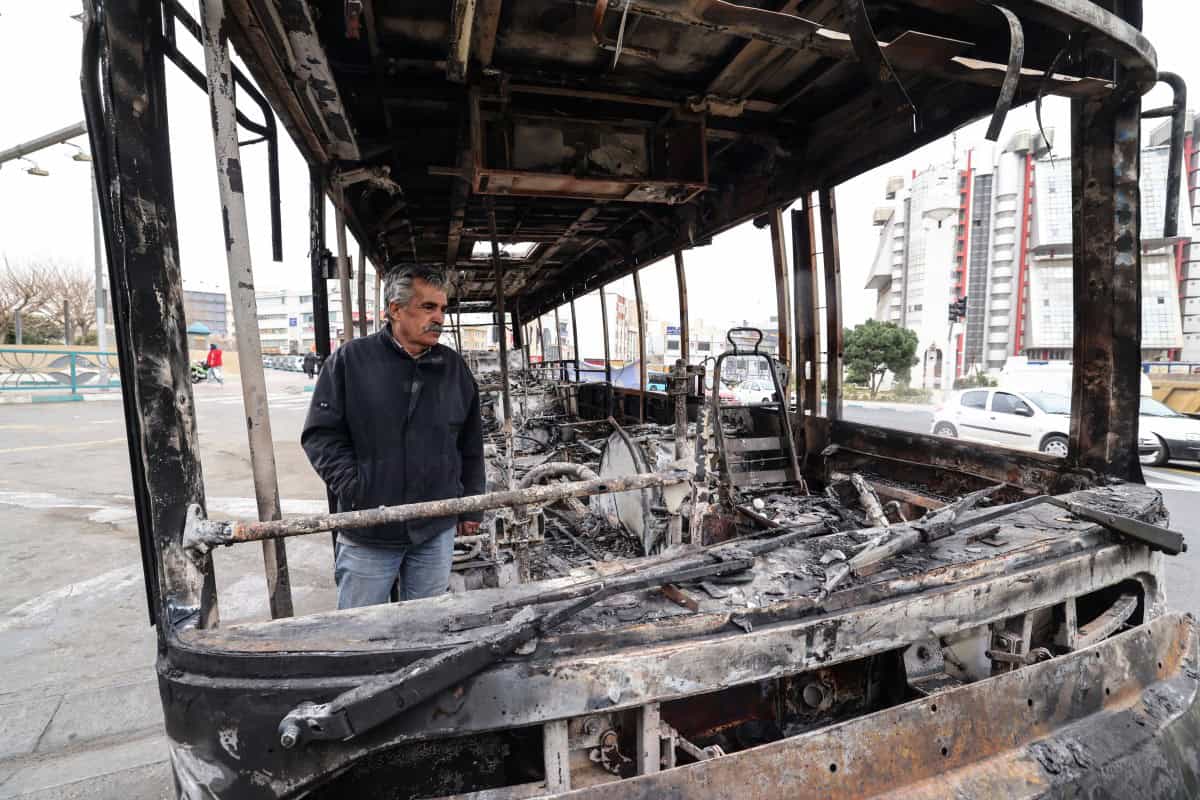
A man stands by the wreckage of a burnt bus bearing a banner (unseen) that reads "This was one of Tehrans new buses that was paid for with the money of the peoples taxes, in Tehran's Sadeghieh Square on January 15, 2026. A protest movement across Iran, initially sparked by economic grievances, has turned into one of the biggest challenges yet to the clerical leadership since it took power in 1979. (Photo by ATTA KENARE / AFP)
Iran vowed on Thursday to defend itself against any foreign threat, after US President Donald Trump said he would “watch it and see” about military action over the crackdown on protesters.
Iran’s judiciary said a protester who the United States and rights groups feared faced imminent execution would not be sentenced to death, after Trump had warned of strikes should people arrested for demonstrating be killed.
The protests were sparked by economic grievances but evolved rapidly into a nationwide movement that has constituted the greatest threat to the Islamic republic since its inception in 1979.
Rights groups say the crackdown by authorities, who exercise zero tolerance for dissent, has left at least 3,428 people dead. They also accuse the country’s theocratic leaders of using an internet blackout to cover up the brutality of their crackdown.
In telephone talks on Thursday, Iranian Foreign Minister Abbas Araghchi told Saudi Arabian counterpart Faisal bin Farhan of the importance of “global condemnation of foreign interference in the internal affairs of regional countries”.
The developments came hours ahead of a UN Security Council meeting on Iran later on Thursday, which was requested by the US.
ALSO READ: SA concerned about deadly Iran protests, calls for ‘maximum restraint’
On Wednesday, Saudi Arabia informed Iran it would not allow its airspace or territory to be used to attack it, two sources close to the kingdom’s government told AFP.
Up until Wednesday, the United States was threatening military action against Iran should it carry out the death penalty against people arrested over the protests.
In an announcement at the White House, Trump said he had now received assurances from “very important sources on the other side” that executions would not go ahead.
“They’ve said the killing has stopped and the executions won’t take place — there were supposed to be a lot of executions today and that the executions won’t take place — and we’re going to find out,” Trump said.
Asked by an AFP reporter in the Oval Office if US military action was now off the table, Trump replied: “We’re going to watch it and see what the process is.”
The comments sent oil prices plunging on Thursday, as concerns eased of a looming supply shock in energy markets. Iran makes up around three percent of global oil production.
ALSO READ: Is the SANDF snubbing its ANC bosses?
All eyes were on protester Erfan Soltani, 26, in prison in Karaj outside Tehran since his arrest, who is facing charges of propaganda against Iran’s Islamic system and acting against national security.
On Thursday, the Iranian judiciary said Soltani has “not been sentenced to death” and if he is convicted, “the punishment, according to the law, will be imprisonment, as the death penalty does not exist for such charges”.
‘No hanging today or tomorrow’
Iran’s judiciary chief had vowed fast-track trials for those arrested, and prosecutors have said some detainees will face capital charges of “waging war against God”.
State media reported hundreds of arrests and the detention of a foreign national for espionage, without giving details.
In an interview with US network Fox News, Iranian Foreign Minister Abbas Araghchi said there would be “no hanging today or tomorrow”, while accusing US ally Israel of orchestrating violence in Iran, without providing evidence.
Araghchi contends the protests devolved into widespread violence between January 7 and 10 because they were infiltrated by external “elements who had a plan to create a big number of killings in order to provoke President Trump to enter into this conflict and start a new war against Iran”.
ALSO READ: Lamola urged to report Iran to UN as protest death toll soars
The authorities imposed an unprecedented internet blackout on January 8, as protests exploded in size and intensity, severely hampering the demonstrators’ ability to communicate with each other and the outside world.
Iran’s Minister of Justice Amin Hossein Rahimi echoed Araghchi’s allegation, telling state news agencies that after January 7, “those weren’t protests any longer” and anyone who was arrested on the streets then “was definitely a criminal”.
‘Full control’
Araghchi said the Iranian government was “in full control” and reported an atmosphere of “calm” after what he called three days of “terrorist operation”.
Iran also struck a defiant tone about responding to any US attack, as Washington appeared to draw down staff at a base in Qatar that Tehran targeted in a strike last year.
Iran targeted the Al Udeid base in June in retaliation for US strikes on its nuclear facilities.
Ali Shamkhani, a senior adviser to Supreme Leader Ayatollah Ali Khamenei, warned Trump the strike showed “Iran’s will and capability to respond to any attack”.
ALSO READ: Trump hits Iran trade partners with tariffs as protest toll soars
Fears of possible US military action continued to rile the region, and Turkey on Thursday said it opposed a military operation against Iran.
‘Zero protests’
G7 nations said Wednesday they were “deeply alarmed at the high level of reported deaths and injuries” and warned of further sanctions if the crackdown continued.
Monitor NetBlocks said Iran’s internet blackout had lasted over 156 hours.
Despite the shutdown, new videos, with locations verified by AFP, showed bodies lined up in the Kahrizak morgue south of Tehran, wrapped in black bags as distraught relatives searched for loved ones.
The US-based Institute for the Study of War, which has monitored protest activity amid the shutdown, said it had recorded “zero protests” on Wednesday.
But it added: “The regime is sustaining repressive measures that impose a significant cost on the regime. This suggests that the regime does not perceive that the threat from protests has subsided.”
ALSO READ: Naval exercises with China, Russia and Iran carry political costs — expert
Iran Human Rights, based in Norway, said security forces had killed at least 3,428 protesters and arrested more than 10,000.
About the Author