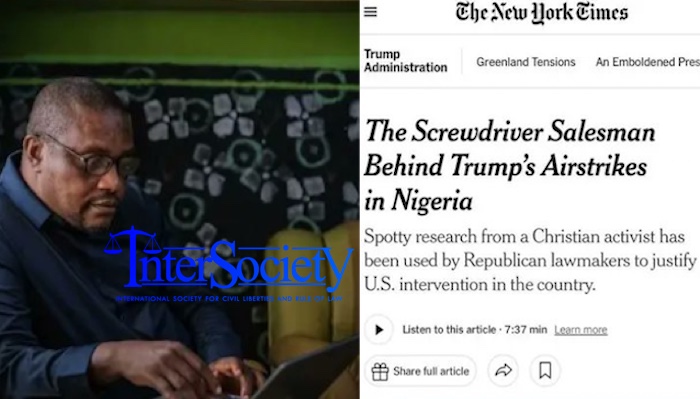
The International Society for Civil Liberties and Rule of Law (Intersociety) has accused the New York Times and its West Africa Bureau Chief, Ruth Maclean, of misrepresentation and false attribution in an interview conducted with its founder, Emeka Umeagbalasi.
In a statement dated January 19, 2026, the Onitsha-based human rights organisation said claims attributed to Umeagbalasi in the publication were never made during the over three-hour interview conducted at his residence in Anambra State in December 2025.
Intersociety stated that the interview focused on what it described as systematic attacks on Christians and churches in Nigeria, adding that the published report distorted its positions and framed its comments in a misleading and dangerous manner.
The organisation alleged that the newspaper improperly linked Umeagbalasi’s remarks to United States airstrikes in Sokoto State that occurred nine days after the interview.
“We are shocked and totally disappointed by the perfidy of lies told against us in the said publication, which have exposed our leadership to life-threatening risks,” the statement read.
Intersociety warned that it would hold the New York Times and Maclean “vicariously liable” should any harm befall Umeagbalasi, his family, or the organisation’s offices in Onitsha, Enugu and Aguata.
The group denied claims that its founder referred to Fulani people as animals or advocated their confinement to a single state, rejecting suggestions that such statements amounted to ethnic cleansing.
It also dismissed allegations that its casualty data were unverified or based on secondary sources, explaining that its documentation combines field investigations with corroborated third-party reports in line with international human rights standards.
Intersociety further denied any involvement in U.S. partisan politics, stressing that its reports on killings since 2009 were rooted strictly in religious freedom monitoring frameworks recognised by the United Nations and the African Union.
The organisation maintained its estimate that over 19,000 churches have been attacked or destroyed in Nigeria since 2009, insisting that while its findings may be debated, attributing false statements that endanger its leadership is unacceptable.
David-Chyddy Eleke in Awka
About the Author