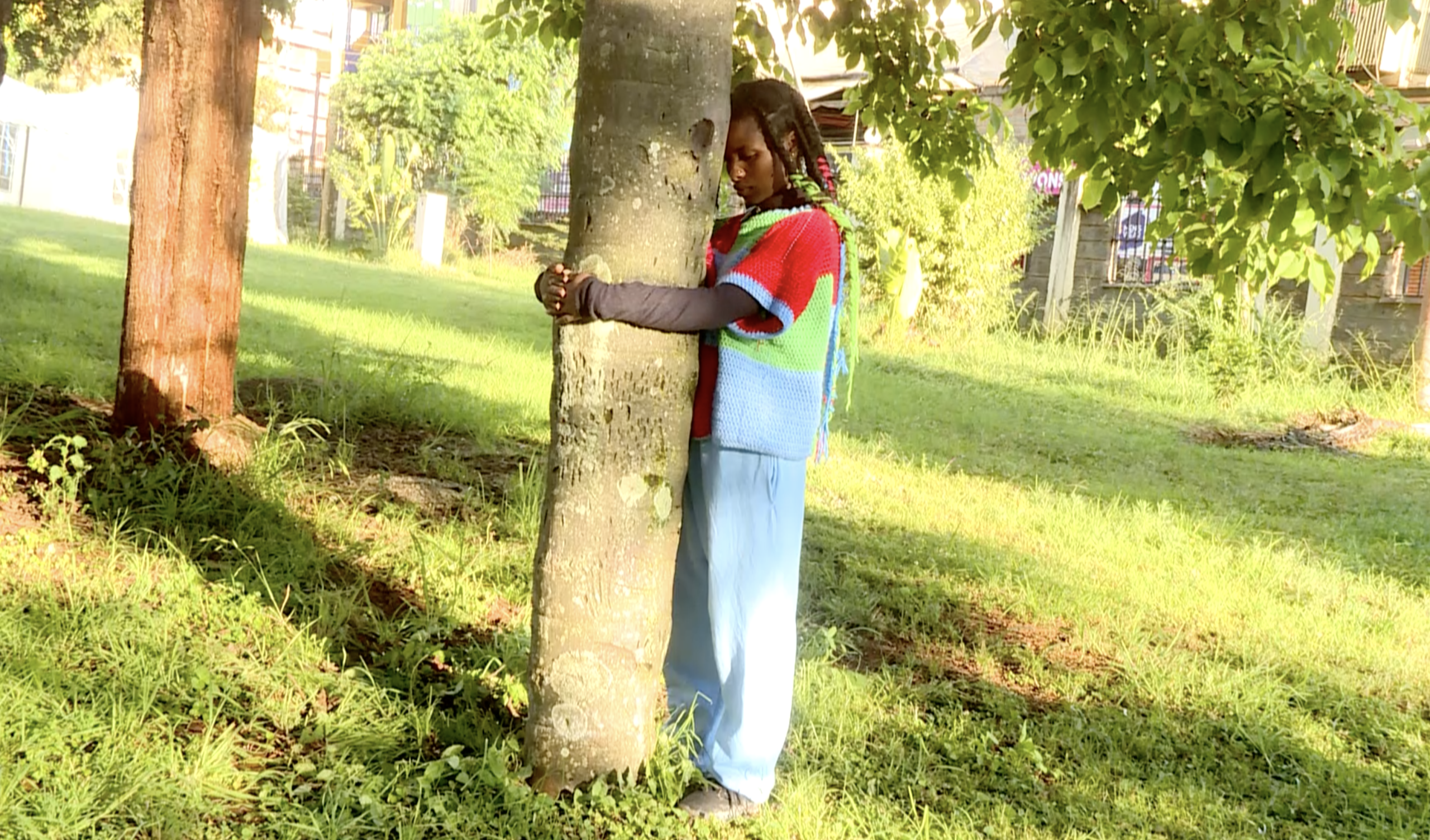
On the edge of Karura Forest, where joggers, cyclists and conservationists often cross paths beneath a canopy of indigenous trees, Guinness World Record holder Truphena Muthoni is rehearsing a different kind of routine.
She moves swiftly from trunk to trunk, arms outstretched, pressing briefly against the bark before stepping away and repeating the motion. It is part endurance, part symbolism and, she hopes, a powerful environmental statement.
The training is in preparation for her upcoming attempt to break another tree-hugging record, this time not with a single tree, but by hugging 1,172 trees within one hour.
Speaking to Nation, Muthoni revealed that she will leave Kenya for Brazil, heading to Acre Forest on Sunday, March 22, 2026, where she plans to make the record attempt.
“The initiative is not just about numbers,” Muthoni says, “but about drawing global attention to forests and the communities that depend on them.”
Her upcoming attempt builds on two feats that first brought her into the public spotlight, a 48-hour tree-hugging marathon, followed by an even more gruelling 72-hour endurance challenge.
“I want people to see forests differently,” she said, “not just as resources, but as living systems we are connected to.”
Her latest record-breaking 72-hour tree-hugging marathon, she explains, was originally planned for Brazil, but logistical challenges forced her to stage it in Kenya instead.
“It was not how I had envisioned it,” Muthoni said, “but it still proved that the message could travel beyond location.”
The new challenge of hugging 1,172 trees is rooted in a plan she conceived around last year’s COP30. Muthoni had hoped to stage the initiative during the global climate conference in Belém, Brazil, but was unable to attend after struggling to secure the necessary clearance.
“I had the idea ready, but I could not travel to Brazil due to lack of accreditation,” she said. “So I had to rethink how to make it happen independently.”
Her upcoming trip to Brazil follows a meeting with President William Ruto at State House, where, she says, he pledged to support her travel in recognition of completing the gruelling 72-hour challenge.
While the trip was initially framed as a vacation, Muthoni chose to redirect it toward environmental.
“I didn’t want it to just be a reward, I wanted it to mean something for conservation and restoration,” Muthoni explained.

Her choice of Acre Forest in Brazil was not random. She deliberately chose the region because of its connection to indigenous forest systems and its historical ties to Chico Mendes, a globally recognised figure in forest justice who was assassinated in 1988.
More significantly, she says, the effort is meant to honour the Quilombola community, a group widely regarded as guardians of parts of the Amazon forest. These communities have long protected their ancestral lands against deforestation and exploitation.
“They have protected these forests for generations, and their role is often overlooked,” she said.
The Amazon rainforest, often described as the “Lungs of the Earth,” is the largest carbon sink in the world. Scientists warn that continued degradation could have far-reaching global consequences, particularly for regions in the Global South, including Africa and the Caribbean, where communities are already vulnerable to climate change impacts.
For Muthoni, the connection between the Amazon and African ecosystems is not abstract.
“When the Amazon suffers, we feel it too,” she says. “Climate change doesn’t respect borders.”
However, she is navigating a wave of public criticism, especially on social media. The backlash, she admits, has taken a toll.
“Right now, I don’t feel as motivated as before,” she says. “It has been difficult seeing negative reactions, especially when you are trying to do something positive.”
Despite this, she continues to train, supported by a small team of about seven people, including her personal photographer and close friends. Among her support system are also a journalist friend and a Member of Parliament, who she says have helped her remain grounded.
“They remind me why I started,” she says. “And that keeps me going.”
Her preparation routine is unconventional but deliberate. She engages in light physical exercises, such as jumping to build stamina, alongside walking, earthing, and what she describes as “forest bathing”, immersing herself in natural environments to build both physical and mental endurance.

So far, she has managed to hug approximately 20 trees at an average rate of 16 seconds per tree. The goal, however, is to significantly increase that pace in order to reach 1,172 trees within a single hour, a target that demands both speed and precision.
“It’s about controlling my breathing and maintaining rhythm,” she explains. “Every second counts.”
Her training has taken place across different forest ecosystems, including Karura and Kiganjo forests, allowing her to adapt to varying terrains and tree densities. Unlike many endurance athletes, she does not have a formal coach, relying instead on personal discipline and peer support.
“I don’t have a trainer,” she says. “But I have people who believe in me, and that matters.”
Muthoni stresses the urgent need to protect forests in Kenya, where forest conservation has become increasingly critical amid climate pressures and urban expansion.
“Forests are essential,” she says. “If we don’t protect them, we are putting our future at risk.”
Her upcoming tour in Brazil will also include a media engagement in São Paulo before she travels to Acre for the initiative.
About the Author