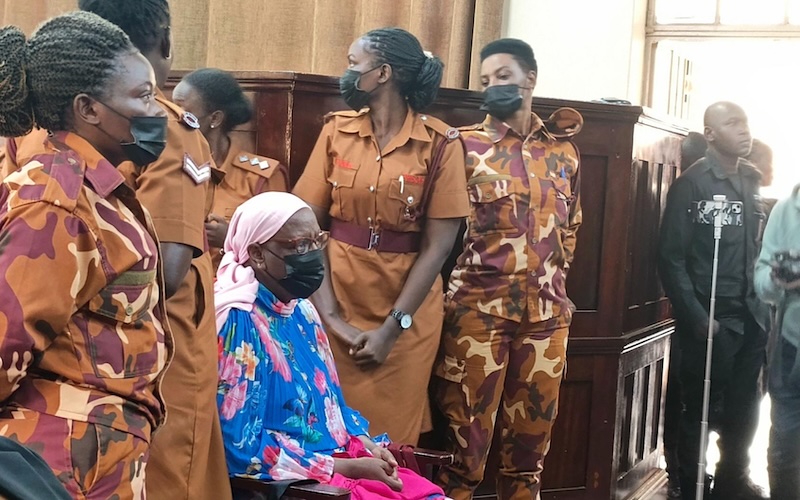
The courtroom settled into a tense quiet last week as Molly Katanga returned to the dock, her presence now familiar but no less scrutinised.
Flanked by prison officers, she took her place for what would become one of the most probing sessions of the trial so far: cross-examination. This time, the questions came sharper, more insistent. Counsel Jonathan Muwaganya, leading the prosecution, opened not with facts, but with a warning, one that hung over the proceedings like a test of credibility.
“We want to be clear on record that you understand the oath that you took, Mrs. Katanga,” he said. “If you tell lies, the court can use them against you.” It was a deliberate start, setting the tone for what followed: a methodical attempt to dismantle her account of the events leading to the death of her husband, businessman Henry Katanga, inside their Mbuya home in November 2023.
At the centre of the dispute is a story Katanga has already told, of violence, confusion, and survival. In her earlier testimony, she described being attacked by her husband, struck repeatedly with a wooden baton, and left with injuries so severe that she now requires support to walk. But as cross-examination began, the prosecution moved quickly to challenge that claim.
“There is evidence that in prison you walk unsupported,” Muwaganya asserted. “So, tell this court, when do you choose to walk unsupported and when not?” Katanga did not hesitate. “That’s not true, my lord.”
The exchange was brief, but it revealed the line the prosecution intended to pursue, questioning not just the details of her testimony, but its consistency. From there, the focus shifted to the bathroom, where Katanga says the assault began.
Her account is specific: she was attacked in the bathroom, at its doorway, and again in the bedroom. Her hands, she said, were so badly injured that she could not use them to open doors. Instead, she relied on her elbows. It is here that the prosecution saw an opening.
“Again, madam, in which posture did you open the door?” Muwaganya asked. “I was kneeling, my lord,” she replied. What followed was less a question than a challenge to physical possibility Muwaganya argued that the door handle was positioned too high for someone kneeling to reach with an elbow.
To reinforce the point, he asked the court to replay a crime-scene reconstruction video, footage that he suggested contradicted her account. The courtroom shifted from words to demonstration.
Patricia Kankwanza was called from the witness dock to help establish the height of the door handle. The defence objected immediately. “She can’t be used as an exhibit, yet she is at the same time accusing her,” defence lawyer Elison Karuhanga argued.
But the presiding judge allowed the exercise to proceed.
“We are at evidence finding, let her come.” The marking was done. The point made. Then came the moment of confrontation. Katanga was asked to demonstrate how she had opened the door using her elbow. She resisted, not the act itself, but the wording. She had not said she “unlocked” the door, she insisted.
Yet when the judge referred back to her earlier testimony, the record showed otherwise. “Do you remember saying that?” Muwaganya pressed.
“I said that, but that’s not what I meant,” she replied. The prosecution seized on the inconsistency.
“Do you want to go on record that you are changing your testimony?” he asked. “You are trying to change because you are realising that what you said is an impossibility.” “I am not changing,” she said. “The door was open, and I used my elbow to swing it open.”
It was a small distinction, unlocking versus pushing open, but one that carried weight in a case built on detail. From physical movement, the questioning turned to medical evidence.
The prosecution suggested that Katanga’s injuries had been exaggerated, even fabricated, in documents from International Hospital Kampala.
“A lot of medical documents were fabricated and exaggerated, intended to make your condition appear worse than it is. Do you agree?” Muwaganya asked. “No, my lord, it’s not true,” she replied.
Again, the pattern repeated: assertion, denial, and a widening gap between two competing versions of reality. Muwaganya then returned to the question of her injuries, focusing on a point that seemed almost impossible to reconcile. If her hands were broken, as she claimed, how had she managed to crawl?
Her answer was less technical than human. “When you are in that situation I was in, you would also crawl,” she said. “I don’t know how I crawled, but I did. I crawled in severe pain.”
For a moment, the courtroom shifted, from legal argument to something more personal. But the prosecution did not linger there. Instead, it moved into territory that seemed, at first, unrelated: her education.
“What is the level of your formal education?” Muwaganya asked. “That is personal, my lord.” “Do you have any medical training?” “No, my lord.” The line of questioning soon became clear.
Katanga had previously suggested that her husband had been under severe stress, even depression, partly linked to financial strain and the death of businessman Apollo Nyegamehe, known as Aponye.
The prosecution challenged that conclusion, arguing it was based on personal opinion rather than medical expertise. It then turned to the financial dimension of that claim.
According to Katanga, Aponye’s death had dealt a significant blow to her husband. But the prosecution presented a different picture, one of continued financial engagement even after the burial.
“Confirm that the debt was not only restructured but the company was paying even after the death of Mr Aponye,” Muwaganya said.
To support this, loan receipts were produced, showing that approximately Shs157 million had been repaid in instalments over several months. It was a subtle but important shift, from emotional strain to financial continuity.
As the session drew to a close, the courtroom was left with two narratives that refused to align. One is built on Katanga’s account of violence, injury, and desperation. The other, constructed by the prosecution, seeks to expose inconsistencies—physical, medical, and contextual—that cast doubt on that account. Neither has yet prevailed.
The court adjourned the trial to April 14, leaving the questions hanging, unresolved. In the end, this phase of the trial is not about what happened that morning in Mbuya. It is about whether what has been said about it can stand.