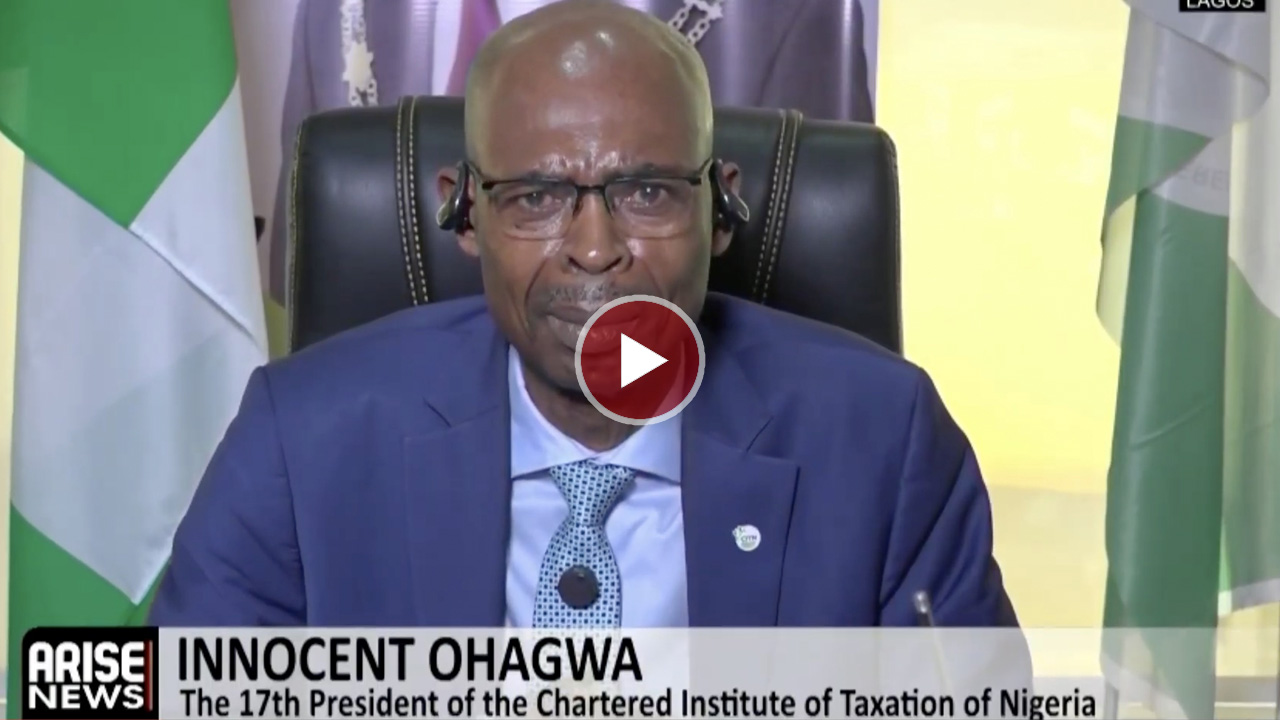

The 17th President of the Chartered Institute of Taxation of Nigeria (CITN), Innocent Ohagwa, has underscored the central role of anti-avoidance provisions and strong enforcement powers in ensuring the effectiveness of Nigeria’s tax system, amid ongoing debates over recent tax reforms.
Ohagwa described anti-avoidance provisions as fundamental to any functional tax regime, stressing that tax laws cannot be enacted without them and that any additions must follow due legislative process to be enforceable.
“The avoidance provisions, which are applicable in most of the tax regulations all over the world, you can’t make that law without putting the avoidance provisions,” he said.
Speaking in an interview on ARISE News on Monday, Ohagwa addressed concerns over discrepancies between the harmonised copy of the tax reform bills passed by the National Assembly and the version eventually gazetted. He noted that the Institute is still awaiting the harmonised copy and called for restraint on disputed sections, while insisting that this should not stall the wider reforms.
“The Institute is of the view that the sessions that are foreign into the one the National Assembly approved should be frozen. But this will not stop the implementation of the whole… we will advise that the implementation of the laws should commence but the affected sections pending the resolution between the Executive and the House of Representatives should not be isolated,” he said.
He also highlighted potential operational challenges arising from reporting thresholds and anti-avoidance mechanisms as reflected in the gazetted version of the law, warning that some provisions could hamper the work of state internal revenue services if implemented as reported.
“The version in the paper said 15 million for the individual monthly basis and then 250 million for companies.. the Gazette said 25 million reported on a monthly basis and 100 million for companies… If we go with the one in the papers, you have shut out the state internal revenue services because how many of the individuals reside in their state that will have 15 million transactions in a month? And again, rendering it on a monthly basis would be cumbersome to the bankers,” he explained.
On Value Added Tax (VAT), Ohagwa said the current legal framework allows for federal collection and distribution to states, noting that any future changes would rest with the National Assembly.
“What we know today is that VAT is collected by federal and shared towards their government. That is the focus of the Institute. If there are changes later, and the law approves it, we will pledge.”
Beyond the legal framework, Ohagwa also stressed the necessity of robust enforcement by revenue agencies, even in the face of resistance from companies. He warned that failure to act would undermine government authority.
“Some of us work at the revenue office and at times we want to go to visit the company for investigation. The company is surrounded with police and security men… even to send letters, they will not collect letters. Are we saying that the revenue authority should go to sleep and allow such to happen?”
He emphasised that revenue officers act on behalf of the state, and that attacks or obstruction against them amount to attacks on government itself.
“The revenue agency is a trusted agent of government. And anybody who attacks any staff of such institution is attacking the federal government.”
Ohagwa added that enforcement powers already exist under existing laws and should be exercised to protect officers and ensure compliance.
“The enforcement powers, even without what is in the law today, the old law, we do carry enforcement powers.”
He concluded by calling for transparency and access to the harmonised tax reform bill to allow for proper scrutiny and informed positions, urging stakeholders to rely on verified documents rather than speculation.
“When I was contacted, ordinarily I would have asked my counsel. They would have turned it down because we have not seen the harmonised copy to enable the Institute to take a position… You can ask for a copy. Under Freedom of Information Act, you can ask for a copy.”
Faridah Abdulkadiri
Excerpt: Innocent Ohagwa says anti-avoidance provisions are fundamental, and revenue agencies must enforce tax laws even when companies resist.
The 17th President of the Chartered Institute of Taxation of Nigeria (CITN), Innocent Ohagwa, has underscored the central role of anti-avoidance provisions and strong enforcement powers in ensuring the effectiveness of Nigeria’s tax system, amid ongoing debates over recent tax reforms.
Ohagwa described anti-avoidance provisions as fundamental to any functional tax regime, stressing that tax laws cannot be enacted without them and that any additions must follow due legislative process to be enforceable.
“The avoidance provisions, which are applicable in most of the tax regulations all over the world, you can’t make that law without putting the avoidance provisions,” he said.
Speaking in an interview on ARISE News on Monday, Ohagwa addressed concerns over discrepancies between the harmonised copy of the tax reform bills passed by the National Assembly and the version eventually gazetted. He noted that the Institute is still awaiting the harmonised copy and called for restraint on disputed sections, while insisting that this should not stall the wider reforms.
“The Institute is of the view that the sessions that are foreign into the one the National Assembly approved should be frozen. But this will not stop the implementation of the whole… we will advise that the implementation of the laws should commence but the affected sections pending the resolution between the Executive and the House of Representatives should not be isolated,” he said.
He also highlighted potential operational challenges arising from reporting thresholds and anti-avoidance mechanisms as reflected in the gazetted version of the law, warning that some provisions could hamper the work of state internal revenue services if implemented as reported.
“The version in the paper said 15 million for the individual monthly basis and then 250 million for companies.. the Gazette said 25 million reported on a monthly basis and 100 million for companies… If we go with the one in the papers, you have shut out the state internal revenue services because how many of the individuals reside in their state that will have 15 million transactions in a month? And again, rendering it on a monthly basis would be cumbersome to the bankers,” he explained.
On Value Added Tax (VAT), Ohagwa said the current legal framework allows for federal collection and distribution to states, noting that any future changes would rest with the National Assembly.
“What we know today is that VAT is collected by federal and shared towards their government. That is the focus of the Institute. If there are changes later, and the law approves it, we will pledge.”
Beyond the legal framework, Ohagwa also stressed the necessity of robust enforcement by revenue agencies, even in the face of resistance from companies. He warned that failure to act would undermine government authority.
“Some of us work at the revenue office and at times we want to go to visit the company for investigation. The company is surrounded with police and security men… even to send letters, they will not collect letters. Are we saying that the revenue authority should go to sleep and allow such to happen?”
He emphasised that revenue officers act on behalf of the state, and that attacks or obstruction against them amount to attacks on government itself.
“The revenue agency is a trusted agent of government. And anybody who attacks any staff of such institution is attacking the federal government.”
Ohagwa added that enforcement powers already exist under existing laws and should be exercised to protect officers and ensure compliance.
“The enforcement powers, even without what is in the law today, the old law, we do carry enforcement powers.”
He concluded by calling for transparency and access to the harmonised tax reform bill to allow for proper scrutiny and informed positions, urging stakeholders to rely on verified documents rather than speculation.
“When I was contacted, ordinarily I would have asked my counsel. They would have turned it down because we have not seen the harmonised copy to enable the Institute to take a position… You can ask for a copy. Under Freedom of Information Act, you can ask for a copy.”
Faridah Abdulkadiri
About the Author