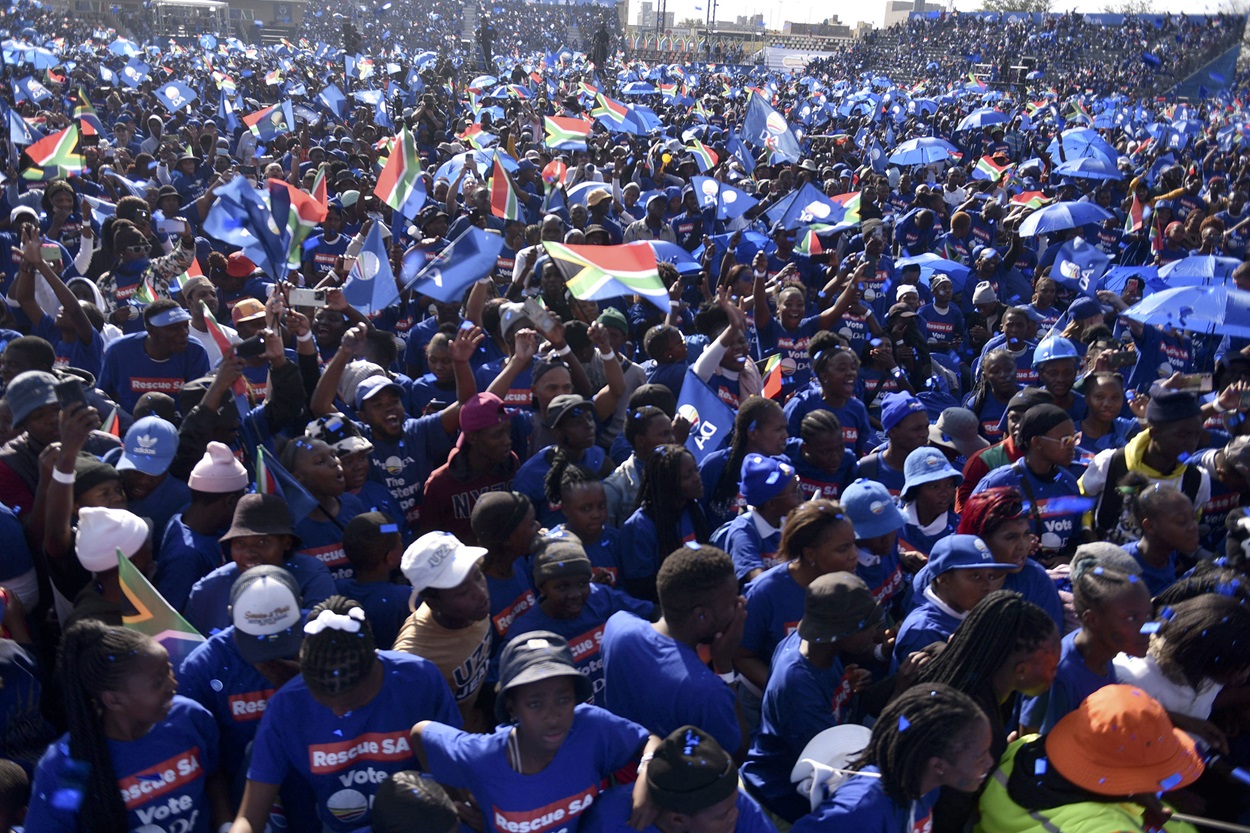
In recent months, the DA, once regarded as the Holy Grail of opposition politics, has been beset by internal rumblings.
The party, which traces its lineage to the Progressive Federal Party of Helen Suzman and Frederick van Zyl Slabbert, now finds itself mired in factional disputes.
This is striking because such infighting has long been associated with former liberation movements like the ANC, PAC, and Azapo, where ideological purity often gave way to personal rivalries and power struggles.
Factionalism in the ANC has always been expected, given its proximity to state power and the allure of the public purse.
But the persistence of splintering within the PAC and Azapo, despite their distance from the levers of governance, raises deeper questions.
ALSO READ: Helen Zille reveals DA will take Joburg Water and the city to court over water crisis
Why, more than three decades after their unbanning, do these parties remain trapped in cycles of division?
The PAC, founded with dignity by Robert Sobukwe, and Azapo, born of Steve Biko’s Black Consciousness Movement, have fractured so frequently that their political relevance has been steadily eroded.
Their inability to adapt to changing times has left them marginalised, unlikely to govern outside coalition arrangements such as the GNU.
Even today, under the conciliatory leadership of Mzwanele Nyhontso, the PAC faces renewed turbulence, with factions claiming the existence of an “alternative president”.
They might be plotting to unseat Nyhontso, who is more open-minded to the significance of the PAC changing strategy.
ALSO READ: Gauteng spends R22m on sound systems and stages, but service delivery remains a challenge
Azapo, historically the smallest of the liberation movements, has endured the highest rate of splintering, further diminishing its influence.
The result is self-inflicted irrelevance for both parties. They have failed to grasp that politics is a dynamic arena in which strategies effective in the 1950s cannot simply be transplanted into the 2000s.
By contrast, the ANC, despite its flaws, has consistently outmanoeuvred them through strategic recalibration at every relevant moment.
Yet the ANC itself now risks sliding into the same downward spiral, not because of poor strategy but because of corruption and a hollowing out of governance capacity. Its policies remain sound on paper, but the implementation of public programmes has been subordinated to rent-seeking.
In this sense, the ANC’s challenge is more insidious: it is not a failure of ideas, but a failure of integrity.
ALSO READ: Zille blasts Joburg Water as leaks gush and residents go dry
If left unchecked, this corrosion of governance could prove as politically fatal as the factional implosions that crippled the PAC and Azapo.
Coming back to the Holy Grail – or should I say the holy cow? – of our politics, the DA. For years, the DA projected an image of enduring stability, perhaps less because of genuine unity than because it avoided washing its dirty linen publicly.
Yet, beneath the surface, as in any political organisation where power is contested, undercurrents have always festered.
Since adopting the slogan “Fight back” (translated to “fight blacks”) under Tony Leon, the DA has struggled to shed its identity as a predominantly white party, with policies and leadership choices reinforcing that perception.
Helen Zille’s tenure, followed by that of John Steenhuisen, deepened the marginalisation of black leaders. One by one, figures of stature, Mmusi Maimane, Lindiwe Mazibuko, Patricia de Lille and Herman Mashaba, among others, were worked out of the system.
ALSO READ: Calm departure, turbulent consequences for the DA
Infighting, as history shows, is the death knell of political parties in South Africa. The PAC, Azapo, Cope and now the ANC, have all suffered from leadership squabbles that alienate voters.
The DA risks joining them in this downward spiral.
About the Author