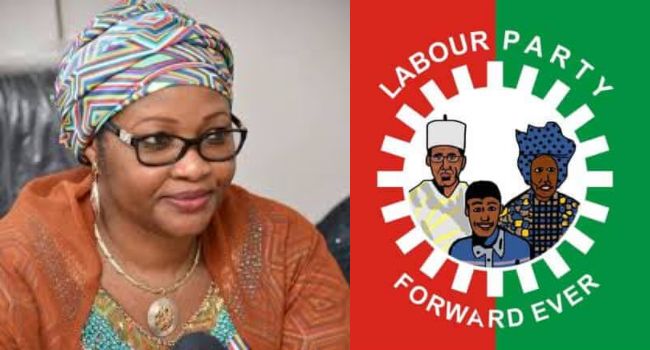
The Independent National Electoral Commission (INEC) has formally recognised the National Working Committee (NWC) of the Labour Party (LP) led by Senator Nenadi Usman, in compliance with a court order.
Checks on the INEC website on Friday confirmed that Usman is now listed as the chairperson of the party’s caretaker committee. Other recognised members of the NWC include Senator Darlington Nwokocha as National Secretary, Hamisu Santuraki as National Treasurer, Aisha Madije as National Financial Secretary, and Eric Ifere as National Legal Adviser.
INEC’s action follows a ruling delivered on January 21 by the Federal High Court in Abuja, which affirmed the Usman-led NWC as the legally recognised leadership of the Labour Party.
In his judgment, Justice Peter Lifu sacked Julius Abure as the party’s national chairman, holding that his tenure had expired.
Justice Lifu anchored his decision on an earlier Supreme Court ruling, which he said established Nenadi Usman as the authentic leader of the party. He consequently ordered INEC to recognise the Usman-led NWC as the lawful authority of the Labour Party pending the conduct of the party’s next national convention.
Although the court acknowledged that leadership disputes within political parties are generally internal and non-justiciable, Justice Lifu ruled that the constitution of a caretaker committee had become “a necessity” arising from the Supreme Court’s prior verdict.
The judgment has further intensified the ongoing leadership crisis within the Labour Party. In response, the Abure-led faction rejected the ruling and vowed to challenge it at the Court of Appeal.
Speaking on behalf of the group, its spokesman, Obiorah Ifoh, described the judgment as contradictory to the Supreme Court’s position. He argued that the apex court had clearly held that no court has the authority to appoint leaders for political parties, as such matters remain internal affairs.
Ifoh also claimed that the Court of Appeal had previously affirmed the Abure-led NWC as the party’s authentic leadership, insisting that the Federal High Court ruling conflicted with established judicial precedents.
The Labour Party’s internal crisis traces back to the aftermath of the 2023 general elections, in which its presidential candidate, Peter Obi, secured over six million votes nationwide.
As preparations begin for the 2027 elections, Obi has since declared his allegiance to the African Democratic Congress (ADC), while the Labour Party named Abia State Governor, Alex Otti, as its national leader—developments that have further reshaped the party’s internal dynamics.
About the Author