The Independent National Electoral Commission (INEC) has proposed a total of N873.8 billion for the conduct of the 2027 General Elections, alongside N171 billion as its statutory budget for 2026 operations.
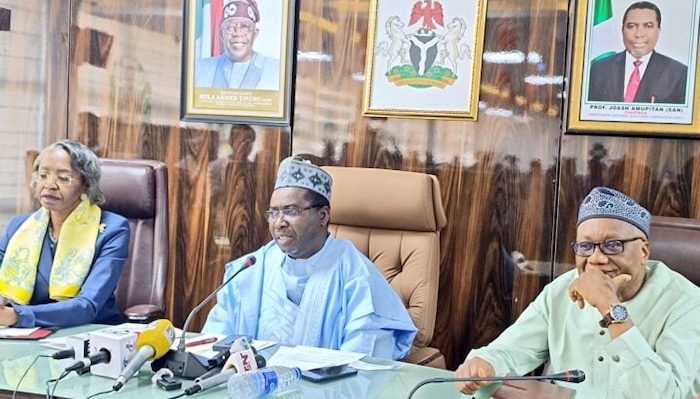
INEC Chairman, Prof. Joash Amupitan, disclosed this while defending the Commission’s 2026 budget and presenting proposed estimates for the 2027 general election before lawmakers.
Out of the N873.8 billion proposed for the 2027 polls, N375.7 billion is earmarked for election operations; N92.3 billion for administrative costs; N209.2 billion for election technology; N154.9 billion for capital expenditure; and N41.6 billion for miscellaneous expenses.
Amupitan said N209.2 billion has been allocated to election technology to enhance transparency and operational efficiency.
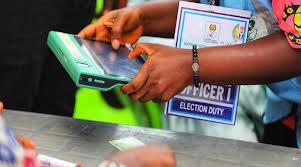
Key technology allocations include N162.5 million for the upgrade of the INEC Result Viewing Portal (IReV); N1.2 billion for a Hybrid e-EC8A and Result Management System; N12.2 billion for printing of Permanent Voter Cards (PVCs) for Continuous Voter Registration (CVR); and N163.2 billion for the procurement of additional Bimodal Voter Accreditation System (BVAS) devices for 2027.
Other technology-related provisions include N2.1 billion for security of accreditation devices and N4.5 billion for procurement of inbuilt power banks for BVAS machines.
INEC also noted that it currently lacks an independent network infrastructure and urged lawmakers to reconsider the envelope budgeting system, arguing that rigid spending ceilings limit its ability to effectively plan for elections.
A breakdown of the N375.6 billion operational expenses shows N37.7 billion for printing ballot papers; N23.4 billion for printing result sheets; N16.9 billion for procurement of non-sensitive materials; and another N16.9 billion for election management materials and forms.
The commission also budgeted N56 billion for honorarium for ad hoc staff; N39 billion for election logistics; N37.3 billion for off-season governorship elections; N14.7 billion for Registration Area Centre (RAC) preparation; and N75.8 billion for other electoral materials.
Additional provisions include N29.4 billion for voter revalidation exercises; N4.8 billion for monitoring of party conventions, congresses and primaries; N300 million for retreats for political parties; N78 million for sensitisation workshops on campaign finance; and N579.7 million for production and airing of voter education jingles.
INEC further proposed N3.2 billion for nationwide CVR training for ad hoc staff; N17.8 billion for training of ad hoc election officials; N892.8 million for refresher training; and N390 million for recruitment of new staff.
Lawmakers noted that the National Youth Service Corps (NYSC) is requesting N32 billion to support the deployment of 450,000 corps members for election duties. The proposal includes N50,000 election duty allowance per corps member, N4,500 feeding allowance, and N5,000 training allowance, amounting to N127,000 per corps member for five days, including training and election duty.
Some lawmakers described corps members as a vulnerable link in the electoral chain that could be targeted for compromise. However, INEC assured that the NYSC request would be carefully examined.
The Senate adopted a motion urging that INEC be treated as a first-line charge to guarantee full and timely release of funds for election preparation and implementation.
Lawmakers emphasised that credible elections require adequate funding and early preparation, pledging to review the proposals thoroughly to ensure critical components are not underfunded.
Amupitan also noted that the commission incurs significant costs conducting by-elections, often triggered by the death or resignation of lawmakers, stressing that such unforeseen polls must be budgeted for in advance.
INEC maintained that proper funding, early appropriation and flexibility in budget implementation are essential to delivering a credible, free and fair 2027 General Election.
Omor Bazuaye
About the Author