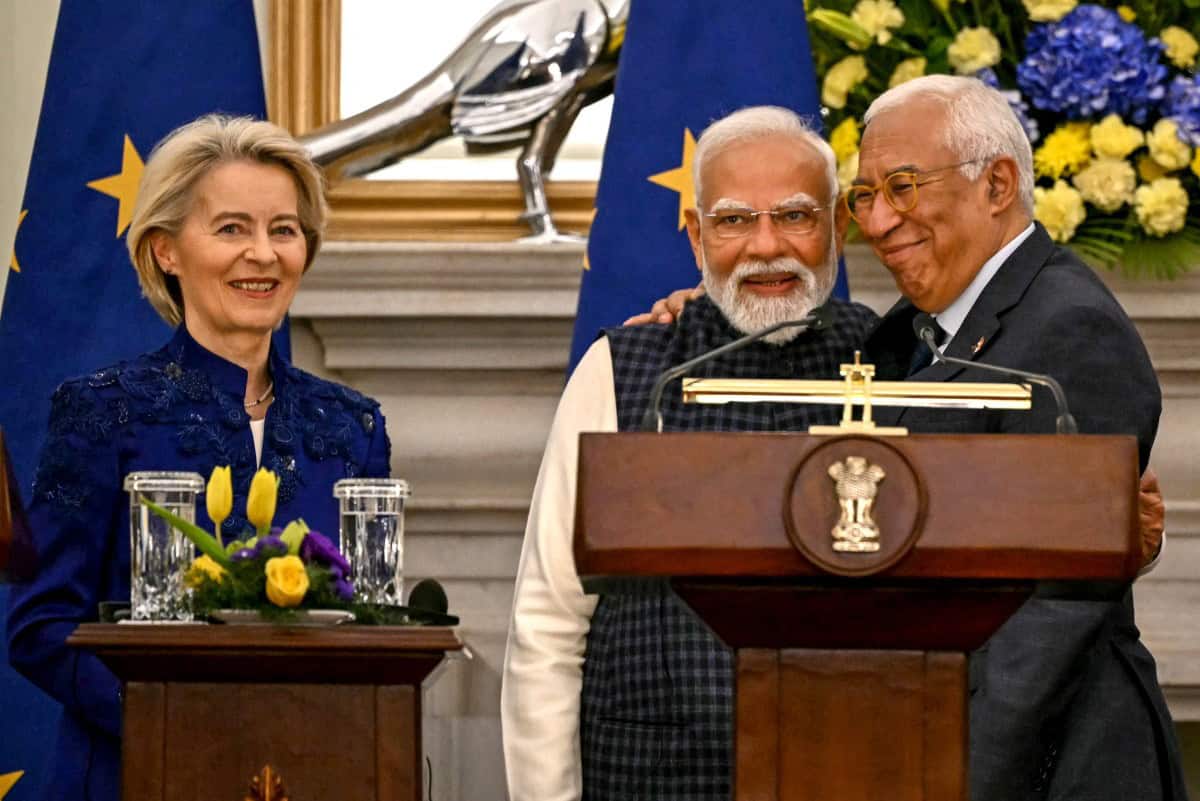
India's Prime Minister Narendra Modi (C) embraces European Council President Antonio Costa (R) as European Commission President Ursula von der Leyen looks on during the joint press statements after their meeting at the Hyderabad House in New Delhi on January 27, 2026. India and the European Union announced on January 27 the "mother of all deals", a huge trade pact to create a market of two billion people, reached after two decades of negotiations. (Photo by Sajjad HUSSAIN / AFP)
The “mother of all deals” signed between India and the European Union (EU) on 27 January – triggered largely by the actions of US President Donald Trump – signals a reset of global trade relations.
The need to conclude a Free Trade Agreement (FTA) between the two economic giants, negotiations for which began as far back as 2007, gained urgency amid Trump’s punitive trade tariffs and volatile foreign policy direction.
With little reprieve from Trump’s bullying tactics on the economic and diplomatic fronts, New Delhi and Brussels were forced to scramble for alternate trade partners to reduce their dependency on both America and China.
With Europe facing the prospect of Trump wresting control of Greenland and India bearing the brunt of the US President’s wrath over its relationship with Russia, both parties felt compelled to conclude the long-delayed FTA.
Suddenly, the almost 20 years in the making Indo-EU negotiations gained renewed impetus towards the end of 2025, leading to their finalisation last month.
ALSO READ: EU, India agree on ‘mother of all’ trade deals
Both India and the EU are set to benefit from the deal, encompassing their vast markets worth a combined $25 trillion (about R400 trillion), covering two billion people and economies that account for 25% of global GDP.
India, which currently imposes 100% tariffs on vehicle imports and 150% tariffs on imported wines, will offer gradual tariff reductions on a range of European products, including vehicles and alcohol. The reductions will, however, be subject to quotas to protect India’s domestic business sectors.
The agreement excludes certain sensitive sectors, such as dairy and agriculture, but India will reduce its extremely high levies on EU agri-food exports like olive oil, margarine, processed foods and fruit juices.
The FTA grants India preferential access to the EU market for over 99% of its exports and eliminates tariffs on labour-intensive goods like textiles, leather and jewellery, while the EU will remove duties on 70.4% of tariff lines immediately, eventually increasing it to over 97% of India’s current export value.
India had been reluctant to liberalise its services sector but, under the FTA, it has opened 102 subsectors to the EU, including in the financial, telecommunications and maritime domains.
ALSO READ: South Africa courts Brics but India skips naval drills
In turn, New Delhi will get access to 144 services subsectors in Europe to help reduce dependence on the US market for its services exports.
The deal signed by New Delhi and Brussels reshapes global trade relations, putting pressure on Trump to be more circumspect in his dealings with US allies.
It also underlines the need for “global middle powers” like India and South Africa to reduce their dependence on the world’s most powerful economy by finding new trade partners.
For India, the EU deal is a strategic pivot that allows the country to balance its Brics membership with deep Western engagement, reducing its trade dependence on the bloc while allowing it to act as a bridge between the West and Brics by pursuing a “multi-alignment” strategy rather than an anti-Western stance.
For South Africa, the FTA poses both challenges and opportunities. The strategic shift by New Delhi heralds a recalibration of intra-Brics dynamics and as India strengthens its position in global supply chains, South Africa may have to re-evaluate its own economic positioning within the bloc.
ALSO READ: Strategic minerals fuel India’s renewable ambitions
Pretoria will have to contend with increased competition in its home market and push for industrial upgrading and deeper integration into global value chains. Its domestic automotive sector, in particular, will be severely impacted.
At a time when South Africa is considering raising tariffs on vehicle imports to 50% to protect local manufacturers whose products will become more expensive, the EU-India deal will flood the market with cheaper Indian-made cars, thereby adding to the competition facing South African manufacturers.
On the other hand, the FTA may open up channels for South African businesses to access European markets through partnerships with Indian companies.
There is also the potential for new manufacturing hubs, as the EU-India agreement, particularly in pharmaceuticals and green technology, could lead to investments in South Africa as a production base.
To cushion itself from any fallout from the India-EU deal, South Africa will have to act swiftly to diversify and find new trade partners; enhance local industrial support by providing emergency support for sectors affected by the influx of cheaper imports; and leverage its partnership with the EU through the “Team Europe” initiatives.
NOW READ: Indo-Africa trade much-needed buoy amid US tariffs
About the Author