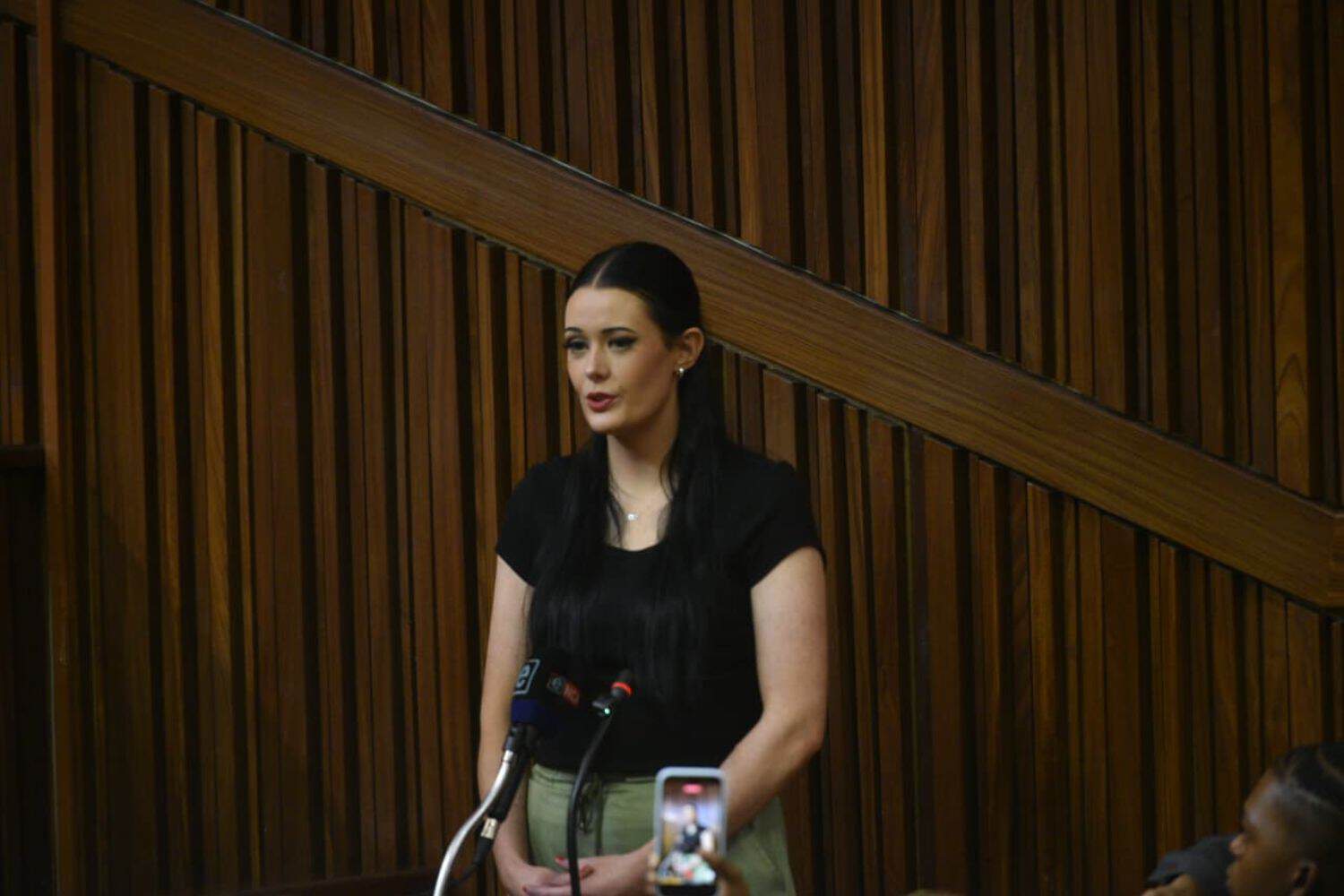
Amber Lee Hughes, convicted of the premeditated murder and rape of four-year-old Nada Jane Challita, returned to the stand in the Johannesburg High Court on Wednesday after two consecutive postponements.
The latest postponement was to allow her legal team to complete consultations.
She drowned the child in a bathtub filled with cold water in 2023.
Hughes told the court that the killing was the result of a long emotional build-up, triggered by the discovery that Nada’s father had been unfaithful.
“On that day it felt like everything that had happened throughout our relationship had built up, and I snapped,” she said.
She testified that she had planned to take both her own life and Nada’s, believing the child was better off dead than left in the care of her father.
“I thought that it would have been better if Nada was dead than to just be with her father,” Hughes told the court.
Hughes’ troubled background and career cut short
When questioned about her personal history, Hughes revealed she had attempted suicide multiple times between the ages of 14 and 16, attributing this to depression and difficulties at home.
The court heard she completed her matric before working in promotional modelling and waitressing.
A family connection eventually led her to Baby Steps preschool, where she began as an intern in November 2020 and was formally appointed as a teacher in February 2021.
Her time at the institution, however, was marked by personal struggles.
Hughes was transferred to another branch and demoted after she began missing work and failing to meet her responsibilities.
“I was falling short, I was demoted to an assistant teacher in 2022,” she told the court.
She resigned from Baby Steps later that year.
Watch: Amber Lee Hughes explains how it was working at Baby Steps
ALSO READ: Amber-Lee Hughes found guilty of murder and rape
Hughes says she always wanted to plead guilty
Hughes maintained throughout her testimony that she had wanted to plead guilty to murder from the outset of her legal proceedings, and that she was advised against this by her previous legal team.
She told the court that when evaluated by medical professionals, she was consistent in her position.
“One of the most common questions I was asked by several doctors was how I would like to plead. I stated to them that I would like to plead guilty,” she revealed.
She is now before the court pleading for mercy ahead of sentencing.
Social worker points to trauma, PTSD and borderline personality disorder
In October 2025, social worker Johanna Wolmarans, who conducted an assessment of Hughes, presented findings to the court that painted a picture of a woman whose capacity to regulate her emotions had been fundamentally shaped by early childhood trauma.
Wolmarans said Hughes had been exposed to traumatic events from as young as six years old and was subsequently diagnosed with post-traumatic stress disorder (PTSD).
The social worker said this early trauma left Hughes without the emotional tools needed to manage frustration or anger as she grew older.
“She cannot deal with frustration. She cannot deal with anger,” Wolmarans said.
Furthermore, the social worker explained that Hughes’s borderline personality disorder (BPD) was a contributing factor in the crimes committed against Challita.
“She does not have the skills, the personality skills, to direct her anger towards the cause of the anger. This was all built up, built up through the whole day and then the incident,” Wolmarans told the court.
Sentencing proceedings are ongoing.
READ NEXT: WATCH: Amber Lee Hughes sentencing to resume today