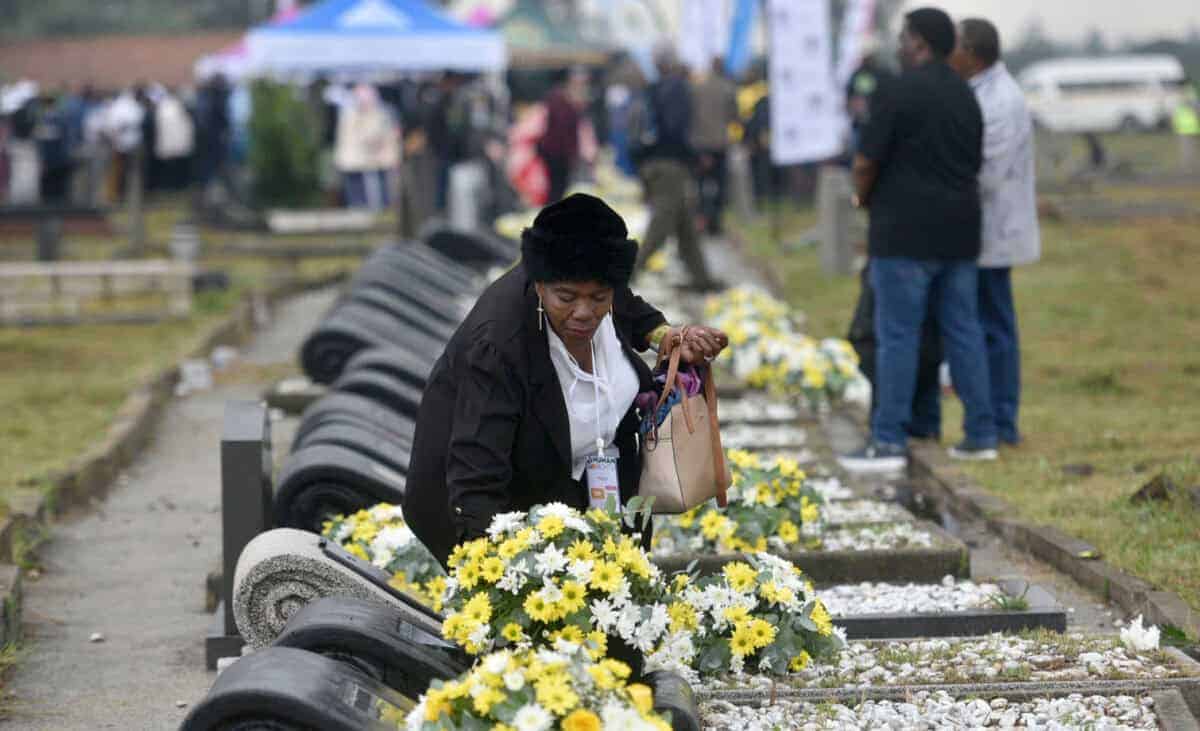
Betty Kolane lays a wrath at her father's brothers grave who was killed during the Sharpville massacre victims at Phelandaba cemetery in Sharpville in Gauteng, 21 March 2026, during the Sharpville massacre commemoration. Picture:Nigel Sibanda/The Citizen
On 21 March, 1960, 69 people were killed at Sharpeville for daring to assert their humanity.
Sixty-six years later, on Human Rights Day this past Saturday, we honoured that moment and took stock of the constitutional democracy emerging from its ashes.
Our constitution is a remarkable document. It enshrines justiciable socioeconomic rights, commits the state to transformation and opens with a founding value that has no equivalent in any other constitutional order: human dignity.
And yet, for the majority of South Africans, the distance between the rights they hold on paper and the lives they are able to live remains vast, stubborn and morally intolerable.
I suggest that the problem is not only one of implementation, of a capable state failing to deliver, though that failure is real and must be named. The deeper problem is conceptual.
We have been asking whether rights are being violated, when we should also be asking whether human beings are flourishing. These are related but not identical questions. And conflating them is costing us.
Limit of the violation frame
Rights-based frameworks are powerful precisely because they are justiciable: when a right is violated, a court can intervene.
The Constitutional Court has done extraordinary work on access to housing, on health care, on the rights of children. This is a genuine achievement of the post-apartheid order.
But the violation frame is, by design, reactive. It waits for a threshold to be crossed. It asks: has the minimum been met?
It does not ask: are the conditions in place for a person to live a full, self-directed, dignified life? It does not ask whether a child who has shelter, but not safety, who has schooling, but not learning, who has food, but not enough to think clearly, is genuinely living in a manner consonant with her humanity.
Ubuntu – the African philosophical tradition that grounds so much of South Africa’s constitutional self-understanding – has always known something that rights discourse struggles to say: person-hood is not a threshold condition. It is a continuous, relational and dynamic achievement.
To be human is to be in relationship, in community, in becoming. Flourishing, not mere survival, is the appropriate measure of a life well-supported by law and state.
Flourishing as constitutional horizon
This is not a utopian argument. It is a reorientation of the question we bring to the assessment of rights realisation.
When we ask whether South Africans are flourishing, we are forced to look at things that a pure violation analysis can obscure: the quality of public education, not just its existence; the safety of women in their homes and communities, not just the existence of legal prohibitions on violence; the capacity of citizens to participate meaningfully in democratic life, not just their formal right to vote.
We are forced to look at structural conditions such as inequality, patriarchy, environmental degradation and the digital divide that do not always rise to the level of discrete rights violations but that systematically deny people the conditions they need to become who they are capable of being.
The Constitutional Court has glimpsed this horizon. In Government of the Republic of South Africa v Grootboom, Justice Zak Yacoob wrote of the need for measures that enable people to enjoy their rights.
In Minister of Health v Treatment Action Campaign, the court insisted the state’s obligations are not discharged by token compliance.
There is in this jurisprudence a latent theory of flourishing waiting to be made explicit.
What Human Rights Day demands of us now
Sharpeville reminds us that human rights are not granted from above.
They are claimed, often at terrible cost, by people who refuse to accept that their humanity is conditional. The generation that built our constitution understood this.
They built a document oriented not toward minimum standards but toward maximum possibility. Thirty years into constitutional democracy, we owe it to the dead of Sharpeville and to the living millions still waiting for transformation to recover that orientation.
We need a human rights culture in our courts, our government, our civil society, our schools that measures itself not by whether the worst has been avoided, but by whether people are genuinely able to live, love, participate, create and become.
The true horizon of human rights in SA – the one the constitution gestures toward, the one Ubuntu has always known – is flourishing.
We are not there yet. Do we still have the will to get there?
About the Author