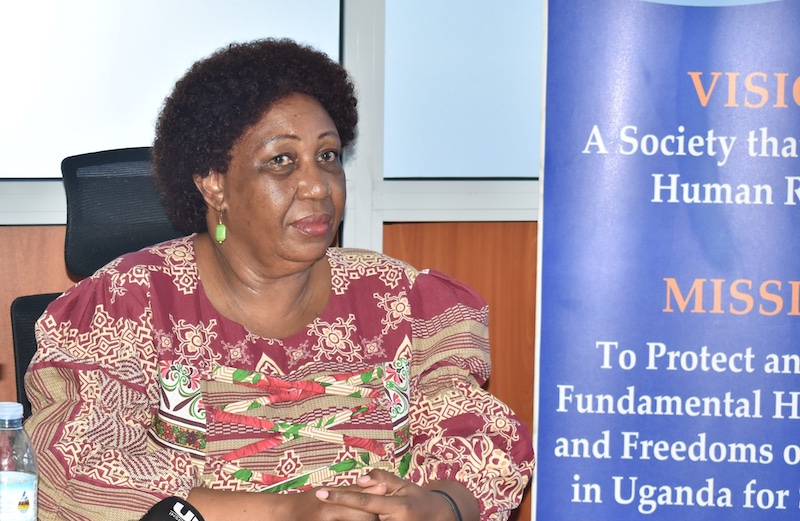
The Uganda Human Rights Commission (UHRC) chairperson, Mariam Wangadya, has admitted that fear has sometimes held her back from strongly condemning atrocities committed by security forces against civilians.
Wangadya, who described herself as “the most unpopular chairperson ever,” said sustained public hostility, harsh criticism, and personal threats have gradually eroded her confidence, affecting how assertively she speaks out during politically tense periods.
She made the remarks during a joint press briefing at the UHRC headquarters ahead of this year’s International Human Rights Day commemorations. The national theme is “Strengthening Democratic Space, Upholding Freedom of Expression, Speech, Association, Media and Security of Person During Elections for All.”
This year’s commemoration will climax in a multi-stakeholder national dialogue on December 10, bringing together political parties, government ministries and agencies, security organs, civil society, and development partners to discuss strategies for maintaining a peaceful atmosphere during and after the general elections.
Responding to concerns that UHRC often avoids holding security agencies accountable for brutality, Wangadya conceded that her critics “may be partly right.”
“We condemn acts of violence against police,” she said. “But we don’t go deep enough the way we do when condemning acts of violence against civilians. I must confess that this is out of fear.”
Her fears may not be unfounded. In May, Chief of Defence Forces Gen. Muhoozi Kainerugaba publicly warned her after she directed the release of a civilian being detained in a military facility.
Muhoozi had claimed that NUP activist Edward Rogers Ssebuufu, also known as Eddie Mutwe, was being detained in a basement and “taught how to speak Lunyankole.” Wangadya said such incidents, coupled with relentless public criticism, have taken a toll on her emotionally and professionally.
“Every cartoon about me is very negative. I am always drawn dressed in yellow, sitting on a heap of torture files and doing nothing. With time, this works on you.” She recalled moments when groups, one claiming to be torture survivors and another made up of widows of missing NUP supporters, stormed her office demanding her resignation.
“They surrounded my office and demanded that I vacate,” she said. “With time, it works on you. You fear to go deep enough.” Although she maintained that the Commission consistently condemns violence against security officers, including cases in Agago and Dokolo where policemen were lynched, Wangadya admitted that the backlash she receives makes it harder for her to speak boldly.
“Sometimes the chairperson feels intimidated,” she said quietly. “Because the tongue-lashing I suffer is a lot. Even my son has asked me, ‘Mom, why don’t you quit this position?’”
The Commission also addressed rising expectations around election-related arrests and claims of abuse. Pauline Nansamba Mutumba, UHRC’s director of complaints and investigations, clarified that the Commission cannot investigate matters already before court.
“Many cases seen in the media, like the recent Mbarara arrests of a NUP candidate, are handled by courts within 48 hours. Once someone is charged, our mandate stops,” she said.
However, she emphasised that UHRC continues to monitor such cases to ensure suspects’ rights are respected, including access to lawyers, medical care, and timely court appearances.
She said the Commission is closely following cases such as the recent death of Meshash Okello in Iganga district, although no formal complaint has yet been lodged. Samuel Herbert Nsubuga, executive director of the African Centre for Treatment and Rehabilitation of Torture Victims (ACTV), said the organisation has not received any torture complaints during the current election period.
“We have not received any complaints so far, but should they arise, we stand ready to rehabilitate the victims,” he said.
About the Author