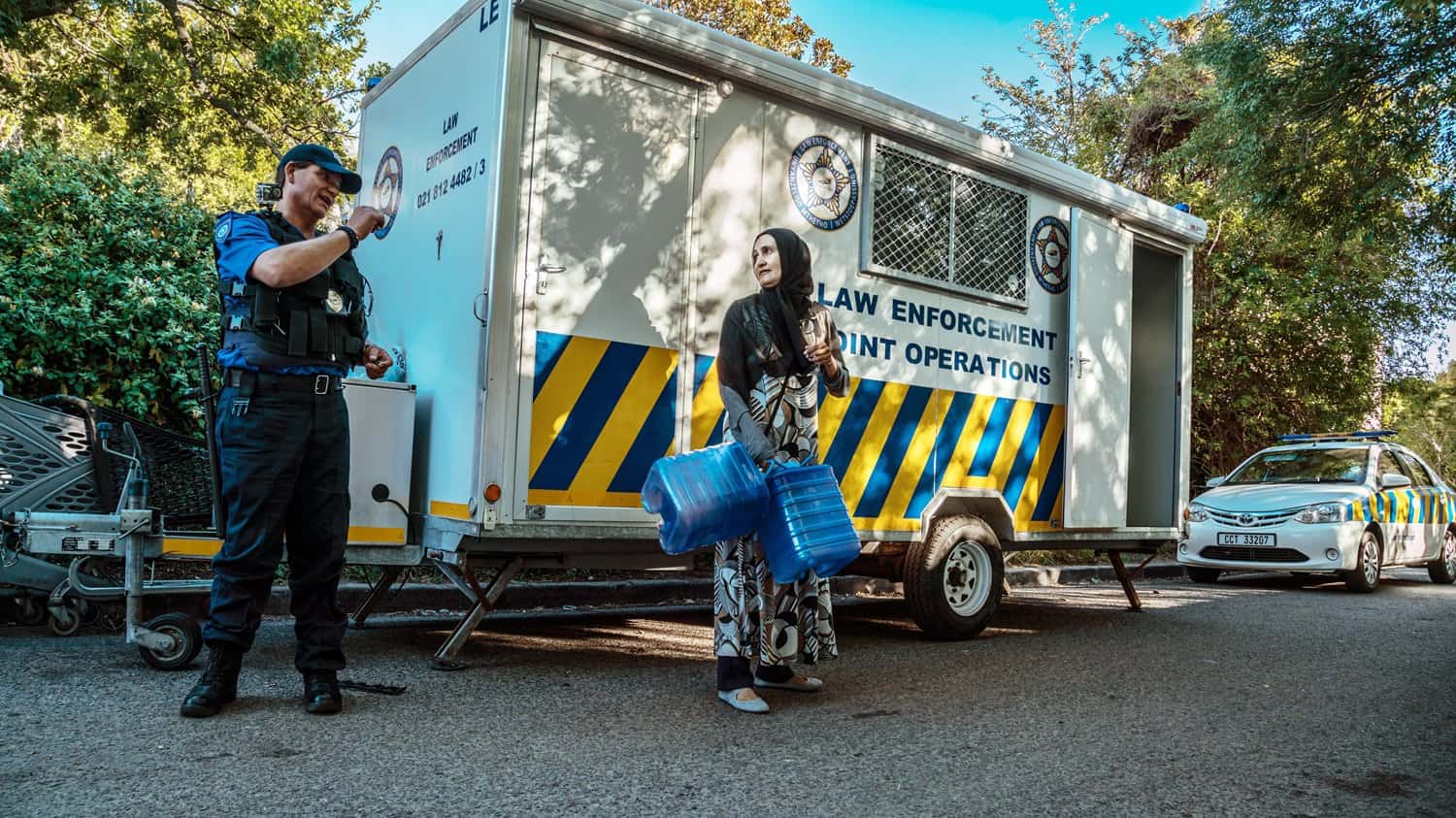
CAPE TOWN, SOUTH AFRICA - FEBRUARY 1: (EDITORS NOTE: Image was created as a still grab taken from video.) Police are now controlling Newlands Spring and limiting water collectors to carrying one 25 liter container at a time. Policemen guarding the entrance to the spring respectfully ask people to leave their extra containers at the entrance. People walk to the spring, fill a container, walk it back to their car, walk back to the spring with an empty container, then join the queue again and repeat. Diminishing water supplies may lead to the taps being turned off for the four millions inhabitants of Cape Town on April 16, 2018, known locally as Day Zero. Water will be restricted from 87 litres per day to 50 litres as temperatures reach 28 degrees later this week. Politicians are blaming each other and residents for the deepening crisis. (Photo by Morgana Wingard/Getty Images)
As residents of parts of the City of Joburg in Gauteng reel in the grip of the continued water crisis, the City of Cape Town in the Western Cape has shared its secrets of success in beating Day Zero in 2018.
When taps across Cape Town, a premier global tourist destination, threatened to run dry, the spectre of Day Zero loomed large.
Dam levels had plummeted to dangerously low levels, residents endured water rationing, leading to queues at natural springs stretching for blocks.
Cape Town avoided Day Zero through collaboration
Residents could use just 50l of water a day, with warnings that failure to heed the call would force the entire city into Day Zero, when all residents would have to use 25l or less per day.
Yet the metro pulled back from the brink and in doing so, rewrote South Africa’s urban water playbook.
According to Zahid Badroodien, the metro’s MMC for water and sanitation, the turnaround was built on a rare partnership between government and citizens.
ALSO READ: Crisis deepens: Is water being throttled in Joburg?
“Although it was a difficult and challenging experience for staff and residents alike, many valuable lessons were learned by both the metro and society as a whole,” he said.
At the height of Cape Town’s 2017-2018 water crisis, four million residents slashed water consumption by 40% compared to pre-drought levels – a saving of 32 billion litres.
“The residents of Cape Town deserve credit for saving Cape Town,” Badroodien said, noting that early resistance gave way to near-universal compliance by late 2017.
Transparency central to success
He said the behaviour shift, combined with improved rainfall, enabled the metro to avoid the dreaded Day Zero.
Badroodien said central to this success story was transparency, detailing how the metro regularly published dam levels, usage data and targets – creating what he described as a sense of shared responsibility.
By demonstrating its own interventions; from pressure management to leak repairs and equipping households with practical water-saving tools, authorities built public trust, he said. The crisis reshaped how Capetonians view water.
ALSO READ: ANC champions Freedom Charter but doesn’t think water is a big enough issue
“The drought changed the public’s relationship with water for the better,” Badroodien said.
Seasonal fluctuations remain. Summer demand rises with garden watering and pool top-ups, he said.
Overall consumption patterns were more restrained than before the drought as public awareness campaigns continue year-round.
Overhauled long-term planning
The metro has overhauled its long-term planning. The 2019-2040 water strategy aims to diversify supply so that by 2040, 75% of water will come from surface sources, 11% from desalination and 7% each from groundwater and reuse.
Central to this shift is Cape Town’s new water programme with the metro planning to add 300 million litres of new water per day by 2031 through projects such as the Faure water reuse scheme, groundwater abstraction from aquifers, desalination at Paarden Eiland, as well as the clearing of invasive alien vegetation that consumes billions of litres in catchment areas.
Infrastructure investment underpins it all. The metro, he said, is investing more in infrastructure than Johannesburg and Durban, with a capital budget 91% larger than Joburg and 117% larger than eThekwini over the next three years.
ALSO READ: Dry tap woes in Joburg may have shocked Ramaphosa into action
Badroodien said water and sanitation account for 42% of the city’s roughly R120 billion 10-year infrastructure pipeline.
“Water infrastructure investment is a major priority because it ensures residents receive a reliable supply.”
The overarching lesson? Do not wait for rain. By pairing behavioural change with aggressive infrastructure expansion and diversified supply, he said Cape Town built resilience against climate shocks and population growth.
Transparency, shared sacrifice and long-term planning
For the City of Joburg, which is now staring down its own Day Zero, the message from Cape Town is clear: transparency, shared sacrifice and long-term planning can turn the tide – before the taps run dry.
Multiple areas across Gauteng have been without water for weeks. Last week, angry Johannesburg residents took to the streets in protest.
They included residents of Melville, Parktown West, Mayfair, Greenside, Parkview and Emmarentia, who have been without water for over 20 days.
NOW READ: Is water Cyril’s aha moment?
About the Author