
The monthly household food basket cost more in January than it did in December, but the price was at least slightly cheaper than in January 2025.
This survey shows how the majority of South Africans struggle to put nutritious food on the table instead of just trying to afford basic staples.
The Pietermaritzburg Economic Justice and Dignity Group tracks the prices of food that low-income consumers buy with the help of women who live in low-income communities at stores where they shop for their own families.
They track the prices of 44 basic foods from 47 supermarkets and 32 butcheries in Johannesburg (Soweto, Alexandra, Tembisa and Hillbrow), Durban (KwaMashu, Umlazi, Isipingo, Durban CBD, Hammarsdale and Pinetown), Cape Town (Khayelitsha, Gugulethu, Philippi, Langa, Delft and Dunoon), Pietermaritzburg, Mtubatuba (in northern KwaZulu-Natal) and Springbok (in the Northern Cape).
ALSO READ: Household food basket: Food prices slightly down compared to previous month and year
Household food basket cheaper than a year ago
The household food basket survey for January shows that the average cost of the basket was R5 401.44, R67.99 (1.3%) more than in December and R32.26 (-0.6%) less than in January 2025.
This chart shows how the food prices in the household food basket changed over the past year:
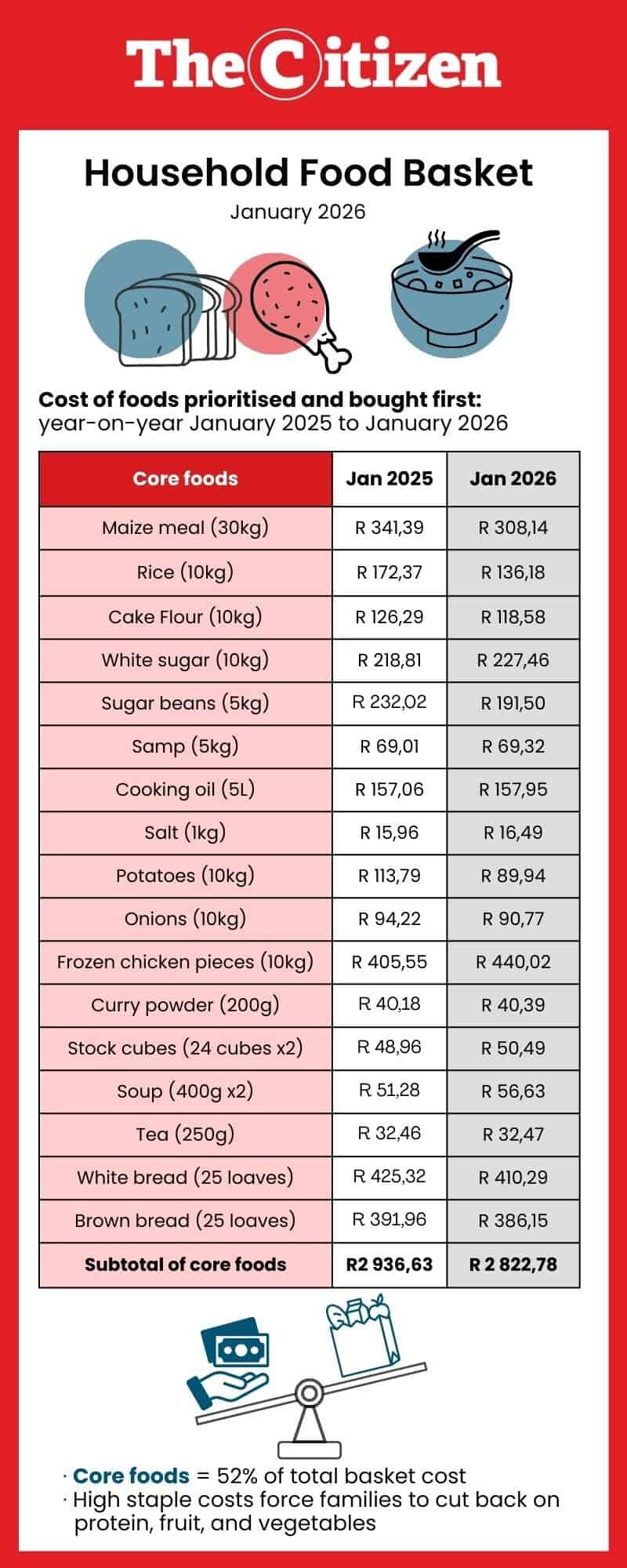
The household food basket survey shows that of the 44 food items tracked in the basket, 26 food items cost more, while 17 food items cost less and one food item’s price remained unchanged.
Food items in the household food basket which cost more than 5% more include: potatoes (15%), onions (15%), frozen chicken portions (5%), soup (7%), carrots (8%), spinach (16%), cabbage (6%) and Cremora (7%).
The food items in the household food basket which cost between 2% and 5% more were rice (3%), salt (4%), Maas (2%), eggs (4%), chicken gizzards (4%), beef (2%), beef tripe (2%), apples (4%), margarine (2%), peanut butter (2%) and polony (4%).
The only food items in the household food basket that cost more than 5% less were chicken feet (-6%) and green pepper (-10%) while sugar beans (-3%), samp (-3%), wors (-4%), butternut (-4%), canned beans (-3%) and bananas (-4%) cost between 2% and 5% less.
ALSO READ: Competition Commission’s report shows shocking price increases in SA over past five years
Food prices in different regions
Prices of the food items in the household food basket also varied from region to region over the past year, with the household food baskets in Johannesburg (+R8. 31), Cape Town (+R20.77) and Pietermartizburg (+R145.91) costing more than a year ago.
This chart shows how the prices differed from region to region:
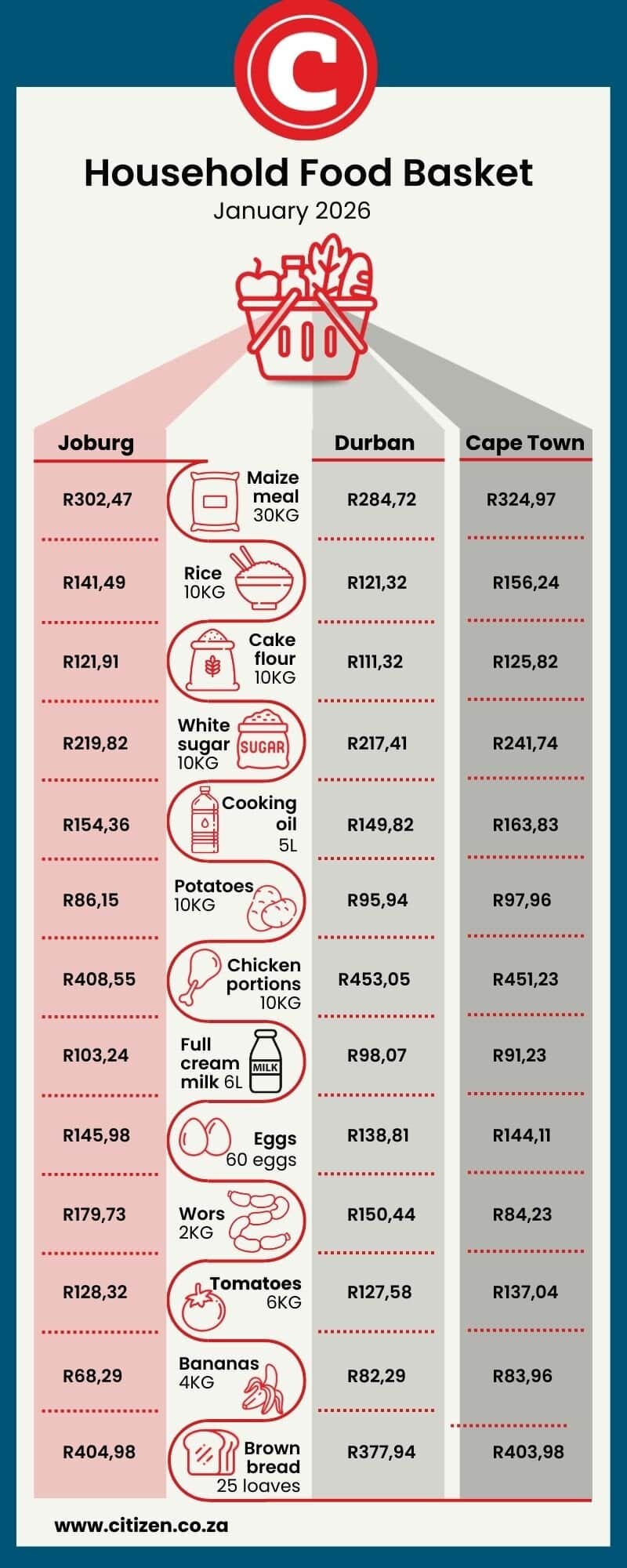
The price of the household food baskets food baskets in Durban (-R155.71), Springbok (-R305.22) and Mtubatuba (-R98.26) decreased.
Low-income consumers who are employed earn the national minimum wage of R28.79 per hour, R230.32 for an 8-hour day and R4 836.72 for an average 21-day working month. January 2026 had 21 working days, which means workers earned the maximum wage for general workers.
Mervyn Abrahams, programme coordinator for the group, says low-income workers work to support their families and therefore, the wage they earn is not just to sustain themselves alone but is used to support the entire family.
“For black South African workers, one wage must typically support 3.9 people. Dispersed in a worker’s family of four, the wage is R1 209.18 per person, far below the 2023 rebased lower-bound poverty line of R1 300 per person per month and the upper-bound poverty line of R2 635 per person per month.”
ALSO READ: Food Security Index: slight improvement, but people still going hungry
Difficulty to feed families nutritious food
This chart shows how difficult it is for low-income consumers to afford food for their families:
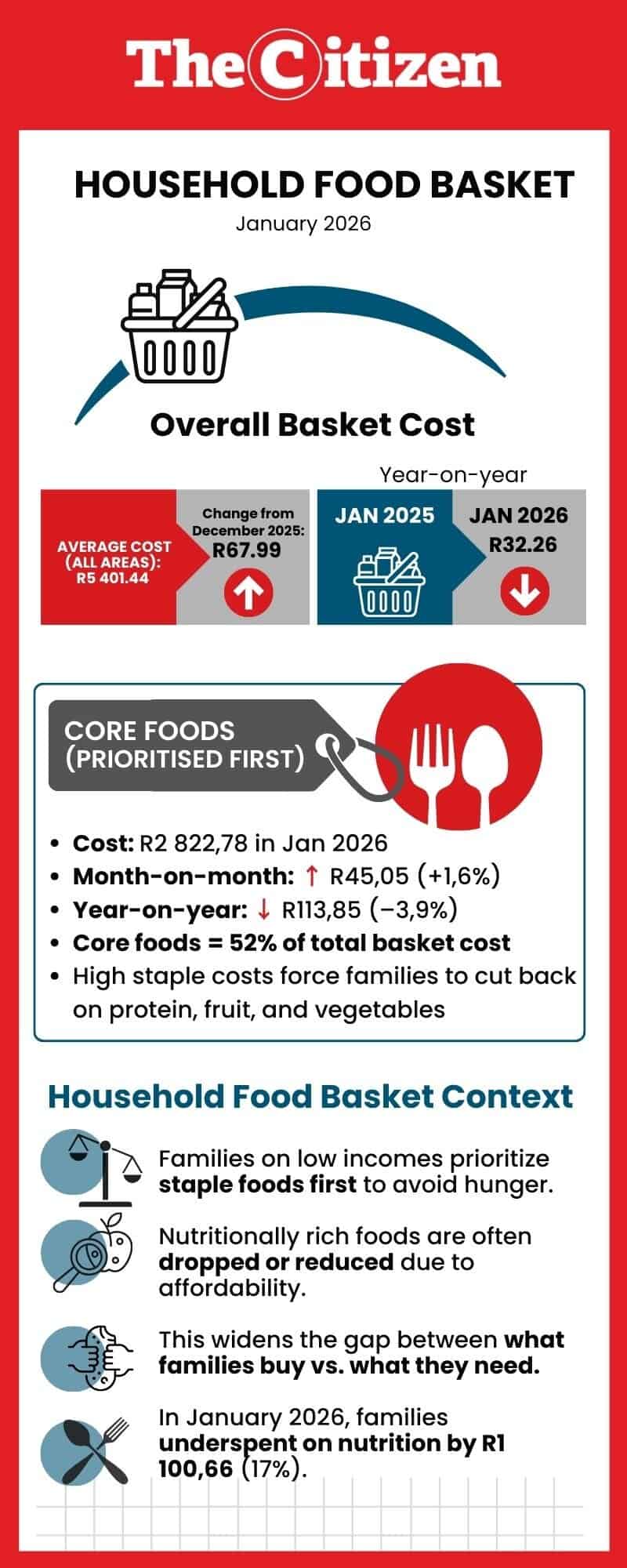
In January, the average cost of a basic nutritional food basket for a family of four was R3 720.25. Abrahams says according to the group’s calculations, using Pietermaritzburg-based figures for electricity and transport and the average price for a minimum nutritional basket of food for a family of four, electricity and transport take up 59.2% of a worker’s wage (R2 861,85 of R4 836,72).
They only buy food once they have paid for transport and electricity, leaving R1 974.87 for food and everything else. Therefore, Abrahams says, the group calculates that workers’ families may underspend on food by a minimum of 46.9% as they have R1 974.87 left over after paying for transport and electricity.
ALSO READ: Warning that food insecurity in SA is worsening and children are most affected
Living under the food poverty line
“In this scenario there is no possibility of a worker being able to afford enough nutritious food for her family. If the entire R1 974.87 all went to buy food, it would provide R493.72 per person per month. This is far below the 2023 rebased food poverty line of R777 per person per month.”
The food poverty line is a monetary-based threshold. People who have less money than the food poverty line indicates cannot afford enough food to meet the minimum daily energy requirement.
This chart shows how workers earning the national minimum wage battle to feed their families and their children, even if they receive the child support grant:
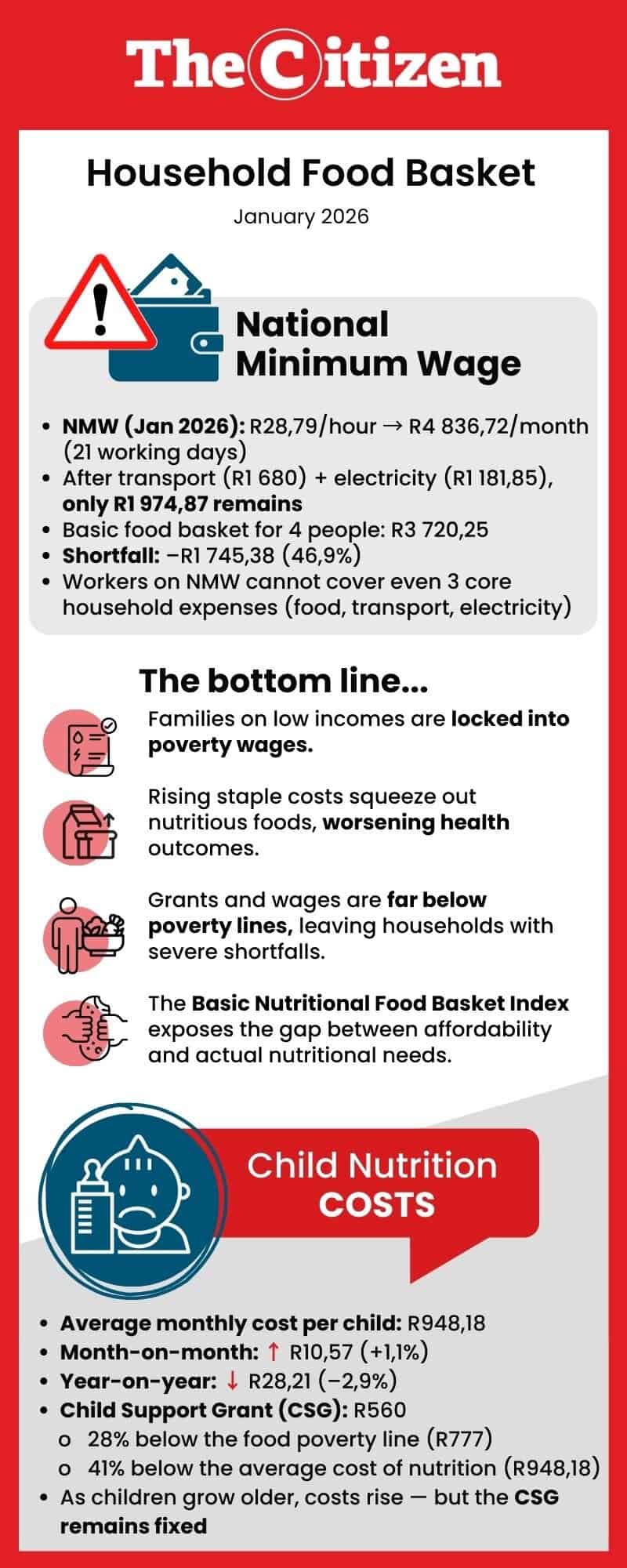
For women and children, the picture is even worse, Abrahams says.
In January, the average monthly cost to feed a child a basic nutritious diet was R948.18. Compare this to the child support grant of R560 per month, which is 28% below the food poverty line of R777 per month. Looking at this calculation, it is easy to see why children are dying of hunger in a country that produces enough food for its people.
About the Author